The Express
In 1979 drug dealers worked a “gauntlet” behind the city’s greatest library. The park averaged nearly three robberies a week.
The park’s walls and hedges, built in the 1930s to make it a refuge, had made it a hiding place.
Two men set out to fix it, and nearly everyone told them their best idea was crazy.
Needle Park
On November 26, 1979, William H. Whyte sent a report to the Rockefeller Brothers Fund about the park behind the New York Public Library. Whyte, a former editor at Fortune, had spent years filming New Yorkers in plazas and parks to learn where people liked to sit and why. He didn’t soften what he found.
Drug dealers worked a “gauntlet,” he wrote, stationed almost permanently at the north end of the library’s back terrace and moving “from person to person.” When police stood at the entrances, the dealers drifted off, and within minutes of the officers moving on, they were back.¹
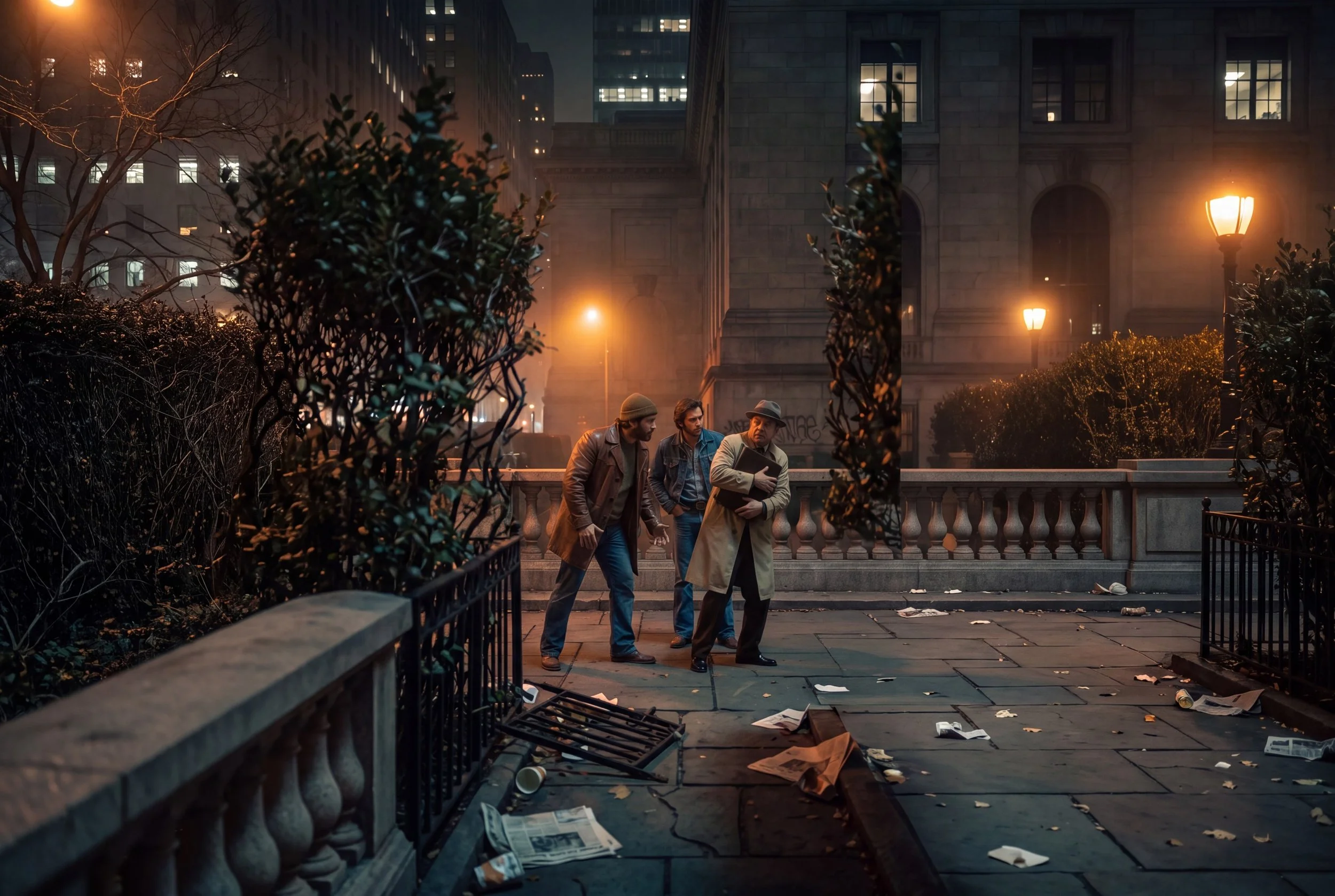
The library's back terrace, 1979, as described in William H. Whyte's report. AI reconstruction made for this story, not a photograph.
It’s no surprise that many people stopped coming. In the early 1970s about a thousand people ate lunch in Bryant Park on a sunny day; by 1979 that was down by a third to a half, and women, who had made up about 42 percent of the visitors earlier in the decade, were now about 29 percent.¹ The park had about 150 reported robberies a year,² and at night the police put barricades across the entrances.³
New Yorkers had a name for it: Needle Park.⁴
Andrew Heiskell, the chairman of Time Inc., had joined the library’s board the year before. He would later remember a party at the library at which pushers tried to sell drugs to two of its most important donors, Brooke Astor and Drew Heinz. “Let me tell you,” he said, “that’s not the way to make yourself popular or help people give you money!”⁵
Whyte’s report ended with a diagnosis that sounded too simple to be true. The drug dealers, he wrote, were not the cause of the problem. “The basic problem is under-use.” A park that nobody used belonged to whoever would use it.¹
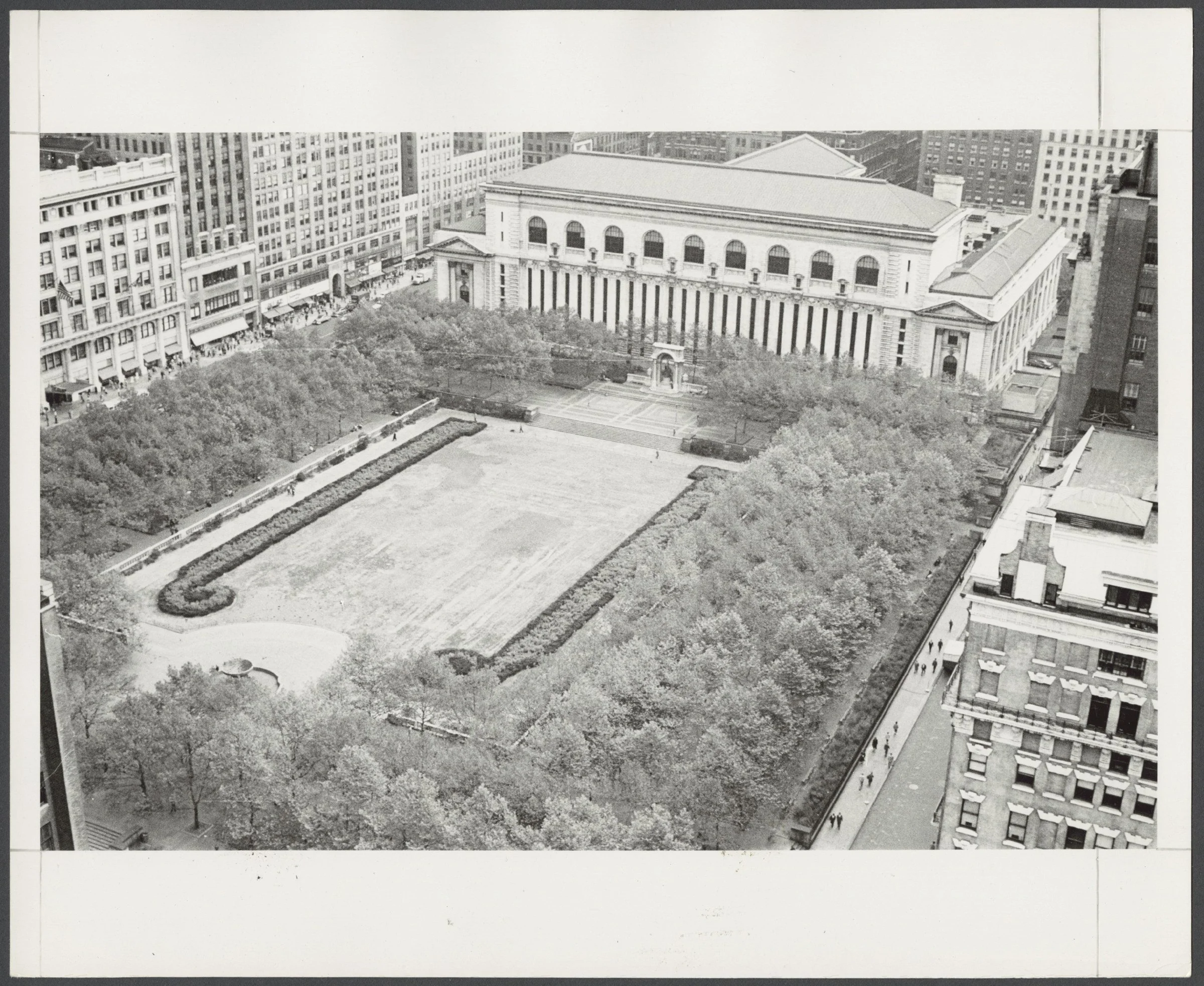
Bryant Park and the library from above, October 1952. Photograph by Angelo Rizzuto. Library of Congress
A graveyard and a glass palace
The block between Fifth and Sixth Avenues, from 40th to 42nd Street, had a long history of dysfunction.
From 1823 to 1840 it was a potter’s field, where the city buried people too poor for any other grave.⁶ When the Croton Distributing Reservoir went up next door in the 1840s, on the site where the library stands now, the graveyard was closed and thousands of bodies were moved to Ward’s Island.⁷ The empty ground beside the reservoir became Reservoir Square in 1847.⁶
In 1853 New York tried to make it the center of the world. For the Exhibition of the Industry of All Nations, the city’s answer to London’s Great Exhibition, the promoters raised a Crystal Palace of iron and glass on the square, crowned by a great dome. More than a million visitors came.⁸ The exhibition lost money, and afterward the building stood mostly empty, rented for fairs.⁹
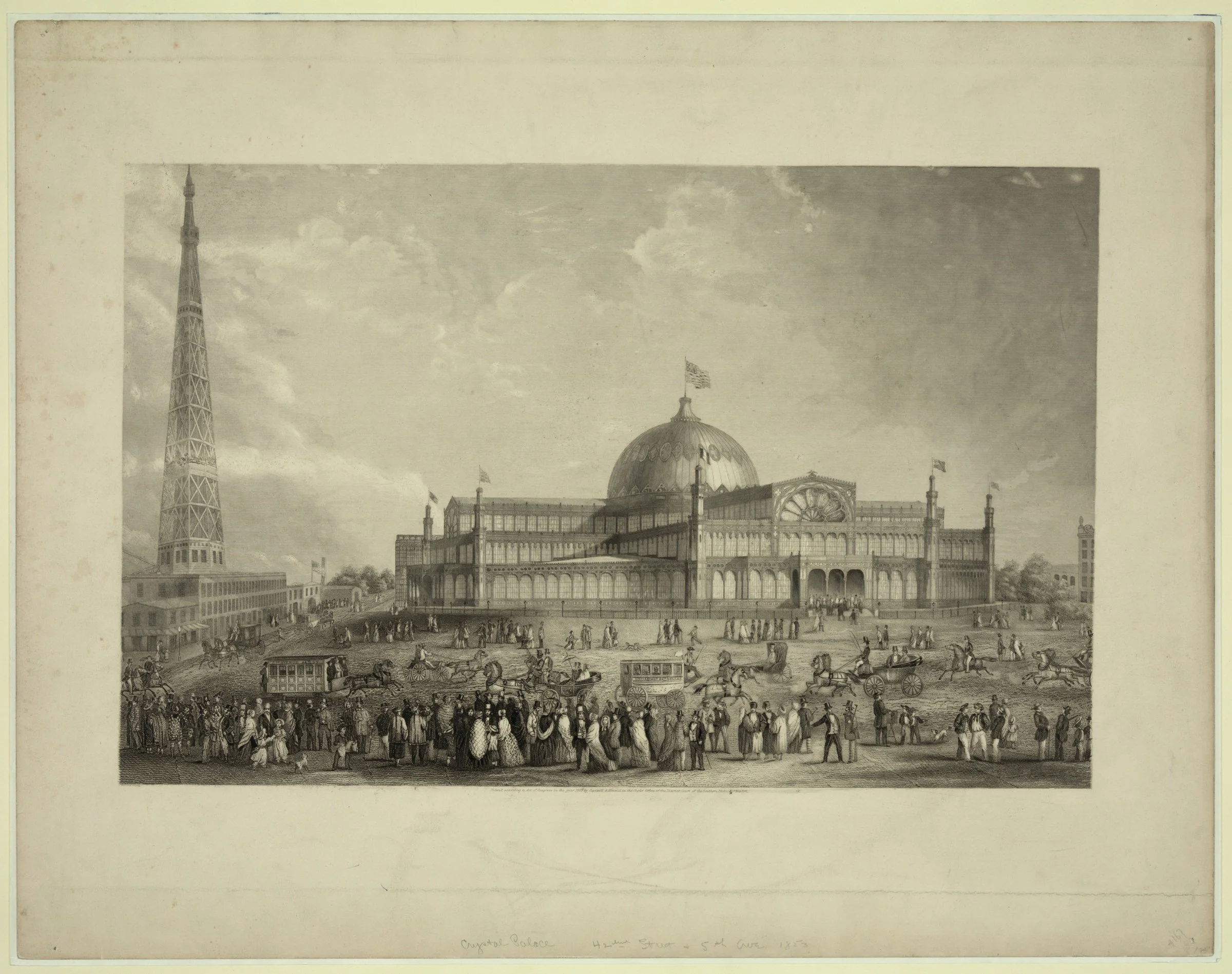
The Crystal Palace, with the Latting Observatory, 1853. Library of Congress
On October 5, 1858, during the annual fair of the American Institute, a fire started in a lumber room on the 42nd Street side.¹⁰ The promoters had advertised the palace as fireproof.¹¹ Nearly 2,000 people were inside, and every one of them got out.¹²
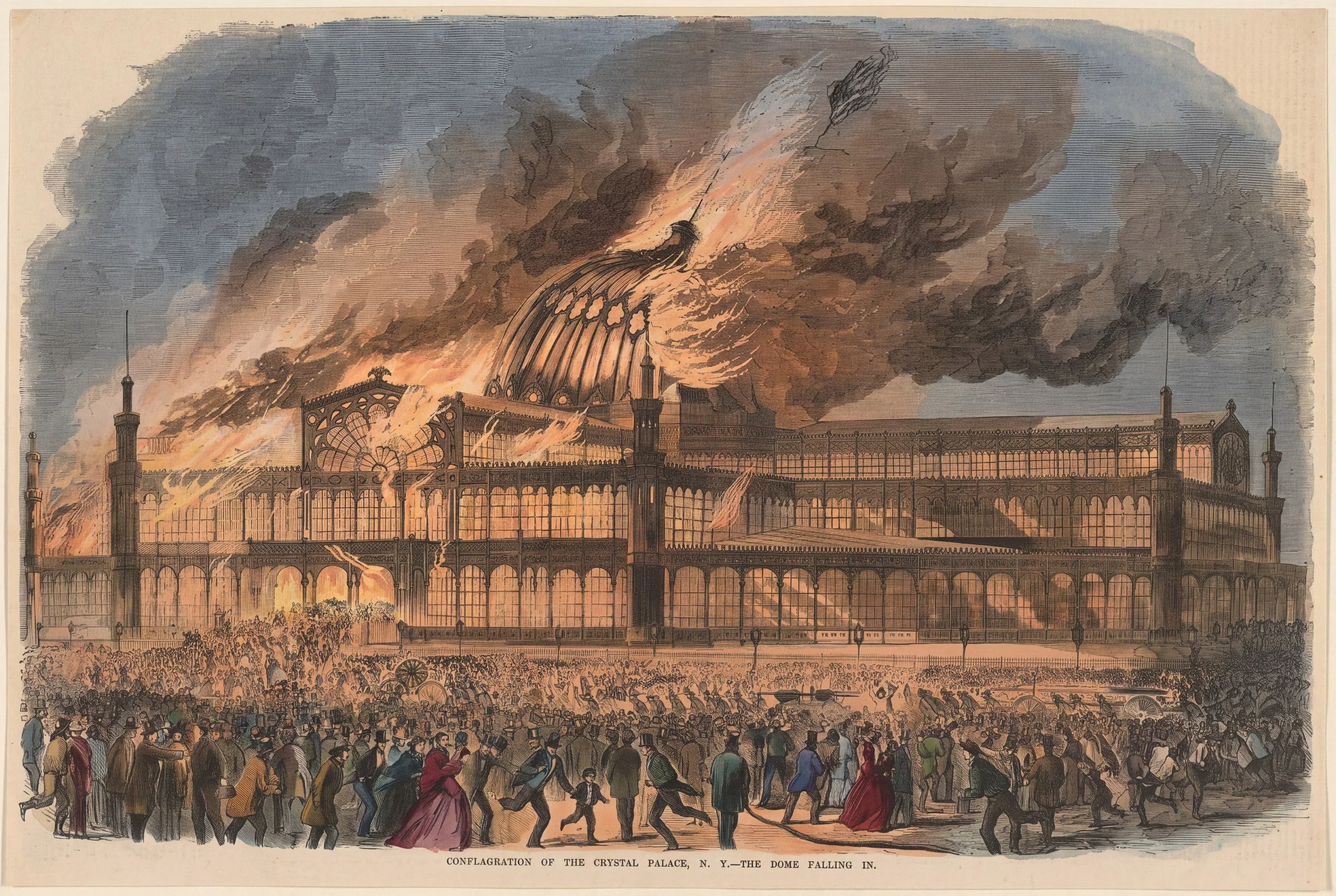
Colorized from an engraving in Frank Leslie's Illustrated Newspaper, October 16, 1858. Original: The New York Public Library.
An exhibitor named Franklin Harvey Biglow wrote to his sister that the whole structure came down in “not more than ten minutes from the time the alarm was given,” and that “very little of the immense value in goods & merchandise was saved.”¹² Within half an hour, New York’s palace of the future was gone.¹⁰
“Designed for crime, really”
The square was renamed in 1884 for William Cullen Bryant, the poet, newspaper editor and parks advocate.¹³ The reservoir came down, and in 1911 the library opened on its site, with the park as its backyard.¹³
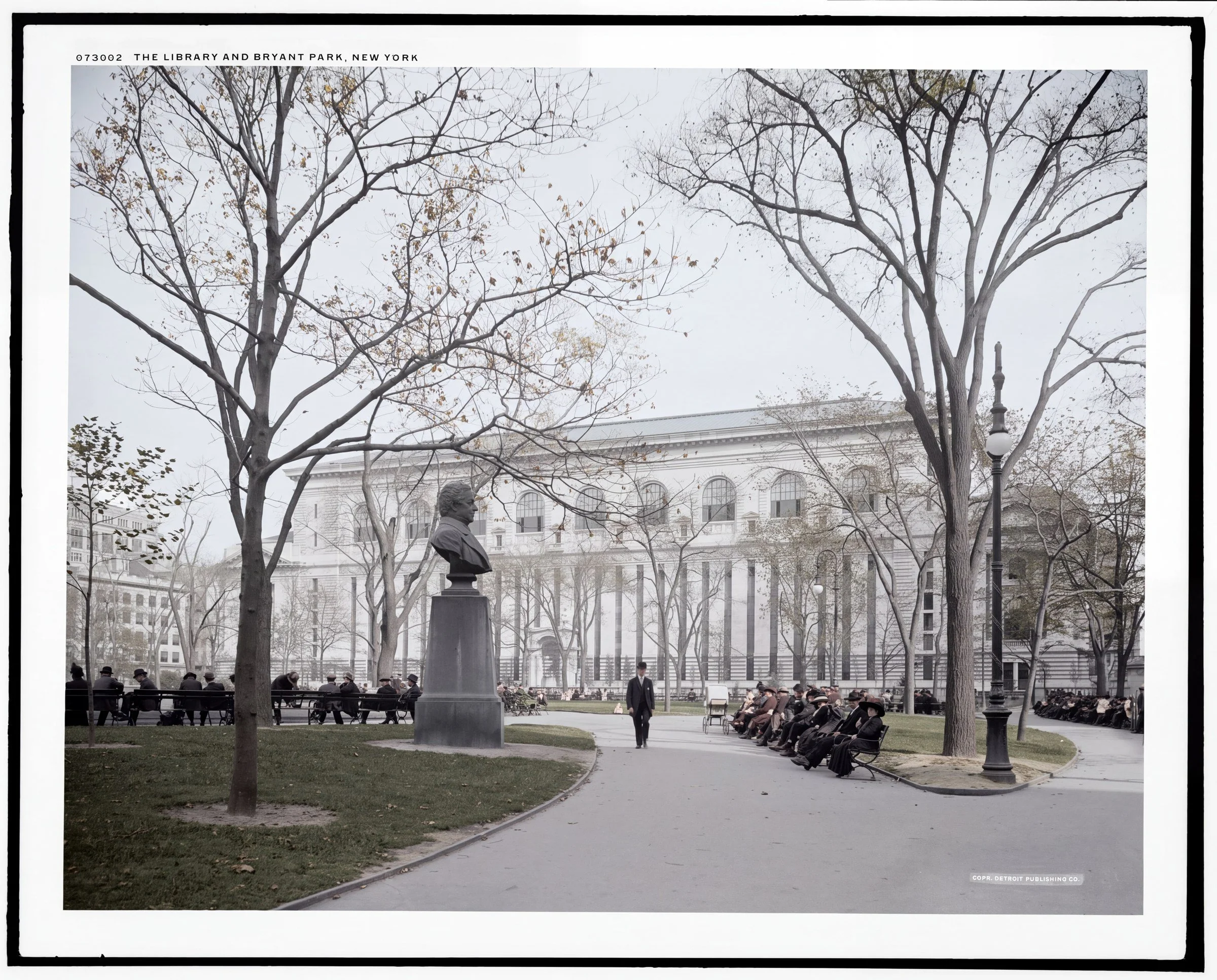
Colorized from a Detroit Publishing Company photograph, about 1910–1920. Original: Library of Congress.
The park’s next real makeover came out of the Depression. In 1933, with thousands of homeless men living in the park,¹⁴ a committee held a design competition open only to architects without work. The winner, Lusby Simpson of Queens, modeled his plan on the Luxembourg Gardens in Paris. In 1934 the new parks commissioner, Robert Moses, built it with federal relief labor.¹⁵
Simpson’s park was meant as a sanctuary, raised four feet above the noise of the street behind granite walls, an iron fence and dense hedges, with only a few ways in.¹⁶ When it reopened on September 15, 1934, it was hailed as a success.¹⁵
It took a generation for the flaw to show. By the 1960s and 1970s, the same walls that kept the city out also kept the police from seeing in. Whyte noted that only “for want of a few inches” was the park hidden from the people walking past it.¹ Heiskell put it more bluntly. Moses had raised the park, he said, and filled it with bushes and hidden paths. “It was designed for crime, really, and there had been a lot of crime there!”¹⁷
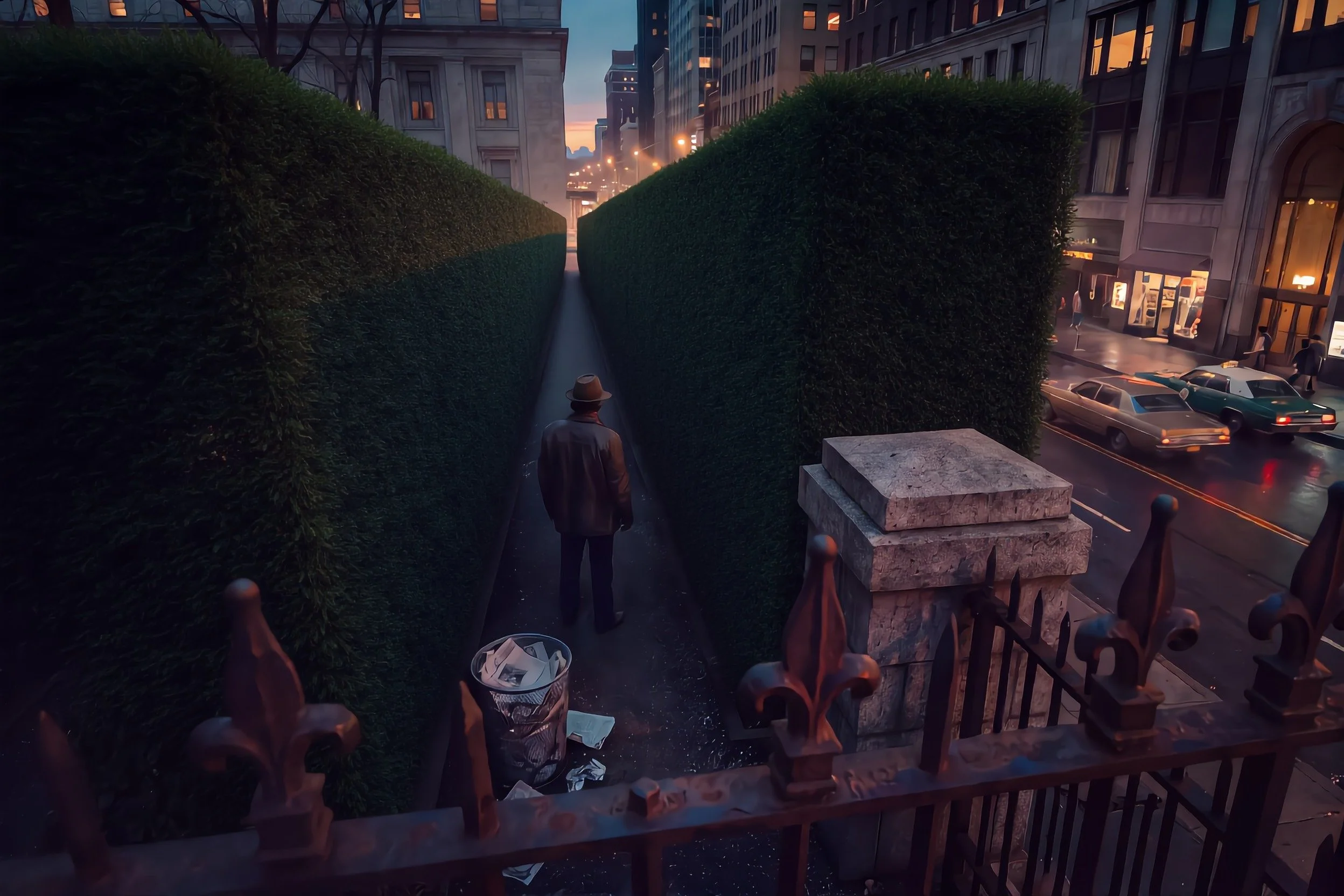
Inside the walled park, 1970s. AI reconstruction made for this story, not a photograph.
Two men and a plan nobody liked
In January 1980 Heiskell and a young Harvard Business School graduate named Dan Biederman founded the Bryant Park Restoration Corporation, with money from the Rockefeller Brothers Fund.¹⁸ “God knows the management of the Library had enough work to do without worrying about Bryant Park,” Heiskell said later.⁵
They started with Whyte’s advice. Cleaning crews scrubbed away the graffiti, and gardeners cut the hedges back so that people on the sidewalk could finally see in. In the very spots where the drug dealers had stood, the corporation set up kiosks selling books and flowers and a booth selling half-price theater tickets, so that the dealers’ corners filled with ordinary New Yorkers.¹⁹ Out front, on the library’s Fifth Avenue terrace, they tried a small experiment in 1982: a handful of movable café tables and chairs, set out to see whether New Yorkers would leave them alone.²⁰
Little by little, the park began to change. In the first six months of 1982, police made 13 robbery arrests there, down from 46 in the same months a year earlier.²¹ By the corporation’s own count, crime fell 92 percent over its first seven years, while the number of visitors doubled.²²
The bigger plan proved much harder. Heiskell wanted something that would keep the park busy day and night, and he settled on a restaurant. Warner LeRoy, best known for Tavern on the Green, designed what Heiskell called “a great marvelous sort of crystal palace restaurant,” to stand against the back wall of the library.¹⁷ After years of waiting on city approvals, LeRoy gave up and pulled out in March 1986.²³ The block, it seemed, still did not care for crystal palaces.
The two men also faced a chorus of critics, who argued that handing a public park to a private corporation was undemocratic. Biederman later remembered the “outright opposition,” and Heiskell complained that the park advocates “kept snapping at our heels.”²⁴,²⁵
Heiskell and Biederman pressed on anyway, and in 1988 the park closed for four years. While it was shut, the library built new book stacks underneath the lawn, and the designers Hanna/Olin rebuilt the park on top: new entrances, the hedges gone, the edges opened so a person on 42nd Street could see straight across the lawn.²⁶
Two thousand chairs
When Bryant Park reopened on April 22, 1992, visitors found a different place.²⁷ The restrooms, locked for 35 years, were open again.²² There were food kiosks, and three years later the Bryant Park Grill opened against the library’s back wall, close to where LeRoy had once planned his crystal palace.³⁷ And everywhere there were chairs: 2,000 green folding bistro chairs, imported from France and set out loose for anyone to use.²⁸
The chairs were Whyte’s idea. In his films and his book he had watched people pick up a chair, move it a few inches and sit down, as if claiming it. “Chairs enlarge choice,” he wrote: “to move into the sun, out of it, to make room for groups, move away from them.”²⁹
Almost nobody believed they would survive. City officials were aghast at the idea of loose chairs in the middle of Midtown. Andrew Manshel, who had joined the corporation the year before, later recalled that people were sure the chairs would be stolen, and thought the restorers were crazy.³⁰
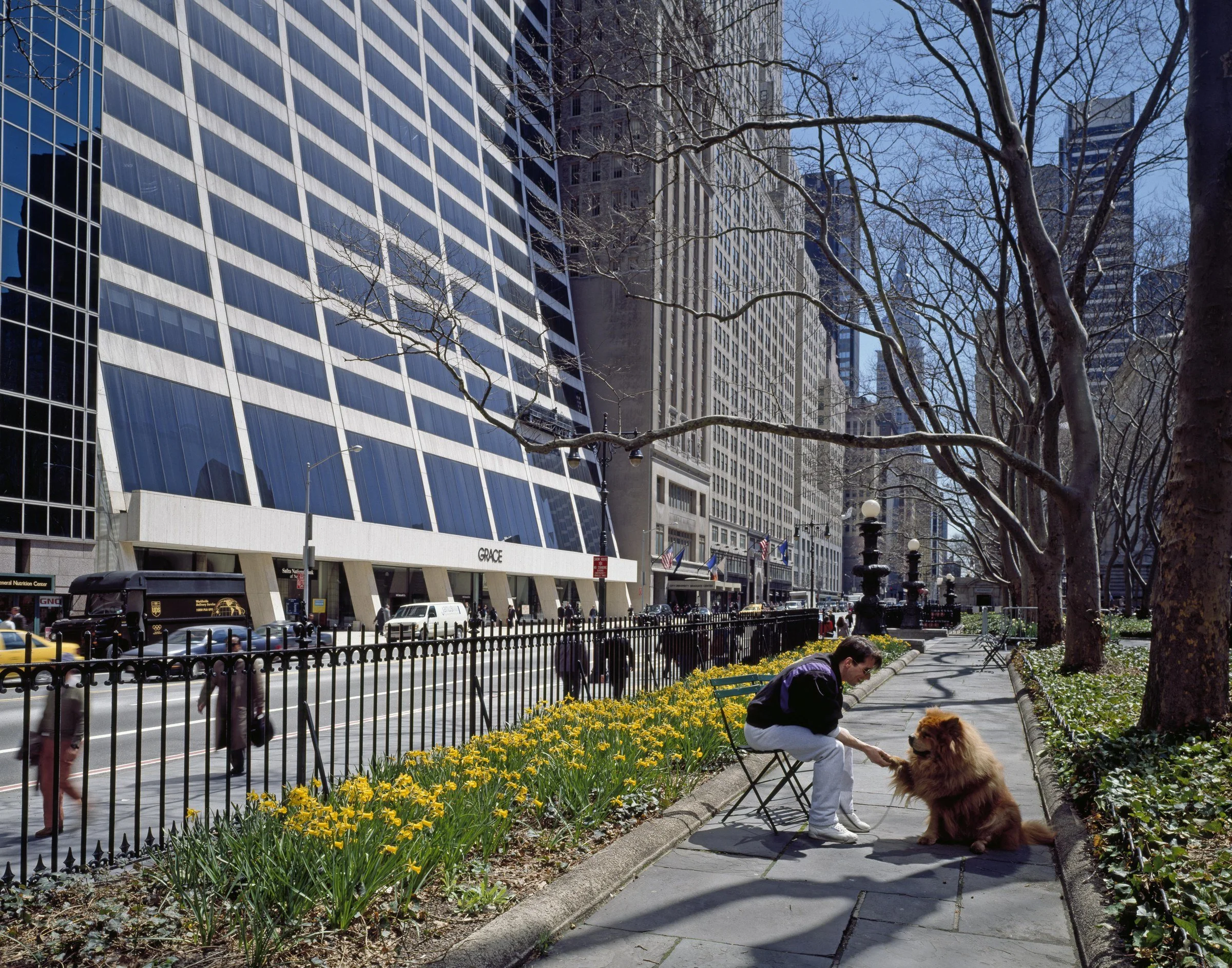
Bryant Park's movable green chairs. Photograph by Carol M. Highsmith. Library of Congress.
The chairs stayed. New Yorkers sat in them, dragged them into the sun and pulled them into circles for lunch, and to this day the park loses only a few each year.³¹ A park that had belonged to drug dealers because nobody else used it now belonged to the people who used it most.
The New York Times’s architecture critic, Paul Goldberger, called the new park “a triumph for many.”³² Time called it “a small miracle.”²²
A magical night in December
Bryant Park now holds about 4,000 chairs and 1,000 tables.³³ On a summer evening the lawn fills with blankets for free movies under the Midtown towers. The private corporation that made people so nervous in 1980 still runs the park for the city, and its formula of chairs, food, events and spotless restrooms has been copied in parks across the country.³³
In the holiday season it becomes something close to a dream. The lawn turns into the city’s largest free-admission ice rink, 17,000 square feet of ice with the library lit up behind it.³⁴ Around it rise the glass booths of an open-air holiday market, more than 180 small shops selling gifts and food and hot chocolate.³⁵
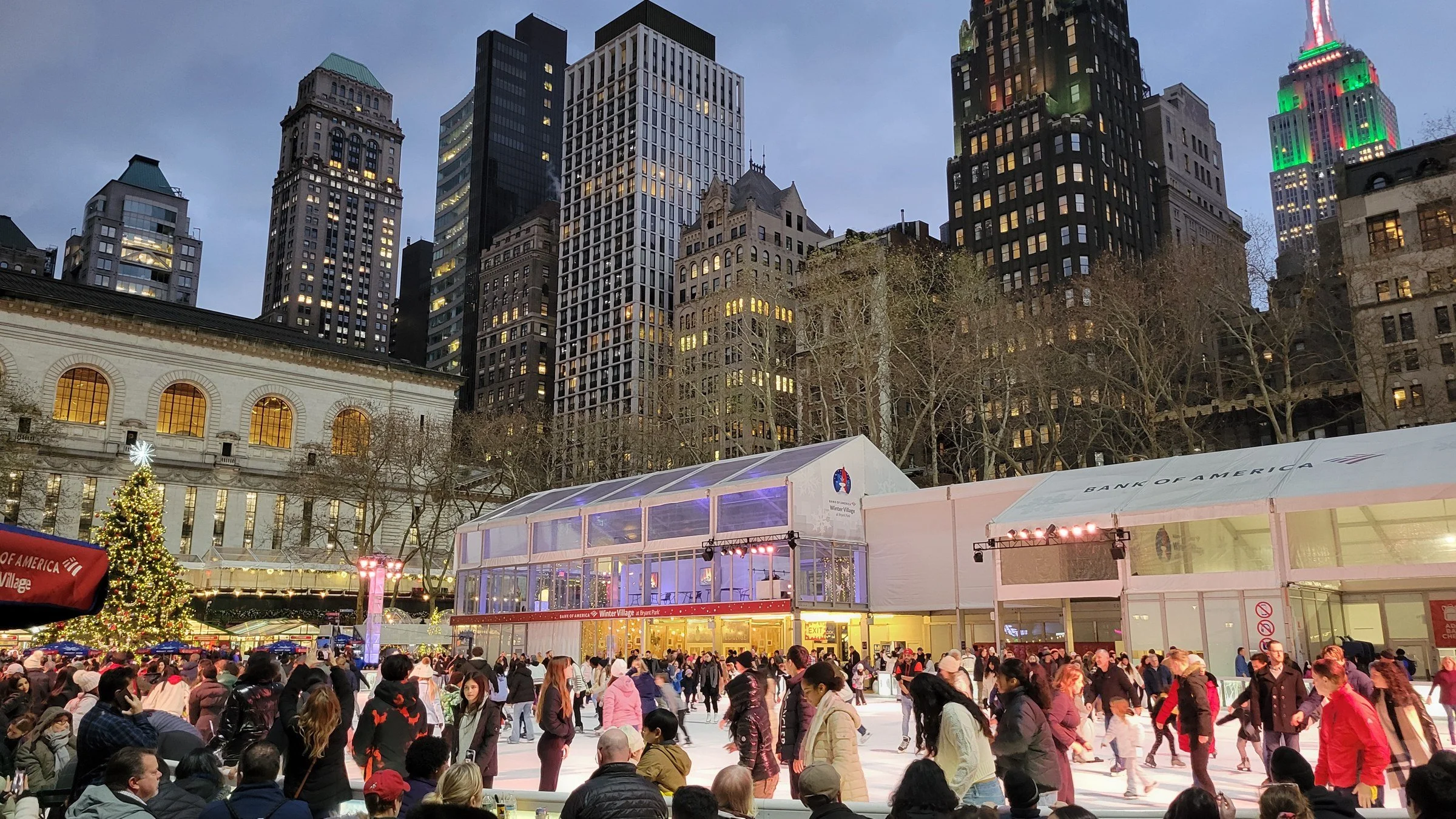
Winter Village at Bryant Park, December 2023. Photograph by Kiran891, CC BY-SA 4.0, via Wikimedia Commons.
At the west end, the Josephine Shaw Lowell fountain, dedicated in 1912 as the city’s first public memorial to a woman, sometimes freezes solid into a sculpture of ice.³⁶ Skaters circle the ice while shoppers drift between the stalls, and when they tire, they do what New Yorkers have done here since 1992: they pull up a chair.
Beneath the lawn lie the library’s books, and beneath them, once, a potter’s field. In 1858 a palace of glass burned on this ground in ten minutes, and a century later the city walled the park off to protect it and nearly lost it altogether. The park still sits four feet above the street.
What changed was not the walls but the doors, opened wide at last, and the chairs that nobody stole.
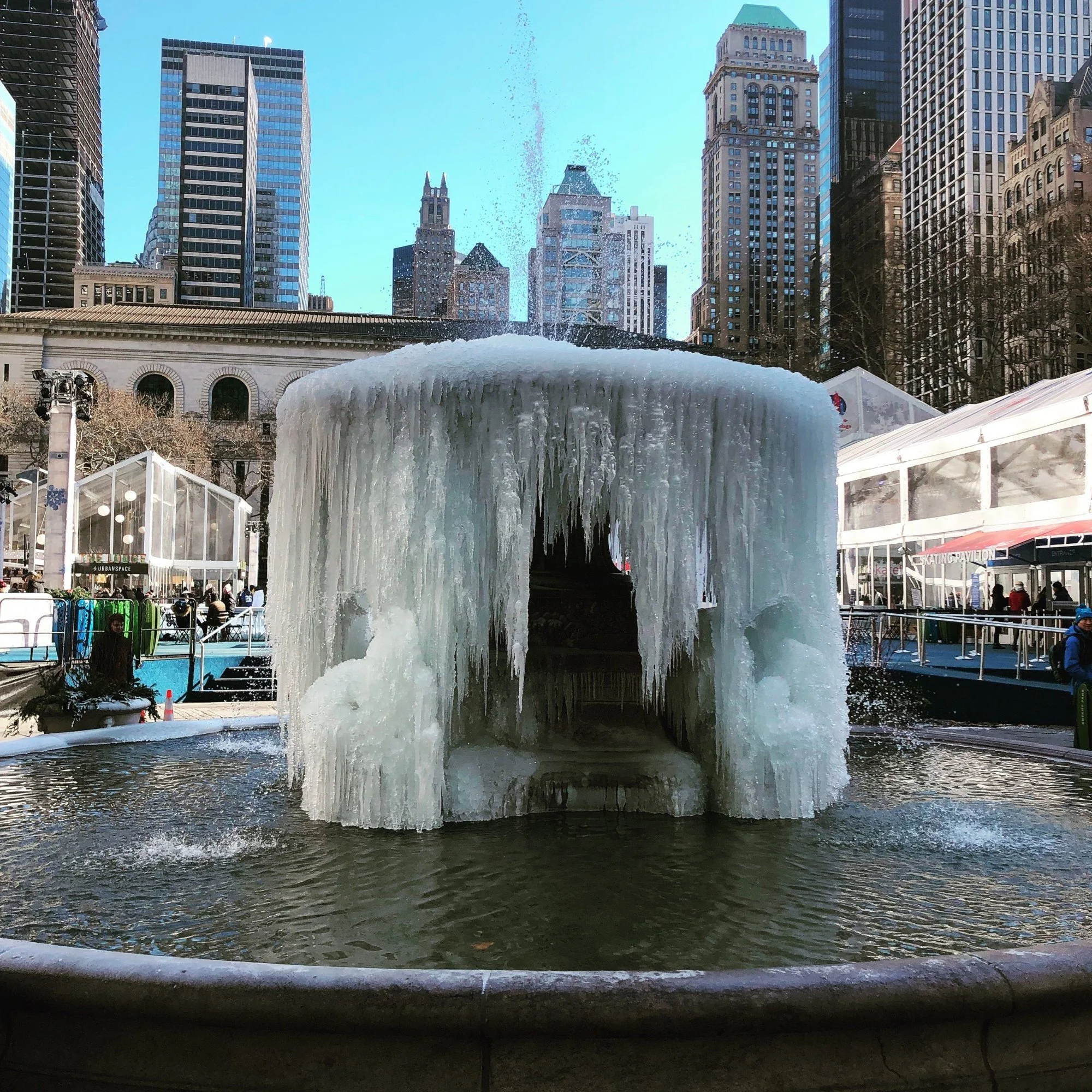
The Lowell fountain, frozen, with the library behind it. Photograph by Mark D. Schutzman.
What is your favorite memory of Bryant Park: a winter skate, a summer movie, or a lunch in a green chair? Tell us.
Notes and Sources
Notes
William H. Whyte, report to the Rockefeller Brothers Fund, “Revitalization of Bryant Park–Public Library front,” November 26, 1979, published by Aaron M. Renn, “William H. Whyte’s Original Plan to Save Bryant Park,” The Urbanophile, October 12, 2016.
Historical marker, “Bryant Park Today,” Bryant Park Corporation (HMDB 57104); “The Fall and Rise of Bryant Park,” New York Sun, January 21, 2004.
American Society of Landscape Architects, 2010 Landmark Award, Bryant Park; SAH Archipedia, “Bryant Park.”
Encyclopedia of New York City, “Bryant Park” (known in the 1970s “as Needle Park because of its resident drug dealers”); “Life of Bryant,” Commercial Observer, March 2019.
Andrew Heiskell, oral history, Columbia University Oral History Research Office, Notable New Yorkers, session 16, p. 770.
NYC Parks, “Before They Were Parks: Manhattan”; NYC Parks, Bryant Park history.
Bowery Boys, Bryant Park history; NYC Landmarks Preservation Commission report citing I. N. Phelps Stokes, Iconography of Manhattan Island. The removal of the bodies to Ward’s Island is reported by several sources; the exact number is not recorded.
Bryant Park Corporation, “History.”
Springfield Museums, note on Currier & Ives, Burning of the New York Crystal Palace (exhibition loss of more than $100,000).
Metropolitan Museum of Art, Currier & Ives, Burning of the New York Crystal Palace, October 5th, 1858, object note.
Museum of the City of New York, Mapping NYC, “Crystal Palace.”
Museum of the City of New York, “The Great Crystal Palace Fire of 1858,” MCNY blog, December 4, 2012, quoting Franklin Harvey Biglow’s letter to Elizabeth Biglow in the Museum’s collection.
NYC Landmarks Preservation Commission, Bryant Park designation report; WTTW, “Bryant Park”; Encyclopedia of New York City, “Bryant Park.”
“Bryant Park” feature, Daily News (New York), 1982.
Bryant Park Corporation, “History of Bryant Park: The Middle Years”; NYC Landmarks Preservation Commission, Bryant Park designation report.
American Planning Association, Great Places in America, “Bryant Park,” 2010.
Heiskell, oral history, session 16, p. 771.
NY Courts, “Bryant Park History”; Bryant Park Corporation, “History.”
Historical marker, “Bryant Park Today” (HMDB 57104); SAH Archipedia, “Bryant Park.”
SAH Archipedia, “Bryant Park”; American Society of Landscape Architects, 2010 Landmark Award, “Bryant Park” (1982 library terrace work, including movable chairs).
Daily News (New York), 1982, on robbery arrests in the park in the first six months of 1981 and 1982.
Bryant Park Corporation, “History of Bryant Park: Modern Times.”
Daily News (New York), 1988, on Warner LeRoy’s proposed $12 million “Crystal Palace” restaurant and his withdrawal in March 1986.
Dan Biederman, interview, Streetsblog NYC, August 4, 2011.
Heiskell, oral history, session 16, p. 772.
Bryant Park Corporation, “History”; ASLA, 2010 Landmark Award.
Bryant Park Corporation, “25 Years of Bryant Park.”
Bryant Park Corporation, “History of Bryant Park: Modern Times” (2,000 chairs); “Bryant Park Braces for a Tidal Wave of Traffic,” Bryant Park Corporation blog (chairs from Lyon, France).
William H. Whyte, The Social Life of Small Urban Spaces (1980), as quoted by the Bryant Park Corporation, “Bryant Park’s Choice Seating.”
Andrew Manshel, as quoted in an article on the park’s chairs originally published by Gothamist. The original article has not yet been located; Manshel’s account is rendered here as indirect speech.
“White Paper: The Movable Seat,” Street Furniture, 2016; “Musical Chairs,” Governing.
Paul Goldberger, “Architecture View,” The New York Times, May 3, 1992.
American Planning Association, 2010; historical marker, “Bryant Park Today.”
Bryant Park Corporation, “The Rink”; 6sqft, “Bryant Park’s Winter Village Is Now Open.”
6sqft, Bank of America Winter Village coverage.
NYC Parks, “Josephine Shaw Lowell”; Bryant Park Corporation, “The Grounds.”
Hardy Holzman Pfeiffer Associates, “Bryant Park and Bryant Park Grill” (completed 1995); Time Out New York (Bryant Park Grill operating “since 1995”). LeRoy’s planned site “along the back wall of the Public Library”: Daily News (New York), 1988.
References
Primary and period sources
Whyte, William H. Report to the Rockefeller Brothers Fund, “Revitalization of Bryant Park–Public Library front,” November 26, 1979.
Heiskell, Andrew. Oral history. Columbia University Oral History Research Office, Notable New Yorkers, session 16, pp. 770–772.
Biglow, Franklin Harvey. Letter to Elizabeth Biglow on the Crystal Palace fire, 1858. Museum of the City of New York.
Currier & Ives. Burning of the New York Crystal Palace, October 5th, 1858. Lithograph. Metropolitan Museum of Art.
Goldberger, Paul. “Architecture View.” The New York Times, May 3, 1992.
Books
Manshel, Andrew M. Learning from Bryant Park: Revitalizing Cities, Towns, and Public Spaces. New Brunswick: Rutgers University Press, 2020.
Whyte, William H. The Social Life of Small Urban Spaces. Washington: Conservation Foundation, 1980.
Jackson, Kenneth T., ed. The Encyclopedia of New York City. 2nd ed. New Haven: Yale University Press, 2010.
Websites
Bryant Park Corporation. “History.” https://bryantpark.org/blog/history
Bryant Park Corporation. “History of Bryant Park: Modern Times.” https://bryantpark.org/blog/history-of-bryant-park-modern-times
Renn, Aaron M. “William H. Whyte’s Original Plan to Save Bryant Park.” The Urbanophile, 2016. https://www.urbanophile.com/2016/10/12/william-h-whytes-original-plan-to-save-bryant-park/
Museum of the City of New York. “The Great Crystal Palace Fire of 1858.” https://blog.mcny.org/2012/12/04/the-great-crystal-palace-fire-of-1858/
NYC Landmarks Preservation Commission. Bryant Park designation report. https://s-media.nyc.gov/agencies/lpc/lp/0879.pdf
NYC Parks. “Before They Were Parks: Manhattan”; “Josephine Shaw Lowell.” https://www.nycgovparks.org
SAH Archipedia. “Bryant Park.” https://sah-archipedia.org/node/80874
Streetsblog NYC. “Dan Biederman: ‘If You Try to Change Things, You Get Opposition.’” 2011.
American Planning Association. “Bryant Park: New York, New York.” 2010. https://planning.org/greatplaces/spaces/2010/bryantpark.htm