The Express
In 1815 a plan to dig a canal from the Hudson River to Lake Erie was all but dead, and the man reviving it held no public office.
When the canal bill finally came to a vote, not one legislator from New York City voted for it.
The city’s merchants and working poor paid for it anyway. Ten years later, its champion poured a keg of Lake Erie into New York harbor.
A “Budget of Blunders”
On December 29, 1815, the New York Evening Post ran a short notice inviting the city’s “respectable” citizens to a meeting at the City Hotel on Broadway in lower Manhattan. The subject was a canal from the Hudson River to Lake Erie. The notice appeared just below an advertisement for a show called “Budget of Blunders.”¹
Plenty of New Yorkers thought the canal belonged in that show. The idea had been studied for years. A state commission had surveyed a route before the War of 1812, and then the war stopped everything.
The man who stood up at the City Hotel had troubles of his own. DeWitt Clinton was 46. He had been mayor of New York for most of the past twelve years, a U.S. senator before that, and in 1812 he had run for president and lost to James Madison. By the end of 1815 his political enemies had pushed him out of the mayor’s office. He held no public office at all.²
What he had was a room full of merchants. William Bayard took the chair, Judge Jonas Platt explained the purpose of the meeting, and Clinton spoke. According to the historians Edwin Burrows and Mike Wallace, he promised them the canal would make New York “the greatest commercial emporium in the world.”³ The meeting named a committee, Clinton among them, to write to the legislature. Clinton wrote it himself.
His “New York Memorial” went to Albany on February 15, 1816. Copies circulated across the state, and a petition backing the canal eventually gathered more than 100,000 signatures. The original still survives in the State Archives, scorched at the edges by the Capitol fire of 1911.⁴
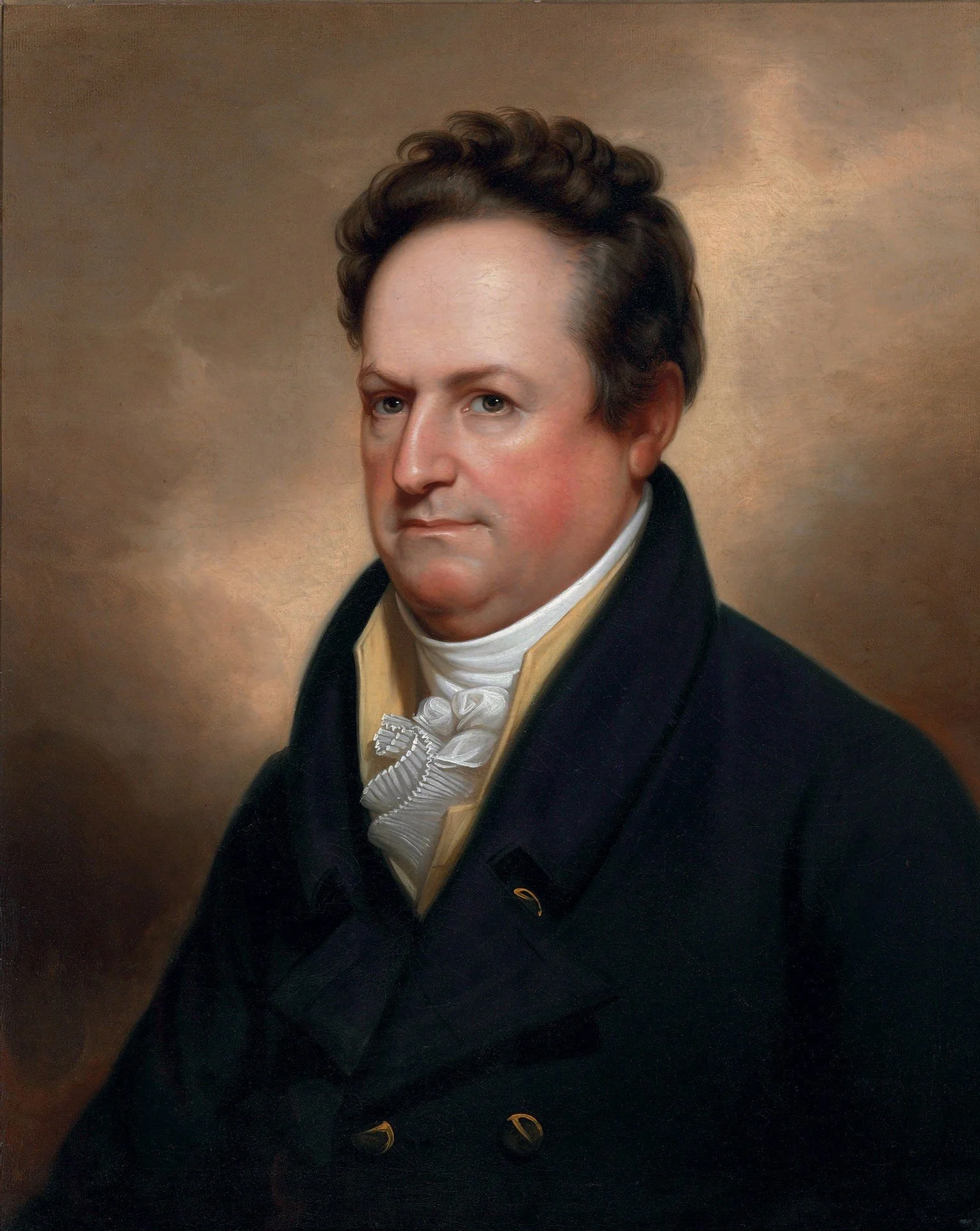
DeWitt Clinton, about 1823. Portrait by Rembrandt Peale.
What a ditch would do for New York
The Erie Canal, as it was eventually built, was a ditch 363 miles long, 40 feet wide and four feet deep, dug across upstate New York. It joined Lake Erie at Buffalo to the Hudson River above Albany, and the Hudson carried everything else down to New York harbor. It was the first water route through the Appalachian Mountains, which until then had walled the Atlantic seaboard off from the interior.⁵
Before it, moving a ton of goods between Buffalo and New York took about three weeks over rutted roads. After it, the trip took eight days and cost up to 90 percent less. The farms and forests of the new West could now ship to the world through a single port.⁵
The merchants at the City Hotel knew what was at stake. New York was already the largest city in the country. The census of 1810 had counted 96,373 people, against 53,722 in Philadelphia.⁶ It had also been the busiest American port since the late 1790s. But the lead was thin. Philadelphia and Baltimore were close behind, and the produce of the West mostly floated down the Ohio and the Mississippi to New Orleans.⁷ Whichever city captured the trade of the interior would win the century, and more.
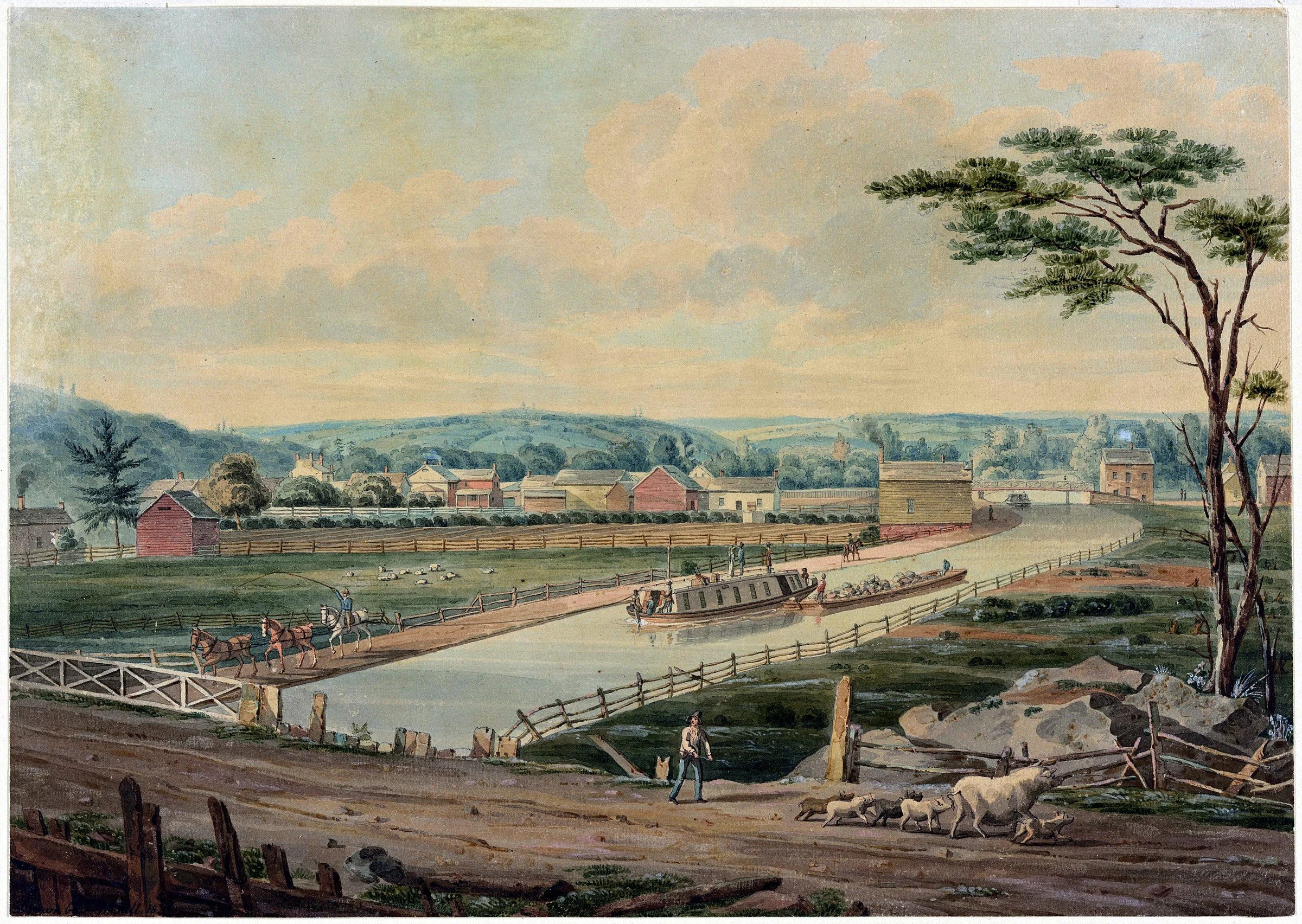
A canal boat on the Erie, 1829. Watercolor by John William Hill. The New York Public Library.
“Little short of madness”
The canal was not Clinton’s idea. It belonged first to Jesse Hawley, a flour merchant from Geneva, New York, who went broke trying to get his flour to market. In 1807 and 1808, during twenty months in debtors’ prison, he wrote fourteen essays under the pen name “Hercules” for a local paper, the Genesee Messenger. They laid out a route, its costs, and its benefits.⁸
The essays reached Albany. In 1808 an assemblyman named Joshua Forman won a state survey, which found a route was possible. In January 1809 Forman went to Washington to ask President Thomas Jefferson for federal help. As Forman remembered it many years later, Jefferson heard him out and replied that a canal of 350 miles through the wilderness was “little short of madness to think of it at this day.”⁹
New York went ahead without him. In 1810 the legislature named a commission to explore a route, led by Gouverneur Morris, with Clinton as one of its members. Then came the war, and the canal stalled until that December night at the City Hotel.¹⁰
Who would pay
Clinton’s memorial worked. In April 1816 the legislature named a new canal commission and put Clinton at its head.¹¹ The commission asked Congress for help. Congress passed a bill to fund roads and canals across the country, and on March 3, 1817, his last day in office, President Madison vetoed it. He wrote that he could not reconcile the bill with the Constitution.¹² If New York wanted a canal, New York would have to pay for it.
That was the heart of the fight in Albany. The canal would cost millions. It would take heavy borrowing and new taxes.¹³ Landowners in the southern and eastern counties asked why they should be taxed for a ditch that would mostly enrich the west of the state. Rival towns fought over where the route should run.¹⁴
The sharpest opposition came from New York City. The city’s legislators were all Tammany Republicans, and they feared two things. One was that city taxpayers would be stuck with the rising costs of an uncertain project whose benefits would go upstate. The other was that if the canal succeeded, it would make DeWitt Clinton, Tammany’s great enemy, the most powerful man in the state.¹⁵
On April 15, 1817, the legislature passed the canal law anyway. It authorized the state to borrow up to $7 million.¹⁶ Not one member of New York City’s delegation voted for it.¹⁵
Two weeks later, Clinton was elected governor in a landslide, 43,310 votes to 1,479.¹⁷ Martin Van Buren, the rising leader of Clinton’s opponents, saw which way the wind was blowing and came around to the canal.¹⁸
The city’s money
The city’s legislators had voted no. The city’s money said yes.
Merchants, banks and other investors in New York City bought most of the state’s canal bonds. The Bank for Savings, whose depositors were largely the city’s working poor, eventually held $1 million of them. John Jacob Astor bought more than $200,000 worth. Manhattan’s auction houses, through which nearly half of the country’s imported goods were sold, paid about $1.3 million into the construction fund through a small duty on every sale.¹⁹
Ground was broken at Rome, New York, on July 4, 1817, three days after Clinton took office as governor.²⁰ Critics called the project “Clinton’s Ditch.” It was built mostly by upstate New Yorkers: country surveyors who taught themselves engineering, and farmers and townspeople who contracted to dig it in hundreds of short sections. In the later years most of the labor came from Irish immigrants.¹⁹
The work went better than almost anyone expected. By 1822, with long stretches already open, a New York newspaper was calling the state “a mighty and flourishing empire.”²¹
Killing a man too dead
Success did not make Clinton safe. Facing strong opposition from Van Buren’s faction, known as the Bucktails, he did not run for a third term as governor in 1822. He kept one job: president of the canal commission, an unpaid post.¹⁷
On April 12, 1824, the last day of the legislative session, State Senator John Bowman moved to remove him from the commission. The motion passed.²² The Bucktails meant to finish him. Instead, voters were outraged. Indignation meetings were held in Albany and New York.²³ Van Buren remarked that there is such a thing in politics as killing a man too dead.²⁴
That November, Clinton ran for governor again and won easily.¹⁷ He would be the one to open the canal.
With the work still more than a year from completion, he made a prediction about his city. New York, he said, “will in the course of time become the granary of the world, the emporium of commerce, the seat of manufactures, the focus of great monied operations.” And “before the revolution of a century, the whole island of Manhattan, covered with habitations and replenished with a dense population, will constitute one vast city.”²⁵
The wedding of the waters
On October 26, 1825, Clinton stepped aboard a canal boat called the Seneca Chief at Buffalo. On board were two kegs of Lake Erie water.²⁶ Jesse Hawley, who had first sketched the canal from a debtors’ prison, was reportedly a passenger.²⁷
Cannon had been placed along the whole length of the canal and down the Hudson. As the boat set off, the first gun fired, and each gun crew fired when it heard the one before. By one account the signal reached New York City in about ninety minutes, and then was sent back the way it came.²⁸
The boats made their way east through the new canal towns, with speeches and dinners at every stop. At Albany the steamboat Chancellor Livingston took the Seneca Chief in tow down the Hudson.²⁹
On November 4, 1825, the flotilla reached New York harbor. Off Sandy Hook, at the mouth of the harbor, Clinton lifted a keg and poured Lake Erie into the Atlantic Ocean. The ceremony was called the wedding of the waters. Vials of water from the great rivers of the world were poured in after it.²⁹ Back in the city, the trades paraded through the streets. The Common Council later reported that the celebration had been carried out “in a style of unusual magnificence and splendour.”³⁰
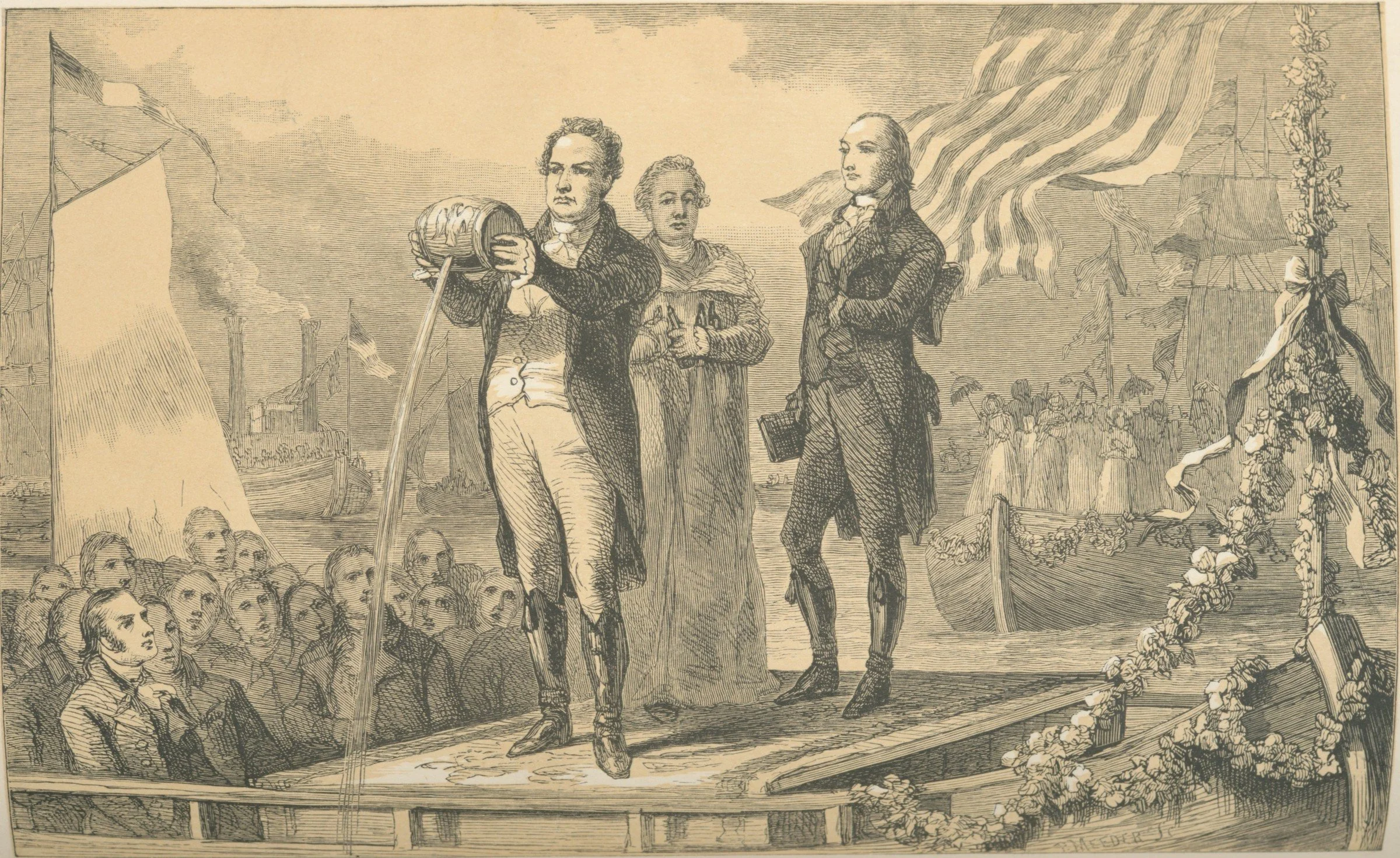
DeWitt Clinton pours Lake Erie water into the Atlantic, November 4, 1825. Engraving by Philip Meeder. The New York Public Library.
The emporium
The numbers came fast.
In 1820 New York had been a distant third to Baltimore and Philadelphia in flour exports. By 1827 it was the runaway leader. In 1815 the city had handled less than a fifth of the nation’s exports; by 1860 it handled well over a third. By 1860 it took in more than two-thirds of the country’s imports, six times as much as second-place Boston.³¹
The city’s population nearly doubled while the canal was being dug, and quadrupled over the thirty years after it opened.³¹ Philadelphia, Baltimore and Boston built canals and railroads of their own to catch up. They never did.³²
The canal paid for itself many times over. Its tolls produced about $40 million in profit before they were abolished in 1883.³³ New York’s bankers, who had learned their trade buying and selling canal bonds, were ready for the railroads that came next.
Clinton did not live to see most of it. He died in office in Albany on February 11, 1828, at 58.²
The canal did not create New York’s lead; the city was already first when Clinton walked into the City Hotel. It made the lead permanent. And the island he described in 1824, covered with habitations, replenished with a dense population, one vast city, arrived well before his century was out.
Did your family come to New York, or move west from it, by way of the Erie Canal? Tell us what you know of the trip.
Notes and Sources
Notes
NYC Municipal Archives, “200 Years of the Erie Canal” (October 2025), on the Evening Post notice of December 29, 1815.
The Encyclopedia of New York City, 2nd ed. (2010), “Clinton, DeWitt,” pp. 271–272; “Erie Canal,” p. 419 (Clinton “recently deposed” as mayor and holding no public office in December 1815); NYC Municipal Archives (age 46).
Edwin G. Burrows and Mike Wallace, Gotham: A History of New York City to 1898 (1999), ch. 28, p. 428. The meeting’s chair and speakers: Thomas Eddy, memoir, in Samuel L. Knapp, The Life of Thomas Eddy (1834), pp. 148–152, 302–303.
New York State Archives, “Memorial from Inhabitants of New York on Canal between the Hudson River and Lake Erie,” February 15, 1816 (Series A4682-99, Box 20, Folder A); NYS Canal Corporation, “Canal History” (the 100,000-signature petition).
Encyclopedia of New York City, “Erie Canal,” pp. 419–420.
U.S. Census Bureau, “1810: Ten Largest Urban Places.”
American Heritage, “Real Estate: Where and When” (New York the busiest port by 1797, its lead “precarious”); Encyclopedia.com, “Erie Canal, Building of” (western freight to New Orleans).
Encyclopedia of New York City, p. 419; Founders Online, editorial note on Jesse Hawley (Jefferson Papers); DPLA, “Making the Case.”
Joshua Forman’s account in David Hosack, Memoir of De Witt Clinton (1829), pp. 346–347, as quoted in Founders Online (Jefferson Papers) and Monticello, “Little short of madness.” Recalled years after the 1809 visit.
Encyclopedia of New York City, p. 419; “Erie Canal Commission,” Wikipedia.
Encyclopedia of New York City, p. 419.
James Madison, veto message, March 3, 1817; “Bonus Bill of 1817,” Wikipedia.
Bill of Rights Institute, “The Building of the Erie Canal.”
Encyclopedia.com, “Erie Canal, Building of”; Paul Contarino, “The Erie Canal” (Hudson River Valley Institute); Bill of Rights Institute.
Encyclopedia of New York City, p. 419; Noble E. Whitford, History of the Canal System of the State of New York (1906), ch. 2.
Schenectady County Historical Society, Mohawk Valley history (act of April 15, 1817); NYC Municipal Archives ($7 million in bonds).
Encyclopedia of New York City, pp. 272, 419.
Bill of Rights Institute.
Encyclopedia of New York City, p. 419.
Erie Canal Museum, “DeWitt Clinton and the Erie Canal.”
Encyclopedia of New York City, p. 420.
“John Bowman (New York politician),” Wikipedia; Whitford (1906).
Thurlow Weed, Autobiography (1883), ch. 12, “Indignation at Clinton’s Removal. Meetings in Albany and New York.”
Widely attributed to Van Buren (e.g., Kenneth Silber, “The Canal Builder,” Research, 2009).
Encyclopedia of New York City, “Erie Canal,” p. 420, which dates the prediction to about a year and a half before completion.
Buffalo & Erie County Historical Society, “The Completion of the Erie Canal” (historical marker).
“Seneca Chief,” Wikipedia.
New York State Archives, Consider the Source NY, “Wedding of the Waters.” Other accounts give other times.
American Heritage, “1825: One Hundred and Seventy-five Years Ago”; New York State Archives, Consider the Source NY.
Common Council, report on the canal celebration, November 10, 1825, NYC Municipal Archives; Cadwallader D. Colden, Memoir (1826).
Encyclopedia of New York City, p. 420.
“History of New York City (1784–1854),” Wikipedia (citing Albion).
Encyclopedia of New York City, p. 420.
References
Primary and period sources
- New York Evening Post, notice of meeting, December 29, 1815.
- DeWitt Clinton, “Memorial of the Citizens of New York, in Favour of a Canal Navigation between the Great Western Lakes and the Tide-Waters of the Hudson,” February 15, 1816. New York State Archives.
- James Madison, veto message on the Bonus Bill, March 3, 1817.
- Laws of New York, 1817, act of April 15, 1817 (the canal law).
- Common Council of the City of New York, report on the canal celebration, November 10, 1825. NYC Municipal Archives.
- Cadwallader D. Colden, Memoir, Prepared at the Request of a Committee of the Common Council of the City of New York, and Presented to the Mayor of the City, at the Celebration of the Completion of the New York Canals (New York, 1826).
- David Hosack, Memoir of De Witt Clinton (New York, 1829).
- Samuel L. Knapp, The Life of Thomas Eddy (New York, 1834).
- Thurlow Weed, Life of Thurlow Weed, Including His Autobiography (Boston, 1883).
Books
- Albion, Robert G. The Rise of New York Port, 1815–1860. New York: Scribner’s, 1939.
- Bernstein, Peter L. Wedding of the Waters: The Erie Canal and the Making of a Great Nation. New York: Norton, 2005.
- Burrows, Edwin G., and Mike Wallace. Gotham: A History of New York City to 1898. New York: Oxford University Press, 1999.
- Cornog, Evan. The Birth of Empire: DeWitt Clinton and the American Experience, 1769–1828. New York: Oxford University Press, 1998.
- Jackson, Kenneth T., ed. The Encyclopedia of New York City. 2nd ed. New Haven: Yale University Press, 2010. “Erie Canal,” 419–420; “Clinton, DeWitt,” 271–272.
- Koeppel, Gerard. Bond of Union: Building the Erie Canal and the American Empire. Cambridge, Mass.: Da Capo, 2009.
- Whitford, Noble E. History of the Canal System of the State of New York. Albany, 1906.
Websites
- NYC Municipal Archives. “200 Years of the Erie Canal.” October 2025. https://www.archives.nyc/blog/2025/10/03/erie-canal-200-years
- New York State Archives. The New York Memorial (1816). https://digitalcollections.archives.nysed.gov/index.php/Detail/objects/42730
- New York State Archives. Consider the Source NY, “Wedding of the Waters.” https://considerthesourceny.org/activity/wedding-waters
- Founders Online. Jefferson Papers, editorial notes on Jesse Hawley and the Forman visit. https://founders.archives.gov/documents/Jefferson/03-19-02-0134
- Monticello. “Little short of madness... (Quotation).” https://www.monticello.org/encyclopedia/little-short-madnessquotation
- U.S. Census Bureau. “1810: Ten Largest Urban Places.” https://www.census.gov/programs-surveys/decennial-census/decade/decennial-facts.1810.html
- American Heritage. “Real Estate: Where and When”; “1825: One Hundred and Seventy-five Years Ago.”
- Bill of Rights Institute. “The Building of the Erie Canal.” https://billofrightsinstitute.org/essays/the-building-of-the-erie-canal/
- Erie Canal Museum. “DeWitt Clinton and the Erie Canal.” https://reflections.eriecanalmuseum.org/laborers-nys-employees/dewitt-clinton-and-the-erie-canal/
- Wikipedia. “Erie Canal Commission”; “Bonus Bill of 1817”; “John Bowman (New York politician)”; “Seneca Chief”; “History of New York City (1784–1854).”