The Express
Vanderbilt built the largest passenger train terminal in the world on 42nd Street, so far uptown that his own backers warned him against it.
Within weeks of its opening, a city inspector reported seven people run over and killed by trains coming and going from the terminal.
When the neighbors came to complain, Vanderbilt agreed with them. Then he named his price.
The depot was “dangerous to life”
In the middle of November 1871, a city sanitary inspector named Morris delivered a report on the newest and grandest building in New York. Its title might have been a warning label. The Grand Union Depot on 42nd Street, he wrote, was “dangerous to life.”¹
The trouble was outside, on Fourth Avenue. North of the depot, the tracks ran down the middle of the avenue at street level, and from 45th to 54th Street the depot’s yard tracks were so crowded with standing railroad cars that people crossing could not see a moving train until it was on them.
More trains were running every hour since the depot opened. Within twelve days of opening, Morris reported, seven people had lost their lives “by being run over by trains approaching or leaving this depot.”¹
The depot had been open barely five weeks. It belonged to one man, and nearly everyone in the city knew his name.
The Commodore’s bet
Cornelius Vanderbilt was 75 years old when construction began on September 1, 1869.² He already controlled the three railroads that ran into Manhattan from the north and east: the New York and Harlem, the Hudson River line, and the New York Central.³ Each had its own station, and passengers and baggage moving between them made a daily mess. Vanderbilt meant to bring all three lines under one roof.²
He chose the Harlem Railroad’s yards at 42nd Street and Fourth Avenue. In 1869 that was the northern edge of the developed city. The site was so far from the city center that even his own backers warned him against building there.² He built anyway. One newspaper wrote that “Commodore Vanderbilt, whose word is law in such matters, has decreed that New York shall have the most spacious, elegant, and convenient depot to be found in the country.”⁴
The architect John B. Snook gave the building three mansard-roofed towers in the French style and a wing nearly 700 feet long, with waiting rooms, ticket offices and restaurants. Vanderbilt persuaded the city to let him plant the building squarely across Fourth Avenue, and a new street, Vanderbilt Avenue, was cut along its western side.²,⁵
Behind it rose the great iron-and-glass hall where the trains came in: 32 iron arches, each spanning 200 feet and rising 100 feet, over 12 tracks. It was modeled on St. Pancras Station in London and was longer and wider than its model, the largest rail facility in the world.⁵
The Harlem Railroad moved in on October 9, 1871. The New Haven, which ran its trains into the city over the Harlem’s tracks, followed on October 16. On November 1 came the New York Central and Hudson River, the single line Vanderbilt had made by merging those two roads in 1869. The bill came to about $6.4 million.²,⁶
The bet was not a new kind for Vanderbilt. He had been making it, in one form or another, for sixty years.
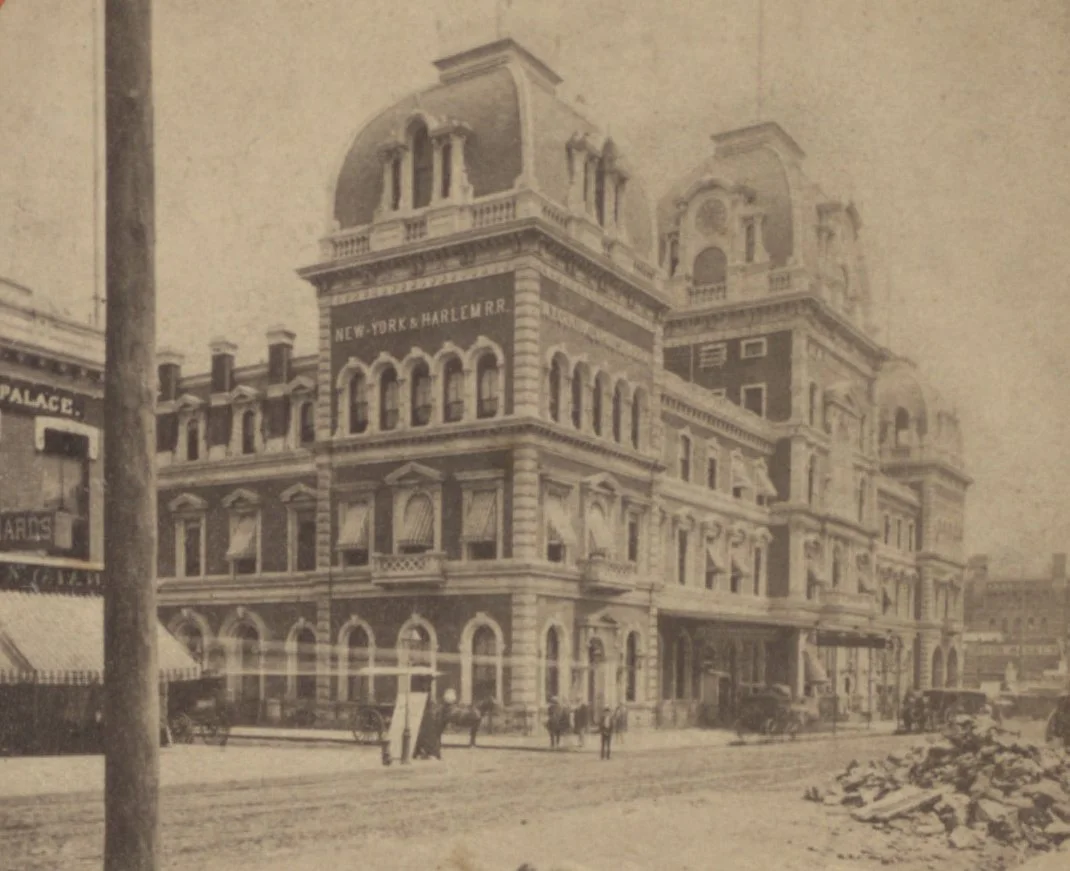
Grand Central Depot, 42nd Street and Fourth Avenue, New York Public Library, Robert N. Dennis collection.
His nickname started as a joke
He was born on Staten Island in 1794 and grew up on the water. By sixteen he was running his own sailboat, a two-masted periauger, carrying freight and passengers across the harbor to Manhattan. He worked so hard at it that the other boatmen started calling him “the Commodore” as a joke. The name stuck.⁷
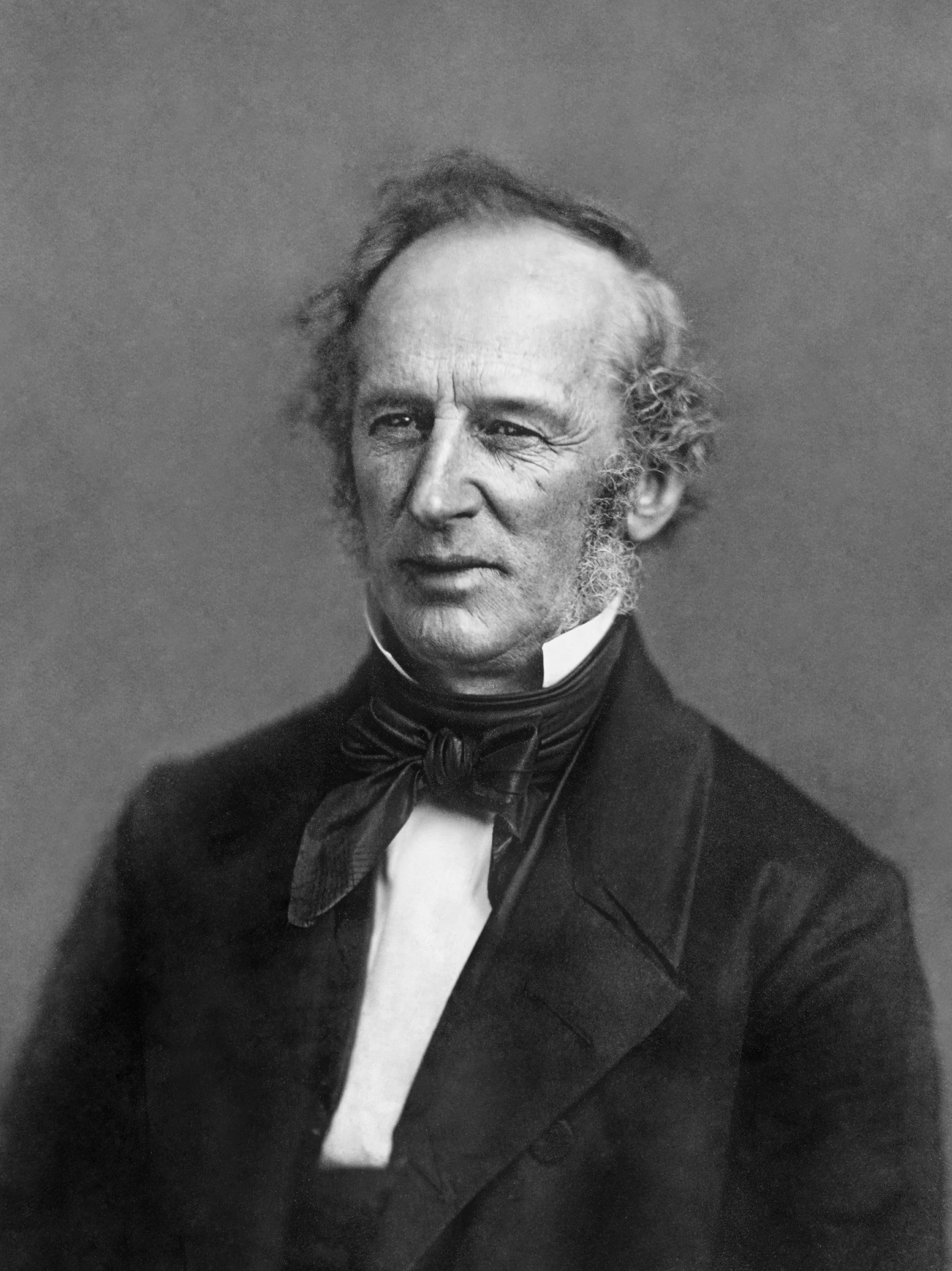
Cornelius Vanderbilt, photographed by Mathew Brady’s studio, circa 1844-1860
In 1818 a New Jersey businessman, Thomas Gibbons, hired him to captain a steamboat, the Bellona, in defiance of the state monopoly on steam navigation in New York waters. For months, process servers and sheriffs chased the captain and his boat around the harbor. They could not catch him.⁸ The fight went to the Supreme Court, and in 1824 Gibbons v. Ogden broke the monopoly. Vanderbilt went on to build a fortune in steamboats.⁹
He came to railroads late, at nearly 70. In 1863 he bought heavily into the Harlem, then a weak line. When speculators, with members of Boss Tweed’s Common Council among them, tried to drive the stock down by betting against it, Vanderbilt and his allies bought every share offered. The stock went up instead, and the men betting against him lost heavily.¹⁰,¹¹ By 1869 he had the Hudson River and the New York Central too.³
The steamboat war and the Harlem stock fight were both fights over who would control a route: New York’s waters in one, the rail line into Manhattan in the other. Both times Vanderbilt won by holding on and refusing to back down. Now his route ran down the middle of an avenue where people lived.
Death Avenue
The Harlem Railroad had run steam trains up Fourth Avenue for decades, and uptown residents had long complained about the noise, the smoke and the danger.¹² The new depot made it worse. North of 42nd Street the tracks ran at street level to 68th Street. The rail yards split the neighborhood in two, and crossing from one side to the other meant crossing active train tracks.⁵
After Morris’s report the newspapers took up the cause. The New York Times ran editorial after editorial, and called the crossings north of the depot the city’s “most fearful death-trap.”⁵,¹² On January 6, 1872, a Herald headline called Fourth Avenue “Death Avenue.”¹³ The residents wanted the tracks put in an underground tunnel.¹²
“A heap of money”
On January 12, 1872, a delegation of Fourth Avenue residents came to see the Commodore. He was 77 and had survived heart trouble, but a Herald reporter found him listening “attentively.” He did not argue with them. The only question, he told them, was how best to do it, and it “would certainly cost a heap of money.”¹²
He put the cost at $5 million, and said the railroad could not pay all of it. The people who owned the land along the avenue would profit too, he argued, because sinking the tracks would raise the value of their property. So, he said, “let each of us pay our proportion.”¹²
He added one more thing. Until a few months earlier, he said, a plan like this could not have gone anywhere, because the Tweed Ring would have blocked it unless it got a large payoff. Now the Ring had fallen.¹²
About two weeks later Vanderbilt met the Citizens’ Eastside Association at the depot and laid out a plan drawn by his chief engineer, J. C. Buckhout. The tracks would drop into an open cut beginning at 48th Street, and the cross streets would pass over it on bridges.
People would no longer have to cross the tracks at all. The bridges would even be “so arranged that horses could not see approaching trains,” so carriage horses would not bolt at the sight of a locomotive passing beneath them. At 97th Street, where the land fell away toward Harlem, a viaduct would carry the trains over the streets.
Buckhout put the cost at $4 million. Some committee members grumbled that they had not gotten everything they wanted, but most accepted the plan. His biographer T. J. Stiles calls Vanderbilt’s conduct that winter “reasonable,” a word, he notes, that historians rarely attach to the man.¹²
That spring the legislature passed “An act to improve and regulate the use of the Fourth avenue.” It ordered 4¼ miles of track between Grand Central and the Harlem River put below the street, and it set up a Board of Engineers to run the job.¹⁴,¹⁵ It also settled the question Vanderbilt had raised in his office.
The railroad and the City of New York would split the cost equally, and the city’s half would come out of the property tax levies of 1872 and 1873.¹⁶ Newspapers charged that bribes had helped it pass.¹²
Work began that fall.¹⁵
The mayor won’t sign
By 1874 the city had a new mayor, William F. Havemeyer, a reformer elected after Tweed’s fall, and he did not like the deal. The city had already raised $1,587,000 in taxes for the first quarter of the cost.¹⁶ When the engineers certified another round of work in May 1874 and the comptroller drew a warrant for the city’s half, Havemeyer refused to countersign it. He had come to doubt, he wrote, that the legislature could lawfully make the city pay for half of a private company’s railroad.¹⁷
The Harlem Railroad took the mayor to court. Justice Westbrook of the State Supreme Court held that the 1872 act was valid and that the city owed its half.¹⁶
On June 20, 1875, the whole line opened. Large crowds gathered to watch the first trains run from Grand Central to the Harlem River below the street.¹⁵
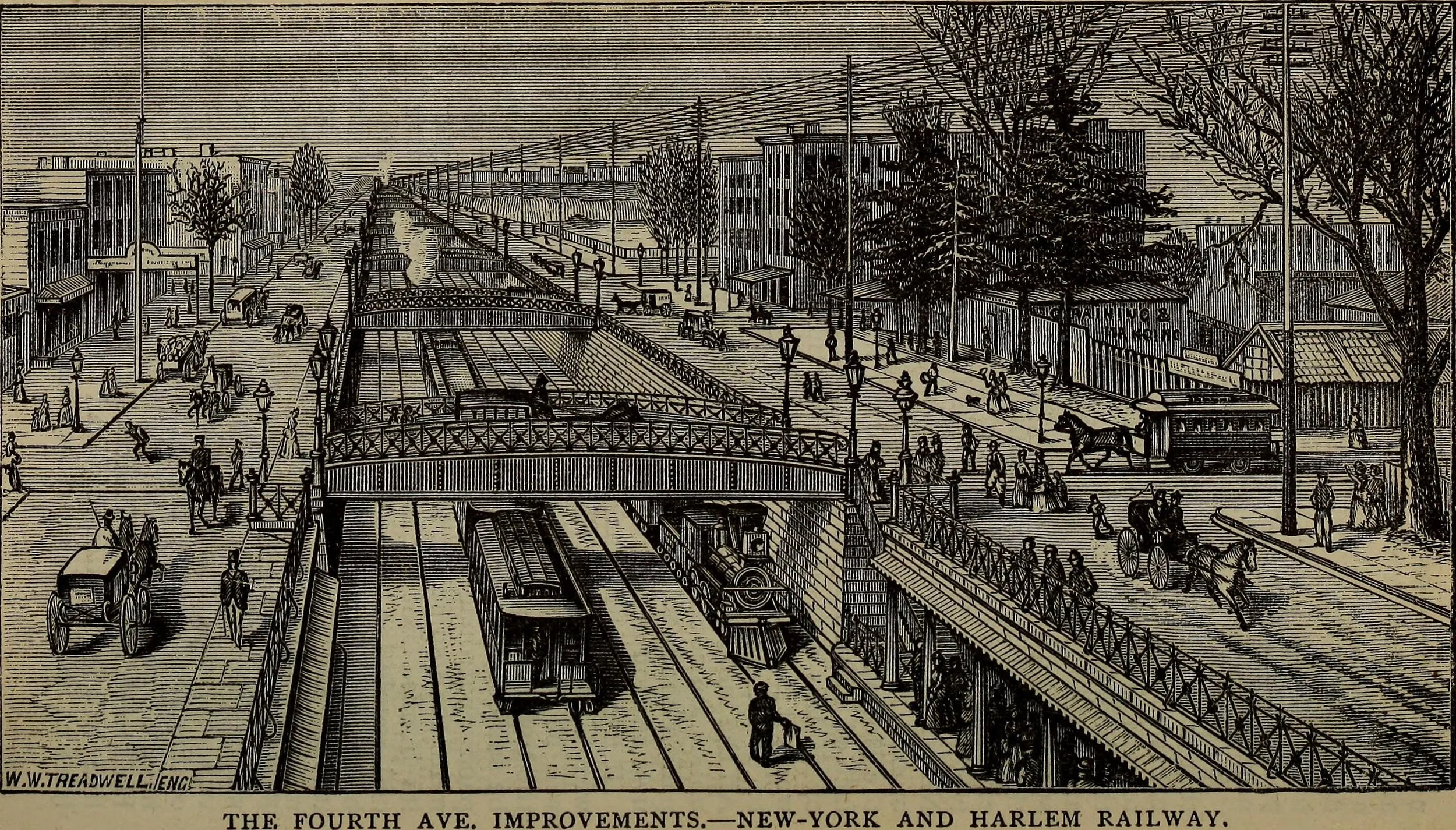
The Fourth Avenue Improvements, New-York and Harlem Railway. Engraving by W. W. Treadwell, The Science Record, 1874.
Death Avenue becomes Park Avenue
To make room for the sunken tracks, Fourth Avenue above the cut was rebuilt as a broad boulevard, 140 feet wide.¹⁸ Down the middle ran a long planted strip with rows of iron-grated openings, so the smoke and steam of the locomotives below could escape.⁵,¹⁸ It was not built for strolling and at first it was closed to pedestrians.⁵
The avenue that had been the city’s most dangerous became one of its most desirable. By the early 1880s mansions were going up along it in the East 90s.¹⁸ In 1888 the city made the new name official. The boulevard north of Grand Central was now Park Avenue.¹⁹
Vanderbilt did not live to see it. He died at his home in Manhattan on January 4, 1877, at 82, the richest man in America.⁷
His depot was rebuilt, then replaced. The present Grand Central Terminal, opened in 1913, stands on the same site, and Midtown grew up around it.² The median is still there, planted now with trees and flowers, running for miles up Park Avenue. It was built to cover the vents.
And Vanderbilt is still there too. In 1869 he had put up a bronze statue of himself on his freight depot downtown, at St. John’s Park. When that depot was torn down in 1929, the railroad moved the statue to Grand Central and set it on the south facade, beneath the great clock.²⁰ He stands there today in his fur-trimmed winter coat, looking south over the traffic, at the head of the avenue his trains made.
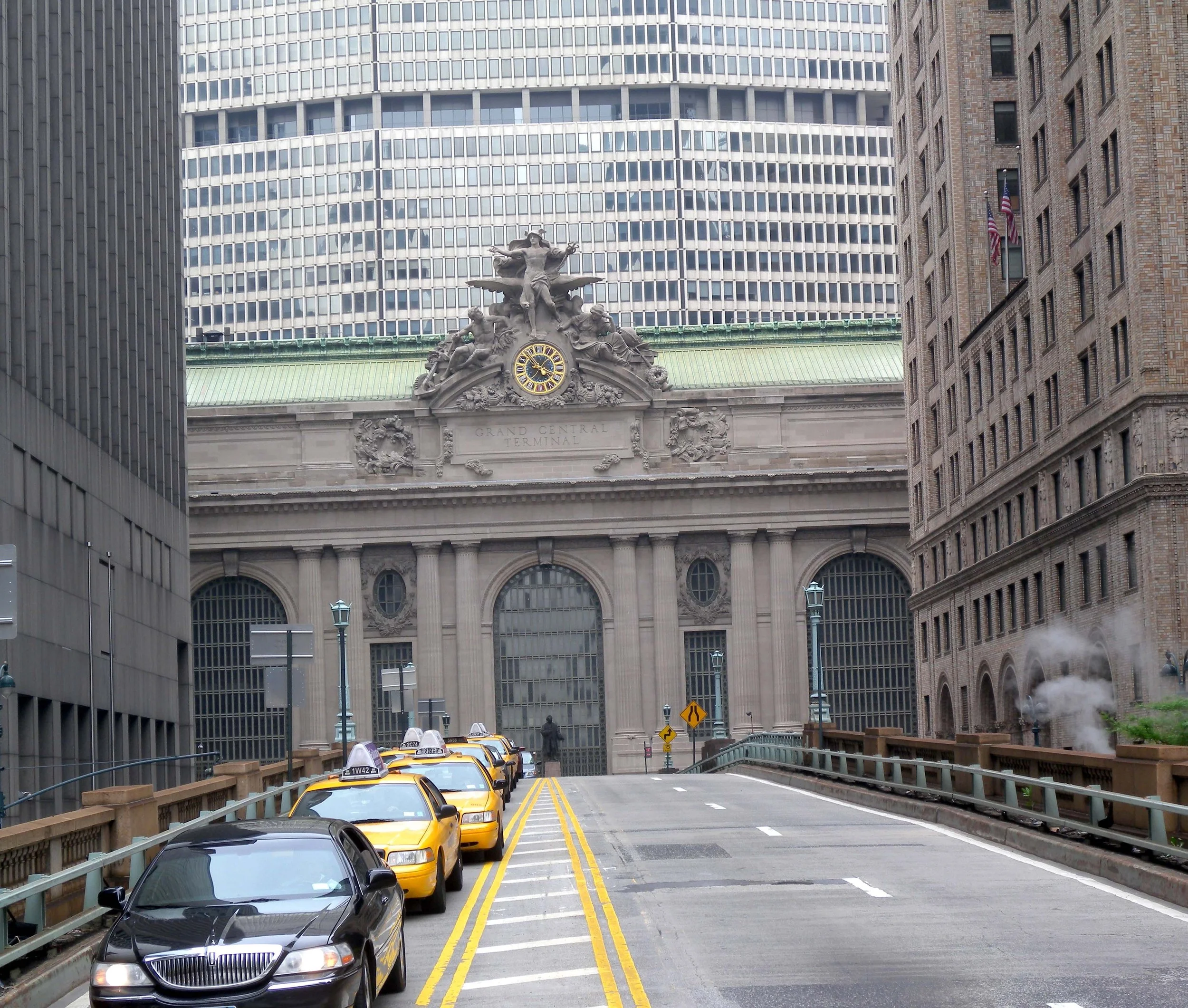
Park Avenue at Grand Central Terminal. Vanderbilt’s statue stands below the clock. Photo: Jim Henderson, public domain.
Does your family have a photograph of Park Avenue or Grand Central from before 1913? Tell us what it shows.
Notes and Sources
Notes
New-York Tribune, November 16, 1871, report of City Sanitary Inspector Morris, as quoted in “The Lost 1871 Grand Central Depot – 42nd Street,” Daytonian in Manhattan, February 4, 2013. Original not yet seen.
“History of Grand Central Terminal,” Wikipedia: construction dates, the warning from Vanderbilt’s backers, the purpose of uniting three railroads, Vanderbilt Avenue, and the opening sequence (October 9, October 16, November 1, 1871).
National Iron and Steel Heritage Museum, “Railroad Barons: Cornelius Vanderbilt” (Harlem 1863, Hudson River 1864, New York Central 1867).
Quoted in Daytonian in Manhattan, “The Lost 1871 Grand Central Depot.” The newspaper and date are not given there; to be identified.
The Skyscraper Museum, “The Invention of Park Avenue” and its timeline: the Snook and Buckhout design, the train shed’s dimensions and comparison to St. Pancras, the tracks at grade from 42nd to 68th Street, the yards dividing the neighborhood, the Times’s “most fearful death-trap,” the median and its vents (illustrated in Scientific American, November 28, 1874), and the mall’s original closure to pedestrians.
Cost of $6.4 million: Daytonian in Manhattan; Seton Hall University, “Grand Central Depot,” NYC History blog, November 14, 2016.
“Cornelius Vanderbilt,” Wikipedia; HISTORY.com, “Cornelius Vanderbilt.” Accounts differ on whether the periauger was his own, bought with $100 borrowed from his mother, or his father’s, run on shares (the 1853 account).
John T. Flynn, Men of Wealth (1941), ch. 5 (Mises Institute online edition); T. J. Stiles, “Gibbons,” tjstiles.net.
“Thomas Gibbons,” Neptune’s Needle (Robert A. McCaughey); Gibbons v. Ogden, 22 U.S. 1 (1824).
Appletons’ Cyclopædia of American Biography, “Vanderbilt, Cornelius” (Wikisource).
Empire State Passengers Association, “The Commodore’s Game” (Tweed and the Common Council in the 1863 Harlem corner).
T. J. Stiles, The First Tycoon: The Epic Life of Cornelius Vanderbilt (New York: Knopf, 2009), ch. 18, citing the New York Herald, January 13, 1872, and later reports. Read in an online copy; quotations to be checked against the print edition and the Herald.
New York Herald, January 6, 1872, “The Car of Juggernaut still moves along Death Avenue,” as cited in a City Tech (CUNY) student archive reflection. Original not yet seen.
Laws of New York, 1872, ch. 702, “An act to improve and regulate the use of the Fourth avenue, in the City of New York.”
“59th Street station (New York Central Railroad),” Wikipedia, citing the New York Times, October 30, 1872, and June 21, 1875; the New-York Tribune, May 24, 1873, and June 22, 1875; and the New York Herald, January 5, 1873.
People ex rel. New York & Harlem Railroad v. Havemeyer (N.Y. Sup. Ct., Westbrook, J., 1874): the 50-50 division of cost under section 7, the tax levies under section 8, and the $1,587,000.50 raised in 1872.
Correspondence on the Fourth Avenue Improvement, City Record (New York), 1874–75, NYC Government Publications Portal. A later letter to Havemeyer’s successor says the constitutional objections “originated with himself.”
Museum of the City of New York, The Greatest Grid, “Peter Baab, Photographic series from the roof of George Ehret’s home at Park Avenue and 94th Street, 1882–83.”
“Park Avenue,” Wikipedia.
“Grand Central Terminal art,” Wikipedia; T. J. Stiles, The First Tycoon (the 1929 move).
References
Primary and period sources
- New-York Tribune. Report of Sanitary Inspector Morris. November 16, 1871.
- New York Herald. “The Car of Juggernaut still moves along Death Avenue.” January 6, 1872.
- New York Herald. Report of the Fourth Avenue delegation to Commodore Vanderbilt. January 13, 1872 (date per Stiles; to confirm).
- Laws of New York, 1872, ch. 702.
- People ex rel. New York & Harlem Railroad v. Havemeyer (N.Y. Sup. Ct., 1874). https://cetient.com/case/6120176/people-ex-rel-new-york-and-harlem-railroad-v-havemeyer
- City Record. Corporation counsel correspondence on the Fourth Avenue Improvement, 1874–75. https://a860-gpp.nyc.gov/downloads/fb494c941?locale=en and https://a860-gpp.nyc.gov/downloads/0p096b894?locale=en
- Scientific American. “The Extraordinary Railway, New York City.” Vol. 31, no. 22 (November 28, 1874): 338.
Books
- Stiles, T. J. The First Tycoon: The Epic Life of Cornelius Vanderbilt. New York: Knopf, 2009.
- Flynn, John T. Men of Wealth. 1941. Mises Institute online edition. https://mises.org/online-book/men-wealth/v-cornelius-vanderbilt-rail-king
- Jackson, Kenneth T., ed. The Encyclopedia of New York City. 2nd ed. New Haven: Yale University Press, 2010. “Grand Central Terminal,” 543; “Vanderbilt, Cornelius,” 1362.
- Schlichting, Kurt C. Grand Central Terminal: Railroads, Engineering, and Architecture in New York City. Baltimore: Johns Hopkins University Press, 2001.
Websites
- Daytonian in Manhattan. “The Lost 1871 Grand Central Depot – 42nd Street.” February 4, 2013. http://daytoninmanhattan.blogspot.com/2013/02/the-lost-1871-grand-central-depot-42nd.html
- The Skyscraper Museum. “The Invention of Park Avenue.” https://skyscraper.org/the-invention-of-park-avenue/?p=76 and timeline, https://www.skyscraper.org/the-invention-of-park-avenue/timeline/
- Museum of the City of New York. The Greatest Grid. https://thegreatestgrid.mcny.org/greatest-grid/east-side/252
- Seton Hall University. “Grand Central Depot.” NYC History blog, November 14, 2016. https://blogs.shu.edu/nyc-history/2016/11/14/grand-central-depot/
- Empire State Passengers Association. “The Commodore’s Game.” https://esparail.org/site/assets/files/25108/empire_service_02_the_commodores_game_w_images.pdf
- Appletons’ Cyclopædia of American Biography. “Vanderbilt, Cornelius.” https://en.wikisource.org/wiki/Appletons%27_Cyclop%C3%A6dia_of_American_Biography/Vanderbilt,_Cornelius
- National Iron and Steel Heritage Museum. “Railroad Barons: Cornelius Vanderbilt.” https://steelmuseum.org/railroad_exhibit_2015/barons_vanderbilt.cfm
- Neptune’s Needle. “Thomas Gibbons.” https://neptunesneedle.github.io/people/thomasgibbons
- Stiles, T. J. Blog post on Gibbons and Vanderbilt. https://tjstiles.net/blog/posts/31204
- HISTORY.com. “Cornelius Vanderbilt.” https://www.history.com/articles/cornelius-vanderbilt
- Wikipedia. “Cornelius Vanderbilt”; “History of Grand Central Terminal”; “Park Avenue”; “59th Street station (New York Central Railroad)”; “Grand Central Terminal art.”