The Express
It seated about 5,300 people, its stage could hold a thousand performers, and elephants lived in stalls beneath it.
For years, rows of women in costume marched into a tank of water onstage and never came up.
Its first backer was reportedly unhappy with $25,000 a week in profit.
The Hippodrome’s famous disappearing women
When the music started, rows of women dressed in martial costumes marched down into a great tank of water at the front of the stage. The water rose to their waists, then their shoulders, then over their heads. Row after row followed. None of them came back up.¹
The audience knew a hundred women were not drowning at every performance. Still, the soprano Nannette Flack, looking back on her years in the theater, called the effect “absolutely weird,” and few people beyond the footlights could say how it was done. By the early 1920s, the theater’s own programs listed the act and then asked, “Where do they go?”¹
As remarkable as the tank was, it was the least of the building’s wonders.
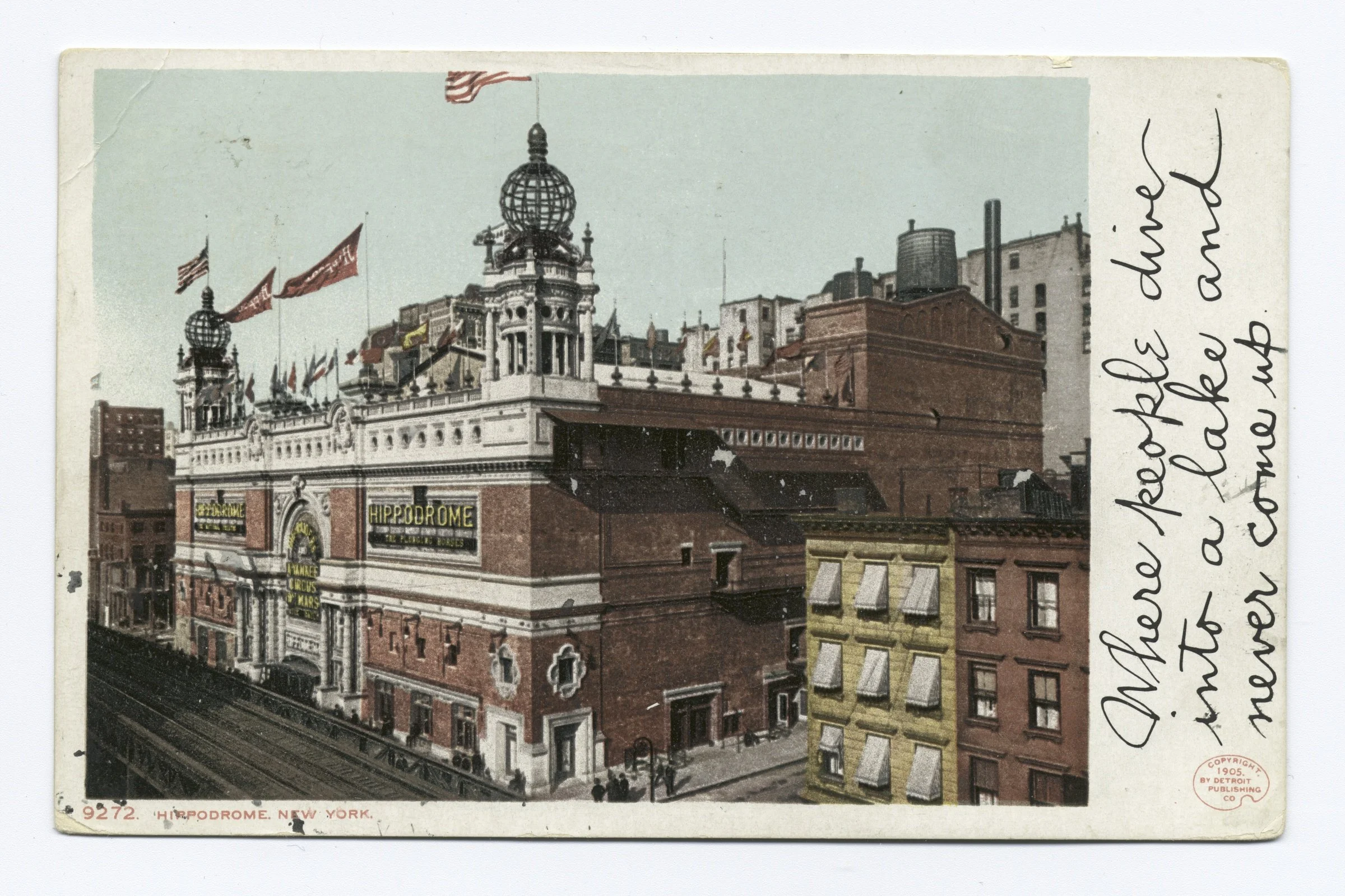
The Hippodrome on Sixth Avenue, 1905, with the elevated train in front. Detroit Publishing Co. postcard; New York Public Library.
The largest theater of its day on a famous corner in midtown
The Hippodrome took up the entire east side of Sixth Avenue between 43rd and 44th Streets and ran 240 feet back toward Fifth. It was built of brick, steel, marble and terra cotta, 72 feet high on the avenue and 110 feet at the rear, over the stage.
Two towers rose 100 feet at the corners, each crowned by a globe ten feet across and lit by 500 electric bulbs. Giant banded columns framed the main entrance. The keystone of its arch was an elephant’s head carved in stone, said to weigh 5,000 pounds.² The facade had to shout so it would stand out in front of the roaring Sixth Avenue elevated train line.³
Inside, about 5,300 seats, each four inches wider than usual, were finished in Roman red with gold, silver and ivory. The dome over the auditorium covered an acre.⁴ The stage measured 100 by 200 feet, about twelve times the size of an ordinary Broadway stage, and could hold a thousand performers at once.
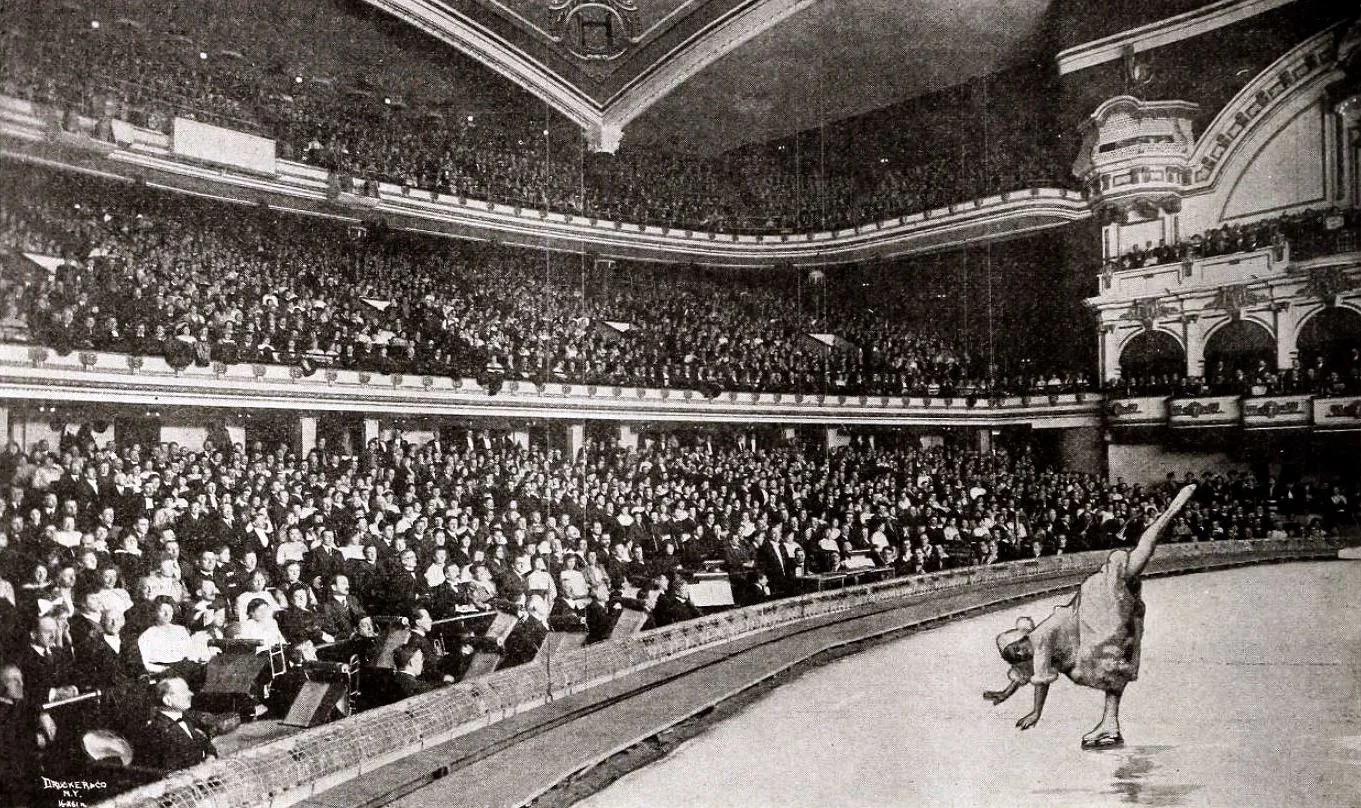
A full house at the Hippodrome, 1916.
Like the Roman Colosseum, the building kept its animals below: beneath the stage were stalls for the elephants and horses.⁵ Out front, under the apron, was the water tank, fourteen feet deep.⁶ Hydraulics, counterweights and trapdoors worked the scenery, and during a performance 196 men labored on and under the stage.⁴ Around the auditorium ran a promenade lined with glass cases of live wild animals, and a restaurant and café opened onto Sixth Avenue.²
The secret of the vanishing women was hidden in the tank. Air chambers, open at the bottom like diving bells, stood on iron rods under the surface and were fed fresh air through pipes. A performer ducked under, came up inside one, and waited, out of sight.⁷
There was a second disappearing act at the Hippodrome. That one was money.
Twenty-five thousand a week wasn’t enough
The men who built it, Frederic Thompson and Elmer “Skip” Dundy, had already made a fortune at Coney Island with Luna Park. Thompson, barely thirty, designed the stage machinery himself.⁴
Their bet was that the crowds who rode the trolley to Coney Island all summer would pay to see the same kind of wonders in midtown, year-round, at popular prices. They built on Sixth Avenue because the lots closer to Times Square cost too much.⁸
Opening night, April 12, 1905, sold out. The best boxes had been auctioned four days earlier; one went for $575, about $22,000 in today’s money. Seats in the upper Family Circle cost 25 cents, less than $10 today.⁴,⁵,¹⁷ The show opened with A Yankee Circus on Mars and closed with Andersonville, a Civil War spectacle in which cavalry troops swam their horses across the tank.⁵ In its first year the Hippodrome drew about 14,000 people a day.⁴
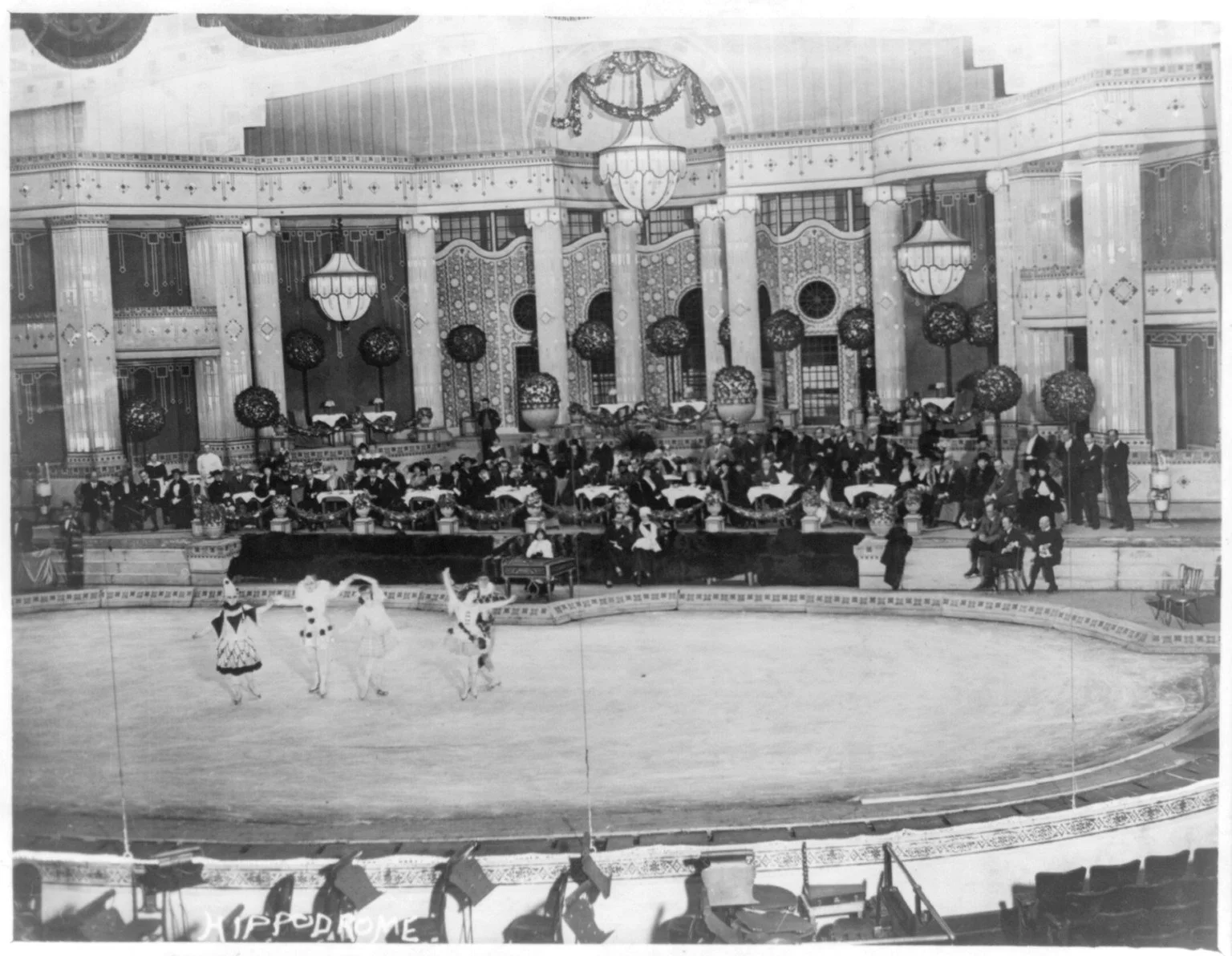
The Hippodrome during a show. Library of Congress.
It also cost about $30,000 a week to run.⁴
Thompson and Dundy’s money came partly from John W. Gates, a former barbed-wire salesman who made a fortune and then became a famous gambler on Wall Street and at the racetrack. The papers called him “Bet-a-Million.”
In 1900 he reportedly won $600,000 on a single $70,000 bet on an English horse race.⁹ By January 1906, the trade paper Variety reported, Gates was not satisfied with the $25,000 a week in net profit the theater was said to be earning. He wanted quicker returns.¹⁰
Gates got his way. By the fall of 1906, Thompson and Dundy were out, and the Shubert brothers, whose name still hangs over Broadway theaters today, were running the Hippodrome with Gates’s backing.¹¹ Neither founder fared well afterward. Dundy died the following February, at 44. In 1912 Thompson went bankrupt, and his creditors took Luna Park.²¹
Tear out the tank
The theater’s best years were still ahead. Under the producer Charles Dillingham, from 1915 to 1923, it was the biggest and most successful house in New York: diving horses, choruses of 500, circus animals, and in 1918 Harry Houdini making a 10,000-pound elephant named Jennie disappear.⁵,¹²
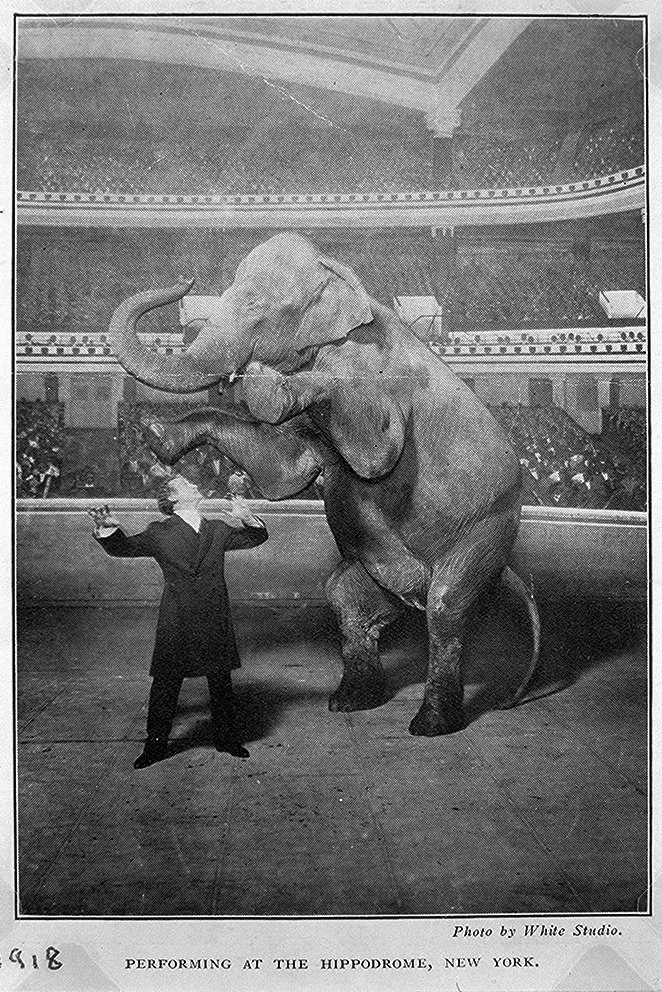
Harry Houdini with Jennie, the elephant he made disappear, 1918.
The bills kept coming too. In 1919 stagehands’ demands set off rumors that the house would become a movie theater. Dillingham promised to stay open and cut some ticket prices in half.⁴ When he left in 1923, the owners announced that a hotel would go up on the site. It never did.¹³
That summer the vaudeville king E.F. Albee leased the building and spent about $1 million converting it into a vaudeville house. To add orchestra seats, he tore out the stage apron and the famous tank with it.¹³ In April 1925 his company bought the land and building for more than $5 million.¹³
Albee had bought into a business that was losing its audience to the movies. The new movie palaces near Times Square put a feature film and a stage show on the same bill. In March 1927 the Roxy opened six blocks north as a “Cathedral of the Motion Picture,” with 5,920 seats, nearly as many as the Hippodrome.¹⁸
That October, The Jazz Singer brought talking pictures to Broadway, and vaudeville never recovered.¹⁹ By 1928 Albee’s own circuit had been merged into RKO, a new company built around the movies.⁵ The Hippodrome had begun showing films in 1925. Its stage shows were now competing with the screen in its own house.⁵
In December 1929, weeks after the stock market crash, the developer Fred F. French, who had just built Tudor City, paid a reported $7.5 million for the Hippodrome. He announced an 83-story skyscraper for the site.⁴,¹³
French borrowed against the property. In August 1932 the bank foreclosed, and he lost it.¹³
Jimmy Durante asks, “What elephant?”
Cut-rate movies followed, then grand opera at bargain prices. In 1935 the showman Billy Rose leased the house and turned the auditorium into a circus big top for Jumbo, a Rodgers and Hart musical starring Jimmy Durante.¹³,¹⁴
The production cost a reported $340,000, then a record for a Broadway musical. Rose put in $35,000; John Hay “Jock” Whitney put in $280,000.¹⁵ Whitney was the young heir to one of America’s great fortunes, built on oil, railroads and tobacco. A few years later he would be the principal backer of Gone with the Wind.²⁰
Its most famous moment had Durante leading a live elephant across the stage. A sheriff stopped him and demanded to know where he was going with that elephant. “What elephant?” Durante asked.¹⁴
The critics liked it. Depression audiences could not keep it going. Jumbo opened November 16, 1935, and closed April 18, 1936, after 233 performances.¹⁶ It was the last musical the Hippodrome ever staged. After it came boxing, wrestling and, in 1938, jai alai, with Lee Shubert as a partner.¹³
Sixth Ave - The Cinderella of Gotham
What finally ended the Hippodrome was not a bad show. It was the land underneath it.
For decades the elevated trains had darkened Sixth Avenue and kept its property cheap. Now the El was coming down. In March 1939 The New York Times Magazine called Sixth Avenue “the Cinderella of Gotham,” the plain sister of the bright streets beside it, waiting for her chance.¹³
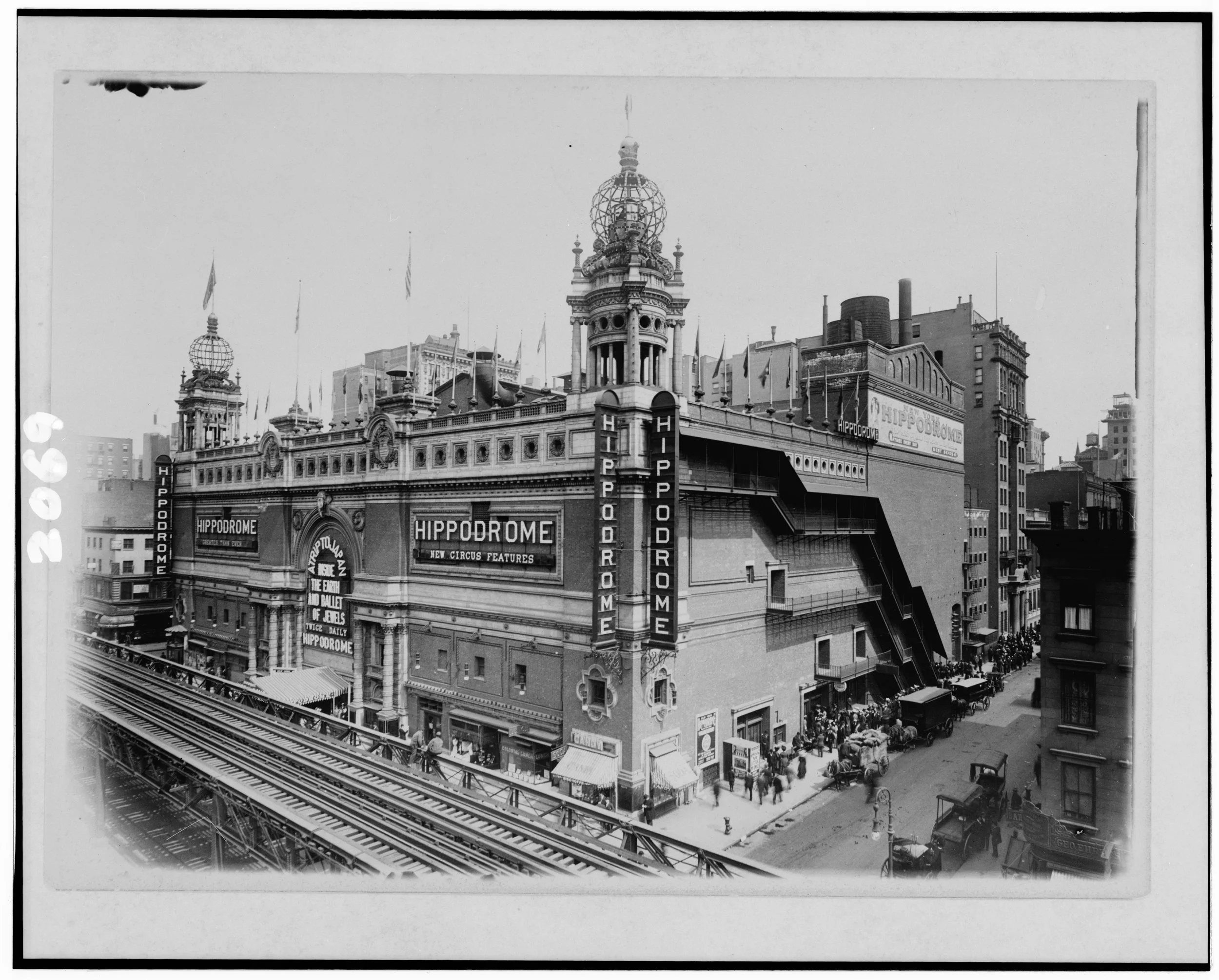
Sixth Avenue and the Hippodrome, about 1910. Photo: F.H. Tucker; Library of Congress.
The owner of the block, City Bank Farmers Trust, did not wait. At the end of June 1939, it told its tenants that their leases would not be renewed and that they had to be out before September 1.
The bank said it planned to put up “a modest group of ‘taxpayer’ stores”: cheap, low buildings meant to earn enough to cover the property taxes until something better came along.¹³
The New York Sun ran a seven-stanza poem in the theater’s memory.¹³ On August 14, salvagers began stripping the fixtures. The boxing promoter Mike Jacobs, the last tenant, had reportedly already carried off the marble fireplace from the ladies’ powder room.¹³ On August 16, 1939, the Hippodrome closed for good, and the wrecking began.
By the end of the year the world’s largest theater was gone, and its block on Sixth Avenue was a vacant lot. With the war, it stayed one, growing weeds, until 1952.⁴,⁵
Then an office building and parking garage went up on the site. It is still there, at 1120 Avenue of the Americas, and its owners kept one thing from the old place. Over the entrance, in large letters, is the name: Hippodrome.⁴
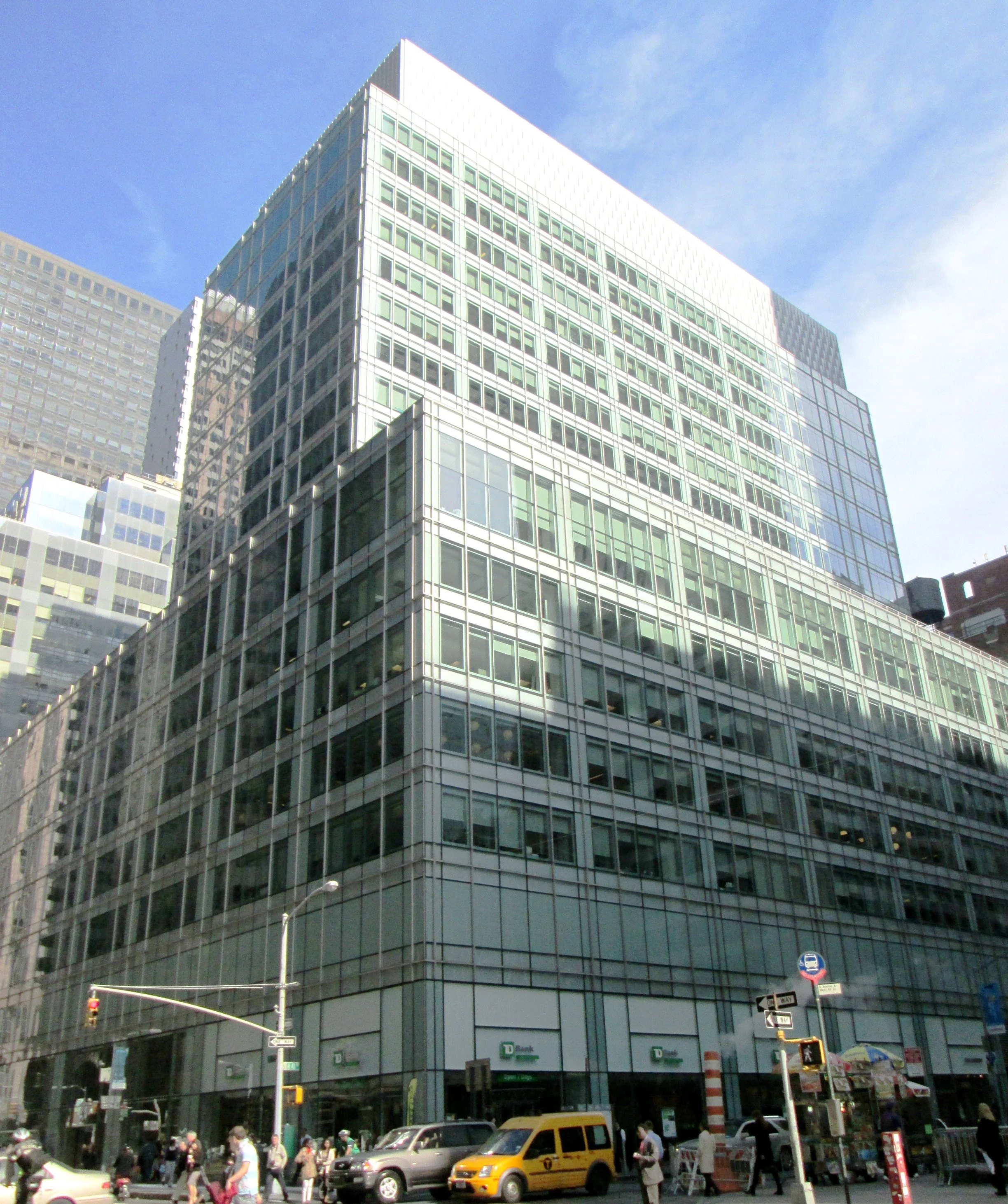
The Hippodrome Building, 1120 Avenue of the Americas, 2013. Photo: Beyond My Ken, CC BY-SA 4.0.
Did anyone in your family see a show at the Hippodrome, or keep a program or ticket stub? Tell us what they remembered.
Notes and Sources
Notes
Sunny Stalter-Pace, “Disappearing Mermaids: Staging White Women’s Mobility through Aquatic Performance at the New York Hippodrome,” Theatre Survey (Cambridge University Press). The “absolutely weird” quotation is from Nannette Flack and Leila Sherman, Singing Can Be Ecstasy (1965), 63, as cited in the article’s note 1. Flack was a soprano who recorded for Columbia and Victor in 1916–17 (Discography of American Historical Recordings). The programs for Good Times (1920) and Better Times (1922) followed the act’s listing with “Where do they go?” (article text; its note 2 cites Cast, New York, May 6, 1922, 35).
New York Clipper, February 1905 (block, 240 feet deep, materials, heights, 100-foot towers, ten-foot globes, 500 lights, 5,000-pound elephant’s head, restaurant and café). Banded columns and the promenade of animal cases: Christopher Gray, “Streetscapes,” New York Times, May 22, 2005, as quoted on Cinema Treasures; also Princeton University Graphic Arts, “The Hippodrome.” East side of the avenue: Historic Districts Council, “Of Preservation and Parking Lots.”
Gray, “Streetscapes,” New York Times, May 22, 2005.
“The Lost 1905 New York Hippodrome,” Daytonian in Manhattan, April 2, 2012, drawing on Broadway Magazine (1905), the New York Times, and Success Magazine (1906): seat width, colors, one-acre dome, Thompson’s age and stage machinery, the box auction, 14,000 a day, $30,000 a week, the 1919 labor trouble and price cuts, the $7.5 million sale, and the vacant lot until 1952.
“New York Hippodrome,” Wikipedia, citing The Encyclopedia of New York City and Alice Sparberg Alexiou, The Flatiron (2010), 188–193: stage dimensions and capacity, the animal stalls, the opening-night prices and program, the Dillingham years, films from 1925, and Keith-Albee’s merger into RKO.
Stalter-Pace, “Disappearing Mermaids” (a tank that could be filled to a fourteen-foot depth). The 8,000-gallon figure in some sources is far too small for a tank of this size and is omitted.
Period explanation of the Neptune’s Daughter air chambers, reproduced in Sue Attalla, “Mystery Solved: How the Hippodrome Mermaids Survived Under Water.” Corroborated by the photograph of the bells in “Million Dollar Mermaid,” New Yorker State of Mind.
Sunny Stalter-Pace, “‘They’re Tearing Down the Hippodrome,’” Gotham Center for New York City History, citing “Thompson and Dundy’s Proposed Hippodrome,” New-York Tribune, July 3, 1904, 10.
“John Warne Gates,” Wikipedia; Britannica Money, “John Warne Gates”; Handbook of Texas, as quoted by Bandera Prophet (the 1900 bet: $70,000 wagered, $600,000 won; rumor inflated it to a million). Standard biography: Lloyd Wendt and Herman Kogan, Bet a Million! (1948).
Variety, January 1906. Trade-paper reporting; attributed.
John Kenrick, “Demolished Broadway Theatres,” Musicals101 (Gates and the Shuberts, 1906–1915); Variety, November 1906 (Shubert management). Wikipedia dates the Shubert acquisition to 1909; Variety, September 1906, speaks of Thompson and Dundy’s management in the past tense; Sue Attalla, “A Brief History of the New York Hippodrome,” says the Shuberts replaced them after A Society Circus disappointed Gates.
“The Vanishing Elephant,” Wild About Houdini (first performed January 7, 1918).
Stalter-Pace, “They’re Tearing Down the Hippodrome,” and the newspapers it cites: New York Times, Feb. 22, 1923; Variety, July 19, 1923; New York Times, Apr. 23, 1925; New York Times, Dec. 16, 1929; Variety, Sept. 6, 1932; New York Times, May 29, 1936; Ernest La France, “Rebirth of an Avenue,” New York Times Magazine, Mar. 19, 1939; New York Times, July 1, 1939; H.I. Phillips, New York Sun, July 14, 1939; New York Times, Aug. 15, 1939; Alva Johnston, New Yorker, Oct. 5, 1946. The “taxpayer” quotation is from “Famed Hippodrome to Be Demolished,” New York Times, July 1, 1939, 19, per Stalter-Pace’s note 23; the same note cites Christopher Gray, New York Times, Aug. 29, 2004, for what a “taxpayer” building is. The Chicago Tribune headline of July 9, 1939, reports the same plan. The original July 1 Times text has not been seen directly.
“Jumbo (musical),” Wikipedia; “JUMBO: the SPIDER-MAN of 1935,” Musical Cyberspace (the big-top conversion).
Peter Filichia, “Jumbo and More,” TheaterMania (Rose’s $35,000 in seed money and Whitney’s $280,000); “Jumbo Fire Chief Show,” Vintage Radio Shows (total of $340,000, a record for a Broadway musical, with the same two figures). Some accounts give the cost as $350,000. Rose said Jumbo “will either make me or break Jock Whitney” (Time).
Internet Broadway Database, Jumbo (1935).
Bureau of Labor Statistics Consumer Price Index, via Official Data ($1 in 1905 = about $38 in 2026). Rounded.
“Roxy Theatre (New York City),” Wikipedia (opened March 11, 1927, 50th Street between Sixth and Seventh Avenues, 5,920 seats); the “Cathedral of the Motion Picture” line is from its New York Times advertisement, March 6, 1927, per Barry Popik.
The Jazz Singer opened at the Warner Theatre on Broadway on October 6, 1927. Vaudeville’s decline: Encyclopaedia Britannica, “Vaudeville” (after the talkies arrived about 1927, the usual bill became a feature film with “added acts” of vaudeville; the Depression and radio then sped its decline).
“John Hay Whitney,” Wikipedia; National Museum of Racing Hall of Fame, “John Hay ‘Jock’ Whitney” (principal financier of Gone with the Wind); Daily Racing Form (family fortune “amassed from oil, railroads, and tobacco”).
“Elmer ‘Skip’ Dundy,” Wikipedia (died February 5, 1907, aged 44); “Frederic Thompson,” Wikipedia (bankrupt 1912); “Coney Island: People,” American Experience, PBS (Luna Park given over to creditors).
References
Primary and period sources
- Cast (New York), vol. 83, no. 826, May 6, 1922, 35. Cited in Stalter-Pace, “Disappearing Mermaids.”
- Chicago Tribune. “Raze Old Hippodrome Theater in New York; Will Build ‘Taxpayer.’” July 9, 1939.
- Flack, Nannette, and Leila Sherman. Singing Can Be Ecstasy: An Instruction Digest for Singers with Recollections of Days in the Theatre. New York: Exposition Press, 1965. Cited in Stalter-Pace, “Disappearing Mermaids.”
- Johnston, Alva. “Profiles: Vaudeville to Television—II.” New Yorker, October 5, 1946.
- La France, Ernest. “Rebirth of an Avenue.” New York Times Magazine, March 19, 1939.
- New York Clipper, February 1905. Media History Digital Library. https://lantern.mediahist.org/catalog/clipper52-1905-02_1982
- New York Sun. H.I. Phillips, “The Sun Dial,” July 14, 1939.
- New York Times. February 22, 1923; April 23, 1925; December 16, 1929; May 29, 1936; August 15, 1939.
- New York Times. Roxy Theatre advertisement, March 6, 1927.
- New York Times. “Famed Hippodrome to Be Demolished: City Landmark to Be Torn Down.” July 1, 1939, 19.
- New-York Tribune. “Thompson and Dundy’s Proposed Hippodrome.” July 3, 1904, 10.
- Variety, January 1906. https://lantern.mediahist.org/catalog/variety01-1906-01_0033
- Variety, September 1906. https://lantern.mediahist.org/catalog/variety04-1906-09_0001
- Variety, November 1906. https://lantern.mediahist.org/catalog/variety04-1906-11_0001
- Variety, July 19, 1923; September 6, 1932.
Books and scholarship
- Alexiou, Alice Sparberg. The Flatiron. New York: Thomas Dunne Books, 2010.
- Jackson, Kenneth T., ed. The Encyclopedia of New York City. 2nd ed. New Haven: Yale University Press, 2010. “Hippodrome,” 597–598.
- Stalter-Pace, Sunny. “Disappearing Mermaids: Staging White Women’s Mobility through Aquatic Performance at the New York Hippodrome.” Theatre Survey (Cambridge University Press). https://www.cambridge.org/core/product/C953ED08BBC4AFE0E21F5210FC7612AC/core-reader
- Stalter-Pace, Sunny. “‘They’re Tearing Down the Hippodrome’: A History of the Theater’s Demolition.” Gotham Center for New York City History. https://www.gothamcenter.org/blog/hippodrome-zy4la-6h6h4-tlwga-allfs-5gpbn-p8hkk-gewm2-86weg-453lp
- Wendt, Lloyd, and Herman Kogan. Bet a Million! The Story of John W. Gates. Indianapolis: Bobbs-Merrill, 1948.
Newspaper and magazine articles
- Filichia, Peter. “Jumbo and More.” TheaterMania. https://www.theatermania.com/news/jumbo-and-more_2711/
- Gray, Christopher. “Streetscapes/Manhattan; From Deep in the Depression, Three Low-Rise Corners.” New York Times, August 29, 2004. https://www.nytimes.com/2004/08/29/realestate/streetscapes-manhattan-from-deep-in-the-depression-three-low-rise-corners.html
- Gray, Christopher. “Streetscapes: From a Palace of Spectacles to an Edifice of Offices.” New York Times, May 22, 2005. As quoted on Cinema Treasures, https://cinematreasures.org/theaters/534/comments
- Time. “World: Eleanor’s Show.” https://content.time.com/time/subscriber/article/0,33009,762478-4,00.html
Reference works and databases
- Bureau of Labor Statistics Consumer Price Index, via Official Data (Alioth Finance). https://officialdata.org/us/inflation/1905?amount=1
- Discography of American Historical Recordings. “Flack, Nannette.” UC Santa Barbara Library. https://adp.library.ucsb.edu/names/111322
- Encyclopaedia Britannica. “Vaudeville.” https://www.britannica.com/art/vaudeville
- Britannica Money. “John Warne Gates.” https://www.britannica.com/money/John-Warne-Gates
- Handbook of Texas, “Gates, John Warne,” as quoted by Bandera Prophet. https://www.banderaprophet.com/220809todayintexashistory.html
- Internet Broadway Database. Jumbo (1935). https://www.ibdb.com/broadway-production/12024
- National Museum of Racing Hall of Fame. “John Hay ‘Jock’ Whitney.” https://racingmuseum.org/node/113
- PBS American Experience. “Coney Island: People.” https://www.pbs.org/wgbh/americanexperience/features/coney-people
- Wikipedia. “Elmer ‘Skip’ Dundy.” https://en.wikipedia.org/wiki/Elmer_%22Skip%22_Dundy
- Wikipedia. “Frederic Thompson.” https://en.wikipedia.org/wiki/Frederic_Thompson
- Wikipedia. “John Hay Whitney.” https://en.wikipedia.org/wiki/John_Hay_Whitney
- Wikipedia. “John Warne Gates.” https://en.wikipedia.org/wiki/John_Warne_Gates
- Wikipedia. “Jumbo (musical).” https://en.wikipedia.org/wiki/Jumbo_(musical)
- Wikipedia. “New York Hippodrome.” https://en.wikipedia.org/wiki/New_York_Hippodrome
- Wikipedia. “Roxy Theatre (New York City).” https://en.wikipedia.org/wiki/Roxy_Theatre_(New_York_City)
Websites and blogs
- Attalla, Sue. “A Brief History of the New York Hippodrome.” https://www.sueattalla.com/hippodrome-background–ohares-first-tunes.html
- Attalla, Sue. “Mystery Solved: How the Hippodrome Mermaids Survived Under Water.” https://www.sueattalla.com/blog/mystery-solved-how-the-hippodrome-mermaids-survived-under-water
- Historic Districts Council. “Of Preservation and Parking Lots.” https://hdc.org/?p=2375
- Daily Racing Form. Hall of Fame article on John Hay Whitney. https://www.drf.com/news/hall-fame-whitney-built-stable-fortune
- Daytonian in Manhattan. “The Lost 1905 New York Hippodrome.” April 2, 2012. https://daytoninmanhattan.blogspot.com/2012/04/lost-1905-new-york-hippodrome-6th.html
- Kenrick, John. “Demolished Broadway Theatres.” Musicals101. https://mail.musicals101.com/bwaypast3b.htm
- Musical Cyberspace. “JUMBO: the SPIDER-MAN of 1935.” January 24, 2011. https://musicalcyberspace.com/2011/01/24/jumbo-the-spider-man-of-1935/
- New Yorker State of Mind. “Million Dollar Mermaid.” https://newyorkerstateofmind.com/tag/hippodrome/
- Popik, Barry. Entry on “Cathedral of the Motion Picture” (Roxy Theatre). https://barrypopik.com/blog/cathedralof_the_motion_picture_roxy_theater
- Princeton University Graphic Arts. “The Hippodrome.” February 10, 2014. https://graphicarts.princeton.edu/2014/02/10/the-hippodrome
- Vintage Radio Shows. “Jumbo Fire Chief Show.” https://vintageradioshows.com/shows/jumbo-fire-chief-show
- Wild About Houdini. “The Vanishing Elephant.” https://wildabouthoudini.com/p/the-vanishing-elephant.html