The Express
New York spent a fortune to become the permanent US capital, and was still building a mansion for the President when Congress voted to leave.
The man who traded the capital away was a New Yorker, desperate to save his plan for the country’s debts.
Only one man at the negotiation table wrote down what happened, and he left something out.
Half an hour on Broadway
One day in June 1790, Thomas Jefferson was walking to the President’s house on lower Broadway when Alexander Hamilton stopped him at the door.
Jefferson wrote later that Hamilton’s look was “sombre, haggard, and dejected beyond description. Even his dress uncouth and neglected.”1
Hamilton had reason to look that way. His plan to put the new nation’s finances in order had stalled in Congress; in April the House voted it down.2 At its center was “assumption”: the federal government would take over the Revolutionary War debts the states still owed and pay them in full. Without it, Hamilton believed, the union could come apart. If he could not get it passed, he told Jefferson, he would resign his post as Secretary of the Treasury.1
For half an hour, Jefferson recalled years later, Hamilton “walked me backwards and forwards before the President’s door,” making his case.3
Jefferson had been in New York only three months. He had come home from five years as the American Minister to France to find himself Secretary of State, and he said he had not yet studied the fight.1 What he offered was dinner. He would bring Hamilton together with his fellow Virginian James Madison, who led the opposition in the House, at the residence he rented on Maiden Lane.
New York did not know it yet, but the conversation on that sidewalk was the beginning of the end of its run as the capital of the United States.
A city building for keeps
New York had been the capital since 1785, when the old Confederation Congress moved into City Hall on Wall Street.4 When the new Constitution took effect in 1789, the city meant to keep the title.
It paid for the chance. Private citizens and the city government put up about $65,000 to turn the ninety-year-old City Hall into Federal Hall, a showpiece designed by the French-born engineer Pierre L’Enfant.5 On its balcony, on April 30, 1789, George Washington took the oath as the first President.6
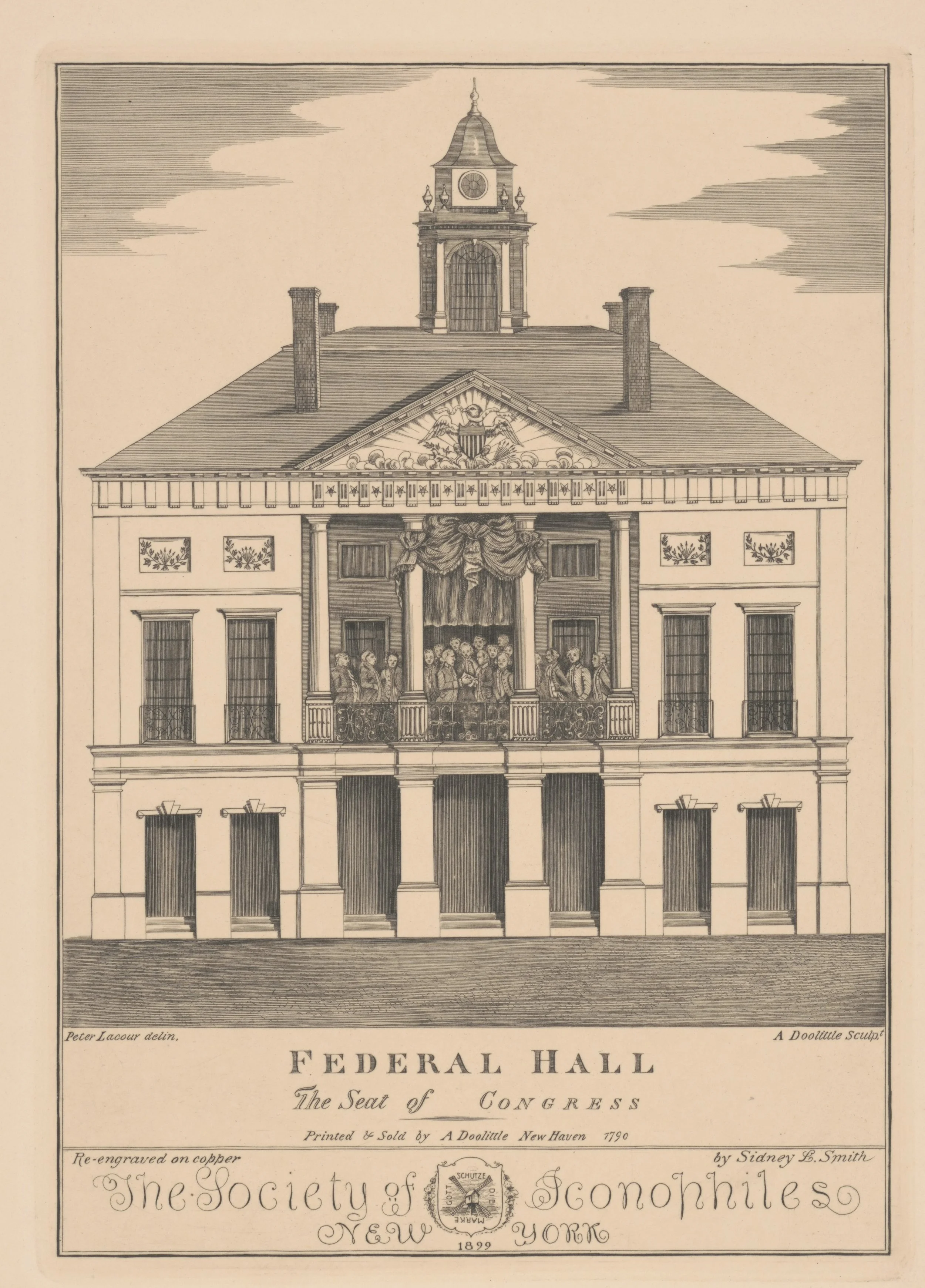
Federal Hall, “The Seat of Congress” (1790). Amos Doolittle’s engraving, made from a drawing by Peter Lacour, shows Washington taking the oath on the balcony. It shows the building New York spent $65,000 to remake.
Washington lived first in a rented house on Cherry Street, then moved in February 1790 to a larger one at 39 Broadway, owned by the merchant Alexander Macomb.7 Neither was meant to last. The state legislature had voted to tear down the old fort at the foot of Broadway and build a proper house for the President. On May 21, 1790, its cornerstone was laid, facing Bowling Green.8
New York was building for keeps. Congress was not so sure. Sixteen sites had been suggested for the permanent capital. Pennsylvania wanted it back in Philadelphia. Virginians wanted it on the Potomac, close to home.2
To many in the South, New York was the wrong place. The debts were IOUs. During the war, Congress and the states had paid soldiers and farmers in paper certificates, promises to pay later. With no money behind them, many holders, veterans among them, sold the paper for a fraction of its value.
By 1790 much of it sat with speculators in Northern cities, and Hamilton’s plan would pay them in full.9 Hamilton’s critics saw the holders as a corrupt urban elite who would use their money to buy influence in Congress.2 A capital in New York put the government a few blocks from them.
Distance mattered too, more than it does now. It had taken Washington seven days on the road to come up from Mount Vernon for his inauguration.10 Members from the Carolinas and Georgia traveled farther still. In an age of horses and sailing packets, whoever lived near the capital had the government’s ear. They could call on a congressman any evening, read the debates first in their own newspapers, and fill the House gallery.
That is why the location mattered so much to Jefferson and Madison. As they saw it, Hamilton’s plan would bind the new government to the men who held its debt. Leave the capital in New York, beside those men and their money, and the two would grow together.
Move it south to the Potomac, close to Virginia and far from New York’s merchants and brokers, and the South might keep its hand on a government Hamilton’s plan was about to make strong. For Madison, who had fought assumption as unjust, that was a prize worth giving ground for.11
Dinner on Maiden Lane
Jefferson’s dinner took place on or about June 20, at 57 Maiden Lane.12
Only Jefferson left an account of the evening. He first wrote it down about two years later, after he had turned against Hamilton. By his telling, the terms were simple. Madison would not vote for assumption, but he would stop fighting it hard and let it pass.
Because the measure would be a bitter pill for the South, something had to sweeten it. The sweetener was the capital. It would go to Philadelphia for ten years, then to a new federal district on the Potomac.1
The votes followed. On July 9, the House passed the Residence Act, putting the capital on the Potomac after a decade in Philadelphia. Washington signed it a week later. On July 26, a handful of members from the Potomac states changed their votes, and assumption passed the House.13
Hamilton had come to New York from the West Indies as a teenager, studied at King’s College, married into the Schuyler family, and built his law practice in the city. He had saved his plan. The price was his own city’s place at the center of the government.
Who really carried the capital
That is the story Jefferson told, and the one most people know. The record is more complicated.
Philadelphia’s ten years had been in play before the dinner, as Pennsylvania’s delegation bargained with Virginia’s. Historians have argued that by the night at Maiden Lane, Madison already had the votes to win the capital, and that Hamilton mainly helped the bill along.
What Virginia gained that evening, and Jefferson’s account leaves out, was a change in the assumption terms that cut its obligations by about $1.5 million, a large sum at the time.14
Jefferson came to regret the bargain. By 1792 he believed assumption had given Hamilton the power to push through the rest of his program, including a national bank, with the help of congressmen who held the new bonds. He told Washington he had been “duped” by the Secretary of the Treasury and made “a tool for forwarding his schemes.”15
No notice at nine o’clock
Congress finished its business in New York that August. Washington left on August 30.
He had asked that his departure not be announced. A little after nine that morning, he and Martha left the house on Broadway. At ten they took their leave at Macomb’s Wharf, with Governor George Clinton, Chief Justice John Jay, the heads of the departments, and the city corporation.
Thirteen cannon fired from the Battery. The President’s barge, rowed by thirteen men in white jackets and black caps, carried them across the North River to Paulus Hook. Alexander Hamilton rode in it.16
The request for no fanfare did not hold. A North Carolina man who was there wrote that vast crowds of citizens came to pay their last respects. Washington never returned to the city.16
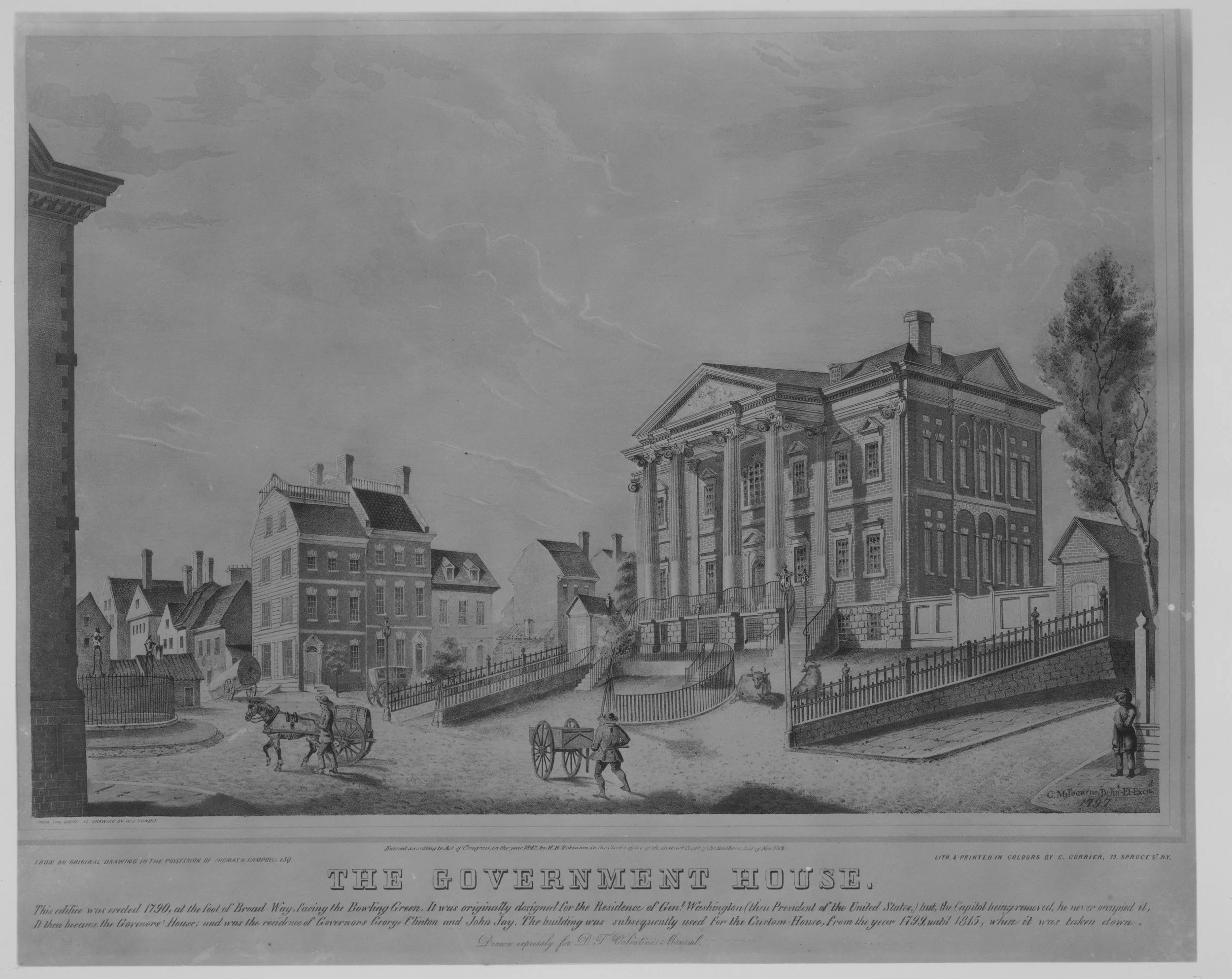
The Government House intended to be the Presidential residence in Manhattan. Washington never lived there. Drawing by W. J. Condit shows the mansion facing Bowling Green. Approximate current day location of the Alexander Hamilton Customs House.
At the foot of Broadway, the mansion meant for him went up anyway. The city fathers pressed ahead in the hope that Philadelphia would not work out. Washington never lived in Government House. It served as the governor’s residence and was torn down in 1815. Federal Hall went back to the city. In 1812, the building New Yorkers had spent $65,000 to remodel was sold for $425 and demolished.17
What New York kept
New York had lost the government. It had not lost what the government was about to create.
Hamilton’s plan took effect within months. The old war debts were refinanced as new federal bonds, and those bonds, along with bank stocks, became the stock in trade of New York’s first brokers. They dealt in them on Wall Street, down the block from Federal Hall.
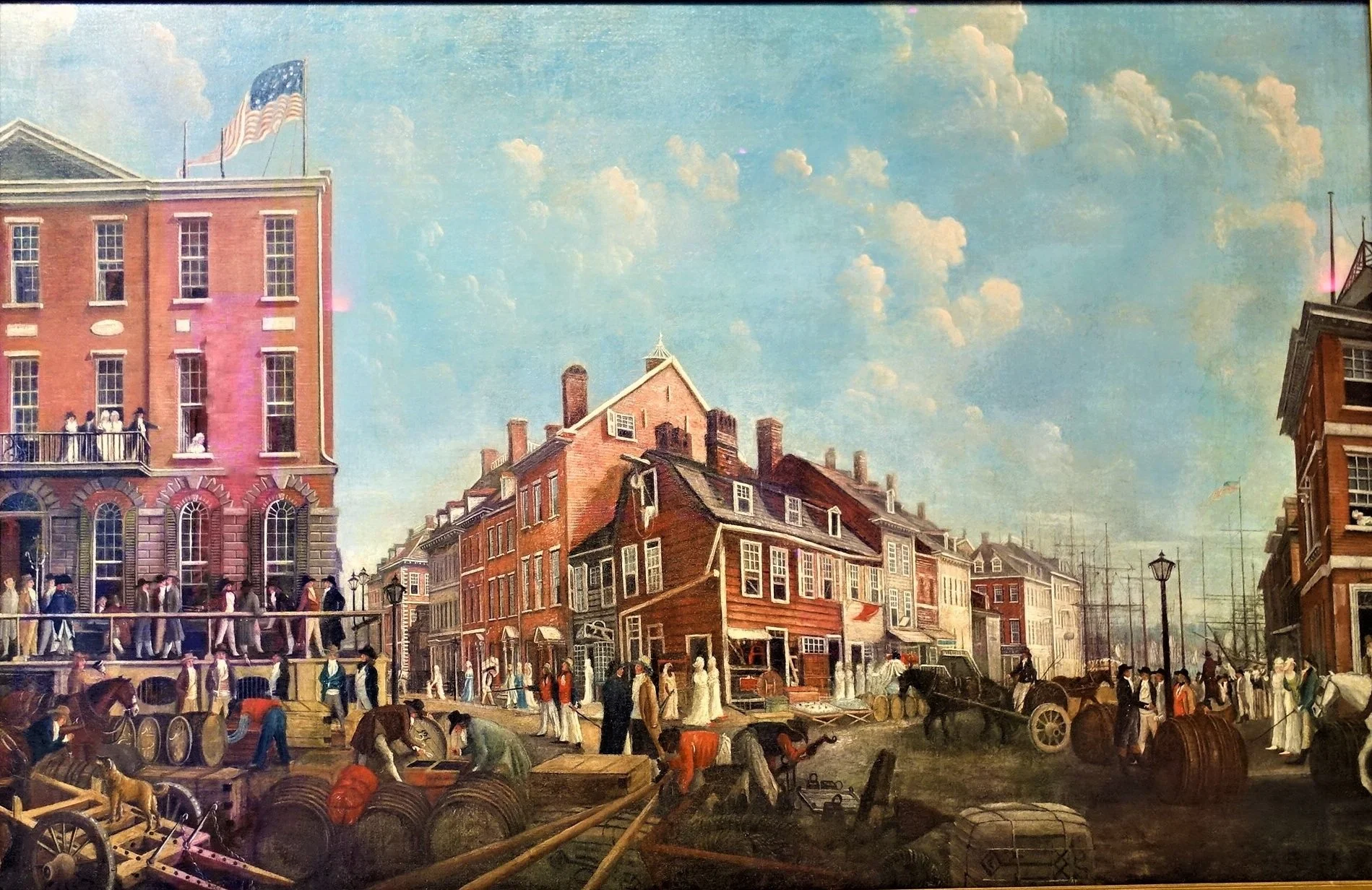
Wall Street about 1797. The brokers who signed the Buttonwood Agreement moved their trading into the Tontine Coffee House (left) when it opened in 1793. Francis Guy, Tontine Coffee House, N.Y.C., c. 1797. New-York Historical Society. Photo: Joy of Museums, CC BY-SA 4.0 (cropped, color-corrected)
In the spring of 1792, the new market had its first panic. On May 17, twenty-four brokers and merchants signed a short agreement fixing their commissions and promising to give one another preference in their dealings. It took its name from the buttonwood tree on Wall Street where they had traded. The New York Stock Exchange dates its founding to that day.18
One New Yorker saw the city’s future early. In January 1791, a writer calling himself “A New York Farmer” argued in the New York Magazine that being the capital was worth little next to what a canal across the state would bring.19 The Erie Canal opened thirty-four years later.
The government went south. The money stayed.
Today Federal Hall National Memorial, the customs house built on the site in 1842, stands across Wall Street from the Stock Exchange. On Maiden Lane, a plaque marks where Jefferson’s house stood, a short walk from the Federal Reserve Bank of New York.20
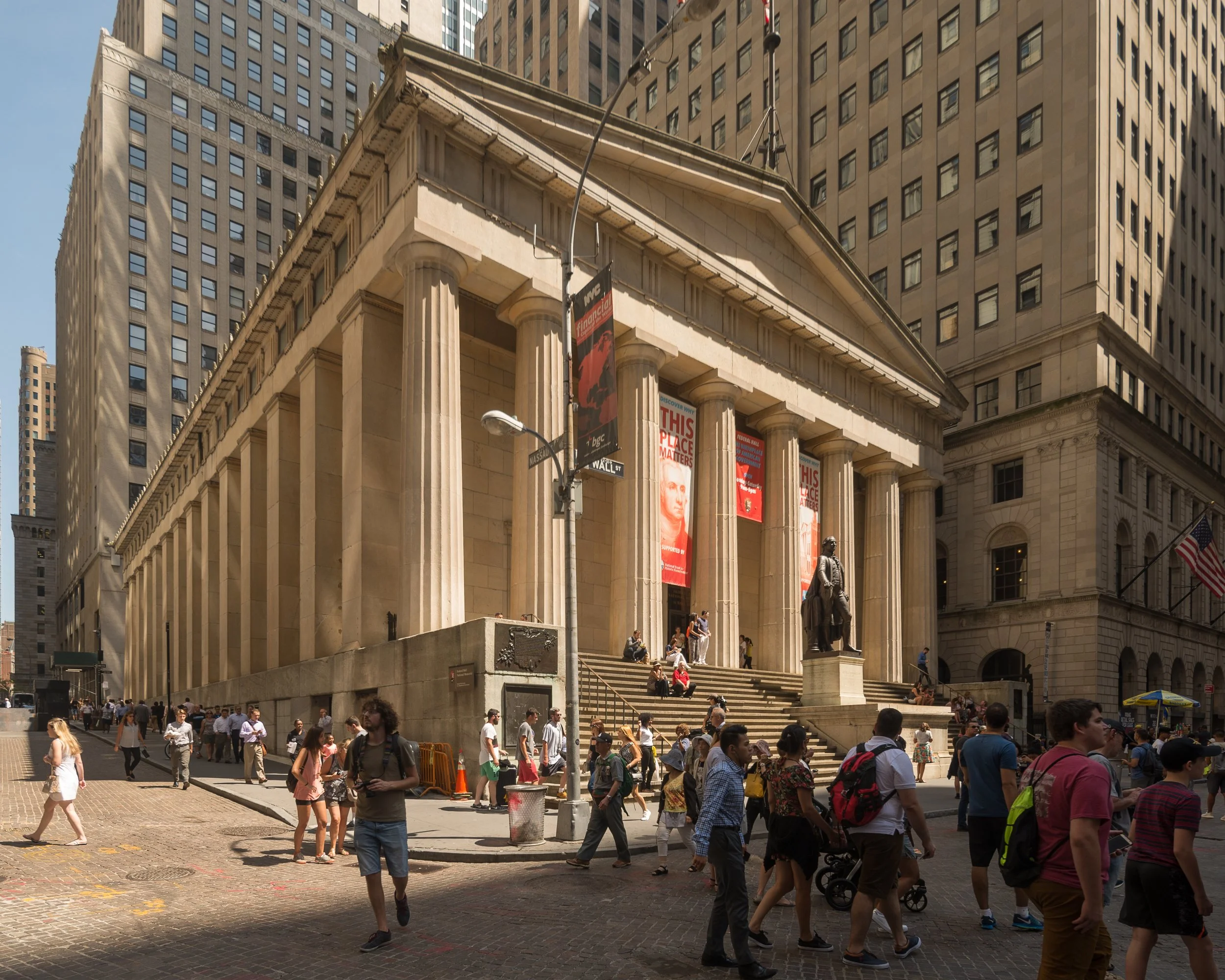
Federal Hall National Memorial, Wall Street, 2017. Photo: Arild Vågen, CC BY-SA 4.0. Corner of Wall Street and Nassau.
Have you found the Jefferson plaque on Maiden Lane, or stood on the steps of Federal Hall? Tell us what you noticed, or which lost New York building you would most like to see again.

Notes
1. Thomas Jefferson, “Jefferson’s Account of the Bargain on the Assumption and Residence Bills,” [1792?], in The Papers of Thomas Jefferson, vol. 17, Founders Online, https://founders.archives.gov/documents/Jefferson/01-17-02-0018-0012. The editors date it to 1792. Quotation as transcribed in Lance Banning, ed., Liberty and Order: The First American Party Struggle (Indianapolis: Liberty Fund, 2004), https://oll.libertyfund.org/page/1790-jefferson-memorandum-on-the-compromise-of-1790.
2. “The Dinner Table Bargain, June 1790,” American Experience, PBS, https://www.pbs.org/wgbh/americanexperience/features/hamilton-dinner-table-bargain-june-1790.
3. Thomas Jefferson, “Explanations of the Three Volumes Bound in Marbled Paper (the so-called ‘Anas’),” February 4, 1818, in The Papers of Thomas Jefferson, Retirement Series, vol. 12, Founders Online, https://founders.archives.gov/documents/Jefferson/03-12-02-0343-0002. This is Jefferson’s second, later telling, written twenty-eight years after the event.
4. Kenneth T. Jackson, ed., The Encyclopedia of New York City, 2nd ed. (New Haven: Yale University Press, 2010), s.v. “Congress” (p. 303) and “capital, federal” (p. 202).
5. National Park Service, “History & Culture,” Federal Hall National Memorial, https://www.nps.gov/feha/learn/hc.htm; “Federal Hall,” Wikipedia, https://en.wikipedia.org/wiki/Federal_Hall (source of the $65,000 figure, paid by private citizens and the city). Other sources give $60,000, or $32,000 raised by subscription.
6. “Presidential Residency in New York,” George Washington’s Mount Vernon, Digital Encyclopedia, https://www.mountvernon.org/library/digitalhistory/digital-encyclopedia/article/presidential-residency-in-new-york/.
7. “Presidential Residency in New York”; “Alexander Macomb House,” Wikipedia, https://en.wikipedia.org/wiki/Alexander_Macomb_House.
8. “Government House (New York City),” Wikipedia, https://en.wikipedia.org/wiki/Government_House_(New_York_City), citing Stokes, Iconography of Manhattan Island, 5:1267; “The Lost Government House,” Daytonian in Manhattan, June 2015, https://daytoninmanhattan.blogspot.com/2015/06/the-lost-government-house-broadway-at.html.
9. On the certificates and their sale at a discount, see “First Report on the Public Credit,” Wikipedia, https://en.wikipedia.org/wiki/Report_on_Public_Credit, and E. James Ferguson, The Power of the Purse: A History of American Public Finance, 1776–1790 (Chapel Hill: University of North Carolina Press, 1961). Ferguson is the standard work.
10. “President-Elect George Washington’s Journey to the Inauguration,” George Washington’s Mount Vernon, https://www.mountvernon.org/george-washington/the-first-president/inauguration. He left Mount Vernon April 16, 1789, and reached New York April 23.
11. Interpretation, drawn from “Dinner Table Bargain,” PBS (Madison’s fear of Virginia’s loss of influence; Southern views of debt holders), and Kenneth R. Bowling, The Creation of Washington, D.C.: The Idea and Location of the American Capital (Fairfax, VA: George Mason University Press, 1991).
12. Mary Tao, “Historical Echoes: Thomas Jefferson Slept Here on Maiden Lane/The Compromise of 1790,” Liberty Street Economics, Federal Reserve Bank of New York, February 21, 2014, https://libertystreeteconomics.newyorkfed.org/?p=908; editorial note to Josiah Parker to James Madison, [ca. 15 June] 1790, The Papers of James Madison, vol. 13, Founders Online, https://founders.archives.gov/documents/Madison/01-13-02-0173 (“sometime around 20 June”).
13. “Residence Act,” Wikipedia, https://en.wikipedia.org/wiki/Residence_Act (House passage July 9, signed July 16, 1790); editorial note, Papers of James Madison, vol. 13 (assumption passed the House July 26); “Dinner Table Bargain,” PBS (four representatives from states bordering the Potomac changed their votes).
14. “Dinner Table Bargain,” PBS; editorial note, Papers of James Madison, vol. 13. The scholarly debate: Jacob E. Cooke, “The Compromise of 1790,” William and Mary Quarterly 27 (October 1970): 523–45; Kenneth R. Bowling, “Dinner at Jefferson’s: A Note on Jacob E. Cooke’s ‘The Compromise of 1790,’” William and Mary Quarterly 28 (October 1971): 629–48.
15. Thomas Jefferson to George Washington, September 9, 1792, Teaching American History, https://teachingamericanhistory.org/document/letter-to-george-washington-4/; also in The Papers of George Washington, Presidential Series, vol. 11, Founders Online, https://founders.archives.gov/documents/Washington/05-11-02-0049. For Jefferson’s view that assumption gave Hamilton the leverage to pass the national bank and built a speculating faction in Congress, see Jefferson, “Account of the Bargain.”
16. Editorial note to George Washington to Thomas Randall, August 30, 1790, The Papers of George Washington, Presidential Series, vol. 6, Founders Online, https://founders.archives.gov/documents/Washington/05-06-02-0182, citing the New-York Journal, the New-York Daily Gazette, and the Gazette of the United States, August 31 and September 1, 1790. The account of the crowds is from Abishai Thomas of North Carolina, quoted in the same note.
17. “Lost Government House,” Daytonian in Manhattan; “Government House (New York City),” Wikipedia; “Federal Hall,” Wikipedia (sale for $425 in 1812).
18. “Buttonwood Agreement,” Wikipedia, https://en.wikipedia.org/wiki/Buttonwood_Agreement; “History of NYSE,” New York Stock Exchange, https://www.nyse.com/history-of-nyse; Howard M. Wachtel, “Alexander Hamilton and the Origins of Wall Street,” working paper, American University, https://econwpa.ub.uni-muenchen.de/econ-wp/eh/papers/9610/9610001.html.
19. “A New York Farmer,” New York Magazine, January 1791, as described in “Locating the United States Capital,” First Federal Congress Project.
20. National Park Service, “History & Culture,” Federal Hall; Tao, “Thomas Jefferson Slept Here.”