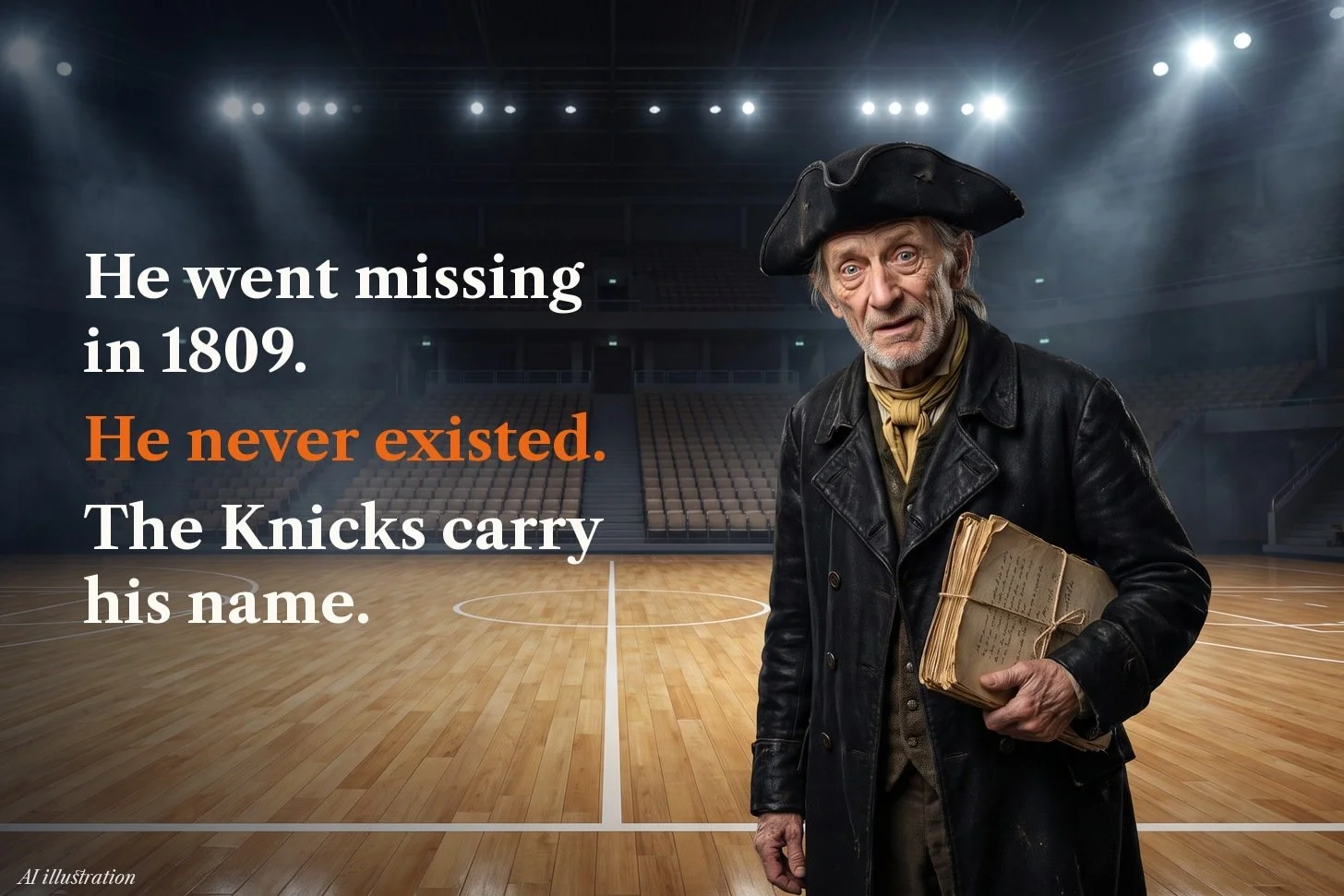
The Express
On October 26, 1809, the Evening Post asked readers for help finding a confused old man in a cocked hat who had vanished from his lodgings.
A traveler reported seeing him by the Albany Road. Then his landlord threatened to sell the strange manuscript he had left behind to cover the rent.
The old man’s name was Knickerbocker. Two hundred years later it is printed on every Knicks jersey.
On Thursday, October 26, 1809, readers of the New York Evening Post found a short notice under a one-word heading: “DISTRESSING.”1
It reported that a small elderly gentleman, “dressed in an old black coat and cocked hat,” had left his lodgings some time before and had not been heard from since. His name was Knickerbocker. There was reason to believe he was “not entirely in his right mind,” and his friends were anxious. Anyone with information was asked to leave it at the Columbian Hotel on Mulberry Street, or at the newspaper’s office.1
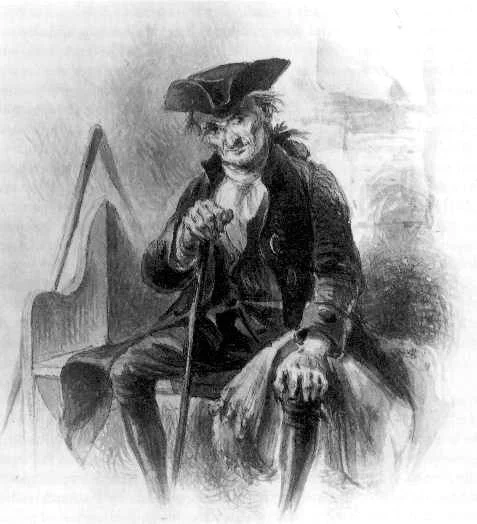
Diedrich Knickerbocker, Irving’s invented historian, as illustrator F.O.C. Darley imagined him for the 1849 edition of A History of New-York.
A postscript asked other papers to reprint the notice. Printers, it said, “will be aiding the cause of humanity.”1 Over the next few days the notice ran in several city newspapers.2
Nobody seemed to know who Mr. Knickerbocker was.
A sighting on the Albany Road
Eleven days later, on November 6, the Post printed a letter from a reader who identified himself as “A Traveller.”1
He had seen the paragraph about the missing gentleman. If it would relieve his friends, he wrote, they should know that passengers on the Albany stage had seen a man matching the description four or five weeks earlier, early in the morning, resting by the side of the road a little above King’s Bridge.1 That was the crossing at the top of Manhattan, where the post road left the island and headed north. The old man had a small bundle tied in a red bandana handkerchief. He seemed to be traveling northward, and he looked very fatigued and exhausted.3
So he had left the city. Where he was going, and why, the letter did not say.
New Yorkers talked about it, including those who suspected something was not quite right.2 According to later accounts, some city officials were concerned enough to consider offering a reward for the old man’s safe return.4
The landlord runs out of patience
On November 16 a third notice appeared. This one came from the man who said he kept the place where Knickerbocker had lived: Seth Handaside, landlord of the Independent Columbian Hotel, on Mulberry Street.1,5
Handaside reported that the old gentleman had left something behind in his room: “a very curious kind of a written book.” He also left an unpaid bill. If Mr. Knickerbocker did not return and settle his account, the landlord would have to dispose of the book to cover what he was owed.1,5
The deadline passed. Mr. Knickerbocker did not come back.
Before long, the city learned that the manuscript would be published. A further notice addressed rumors already going around: that Knickerbocker was not the true author of the book about to appear in his name, and even that he did not exist at all.3
Those rumors were true.
The man behind the notices
There was no Diedrich Knickerbocker, no landlord named Seth Handaside, and no traveler on the Albany stage. Every notice had been written by Washington Irving, a 26-year-old New Yorker who had been admitted to the bar and wrote on the side.2,6 He placed them in the Evening Post as paid notices.7 The paper sold him the space, and the city did the rest.
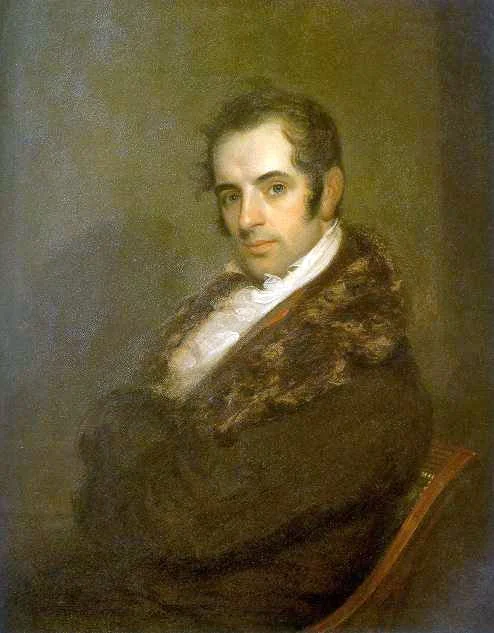
Washington Irving by Jarvis 1809
Irving was the youngest of eleven children of a Scottish-born merchant. He still lived with his mother on William Street.8,9 He had already had a taste of literary success: in 1807 he and two partners, his brother William and James Kirke Paulding, had produced Salmagundi, a series of satirical papers about New York society.10
The book in Knickerbocker’s room began as a joke between Washington and his brother Peter. They had started writing a full-length parody of New York history. Then two deaths stopped the project: their sister Ann in the spring of 1808, and Washington’s fiancée, Matilda Hoffman.7
Matilda was the daughter of Josiah Ogden Hoffman, the lawyer in whose office Irving had studied law.11 She fell ill with a cold in February 1809. It turned into consumption (early term for Tuberculosis), and she died on April 26, 1809, at the age of 17.12 Grief stopped Irving’s writing for a time.11 When he came back to it, he finished the book.11 He never married.9
That fall he needed readers. So he invented an author, made him disappear, and let the newspapers carry the story.
What was in the curious book
The book went on sale on December 6, 1809. It came in two volumes, priced at $3.2 The full title was long even by the standards of the day, beginning A History of New-York, from the Beginning of the World to the End of the Dutch Dynasty, and promising “the Unutterable Ponderings of Walter the Doubter, the Disastrous Projects of William the Testy, and the Chivalric Achievements of Peter the Headstrong.” The author was given as Diedrich Knickerbocker, Irving’s penname .13
It was a comic history of Dutch New Amsterdam, written as if by a fussy old antiquarian who starts his account at the creation of the world.11 It was an immediate success with critics and the public.6
Another Oddity – this one is real
Irving had taken the surname from a real family. Its founder, Harmen Jansen, a Dutch settler on the upper Hudson, had no fixed surname at all, as was normal for the Dutch at the time. Clerks called him Harmen, son of Jan, from Bommel, or tacked on other names; one count finds about eighteen versions in the records. On a 1682 contract he signed himself “van Wyekycbacke,” and the clerk on the same paper wrote “Kinne-ker-backer.” By the 1690s the records were calling him Knickerbacker.14,15,16
What the name meant is still argued over. The likeliest answer is knikkerbakker, “marble baker,” perhaps a nickname.16 Irving changed the spelling slightly for comic effect and made Diedrich a relation of the family.8 Diedrich offered his own explanation in the book. Some said it came from knicker, to shake, and beker, a goblet, because his ancestors had been “sturdy toss-pots of yore.” In truth, he explained, it came from knicker, to nod, and boeken, books, because they were “great nodders or dozers over books.”16 Both explanations were jokes.
A real-life Knickerbocker - a cousin in Congress
The most prominent Knickerbacker of the day was Herman, a lawyer from Schaghticoke, north of Albany. He was known as the “Prince of Schaghticoke” for the parties he gave on the family estate.17 In 1809, the year the hoax ran, he took his seat in Congress.17,18 Irving’s book mentioned Diedrich’s cousin, the congressman.19
Herman Knickerbocker is often said to have been Irving’s friend and the inspiration for the name. The dates suggest otherwise. Irving went to Washington in 1811 as a lobbyist for his brothers’ import business, and that is where he met the congressman.7,11 Herman had enjoyed the book, and the two became lifelong friends.7 Irving’s nephew later recalled his uncle saying that he had taken the old Dutch names at random, without intending to refer to anyone in particular.20
A family story says Irving once introduced Herman to President James Madison as “my cousin Diedrich Knickerbocker, the great historian of New York.”19 If it happened, the joke had come full circle: the real Knickerbocker was being introduced under the name of the invented one.
How the name came to mean New York
Irving later reprinted the 1809 notices at the front of the book, which left little doubt about who had written them.1,20
By 1831, “Knickerbocker” meant a descendant of the Dutch settlers of New York.21 A literary magazine called The Knickerbocker started in 1833.22 In 1845 Alexander Cartwright’s baseball club in Manhattan called itself the New York Knickerbockers.23 By 1859 “knickerbockers” meant a style of loose trousers gathered at the knee, named for their resemblance to the breeches worn by the old Dutchmen in George Cruikshank’s illustrations for Irving’s book.21 The trousers were named after the book, not the other way around. The Dutch colonists themselves were not called Knickerbockers until the early 1800s.24
In 1848 Irving looked back at what had happened. He found the book’s very name had become “a household word,” attached to Knickerbocker societies and Knickerbocker insurance companies, and New Yorkers of Dutch descent were priding themselves on being “genuine Knickerbockers.” He was pleased to think, he wrote, “that I have struck the right chord.”16
By the late nineteenth century, Father Knickerbocker, in a cotton wig, three-cornered hat, buckled shoes and knee breeches, was the city’s best-known symbol.23 The name went onto a hotel, a steamboat and a beer.7
An NBA franchise needed a name
In the summer of 1946, the new Basketball Association of America granted a franchise to Ned Irish, the president of Madison Square Garden.23,25 The team needed a name.
Years later, Fred Podesta, a longtime Garden executive, described how they found one. A publicity man for Ned Irish, named Lester Scott and a few others were sitting in the office one day. “We each put a name in the hat,” Podesta said, “and when we pulled them out, most of them said Knickerbockers, after Father Knickerbocker, the symbol of New York City.” It was soon shortened to Knicks.23
In June 2026, when the Knicks clinched their first championship in 53 years, the city celebrated a name that began as a fake missing-person notice.26 Nobody ever found the old man in the cocked hat. He was never there to find.
Author’s note. Two traces of this story survive. The Knickerbacker family’s mansion in Schaghticoke has been restored and is open to visitors.18 And in many editions of Irving’s book, the notices are still printed at the front, the way New Yorkers first read them in the fall of 1809. — Mark D. Schutzman
A question for readers. Does your family have anything with the Knickerbocker name on it: a beer tray, a hotel menu, an old magazine, an early Knicks program? Send a photo to mdschutzman@400stories.net.

References
1. Washington Irving, A History of New York, front matter, “Notices which appeared in the newspapers previous to the publication of this work” (Evening Post, October 26, November 6 and November 16, 1809), as reprinted at AmericanLiterature.com.
2. New York Society Library, “Frauds in the Stacks: Washington Irving, the Perfect Hoax?”
3. Kingsbridge Historical Society, “Knickerbocker Advertisements,” transcription of the 1809 Evening Post notices.
4. Wikipedia, “A History of New York.”
5. Mental Floss, “The Disappearance of Diedrich Knickerbocker: How Washington Irving’s Clever Hoax Named the New York Knicks.”
6. Christopher Benfey, “The Mysterious Mythmaker of New York,” New York Review of Books, April 29, 2010.
7. HistoryNet, “New York’s Other Moniker: Knickerbocker.”
8. Wikipedia, “Washington Irving.”
9. WikiTree, “Washington Irving (1783–1859).”
10. Wikipedia, “Knickerbocker Group.”
11. Encyclopaedia Britannica, “Washington Irving.”
12. Women History Blog, “Washington Irving’s One and Only Love.”
13. New York Society Library, “Overlooked Books: April Fool! Lies and Tricks from Irving, Poe, and Melville.”
14. Knickerbocker Family Genealogy (knic.com), “The Many Names of Harmen Janse,” Parts 1 and 2, January 2, 2018.
15. Wikipedia, “Harmen Jansen Knickerbocker.”
16. J. J. Lamberts, “Knickerbocker,” Names (American Name Society), pp. 70–74, quoting Irving’s History and his 1848 “Apology,” and the 1682 and c. 1697 records of Harmen Jansen’s name.
17. Wikipedia, “Herman Knickerbocker.”
18. Find a Grave, “Herman Jansen Knickerbocker” (1779–1855).
19. Knickerbocker Family Genealogy (knic.com), “Fifth Generation,” citing Appleton’s Cyclopaedia of American Biography, vol. 3, p. 562; Prabook, “Herman Knickerbocker.”
20. Mental Floss (as in note 5), citing Pierre Munroe Irving.
21. Online Etymology Dictionary, “Knickerbocker” and “knickers.”
22. History.com, Lesley Kennedy, “Knickerbocker: How a Fictional Character Named the Knicks.”
23. NBA.com, “The Knickerbocker Name,” quoting Fred Podesta.
24. Dutch Review, “Here’s How the New York Knicks Got Their Name from the Dutch.”
25. Wikipedia, “New York Knicks.”
26. NPR, “What’s in a name? The origin of the ‘Knick,’” June 14, 2026 (via WCMU).