The Express
Jim Fisk and Jay Gould printed 100,000 new shares of Erie Railroad stock to beat Cornelius Vanderbilt, then ran the railroad from an opera house on 23rd Street, with Boss Tweed’s judges on their side.
In 1871 the newspapers came for Tweed. Fisk’s mistress left him for his business partner, and his old love letters became a weapon.
On January 6, 1872, his former partner was waiting at the top of a hotel staircase on Broadway with a revolver. A bellboy testified he heard him say, “I’ve got you now.”
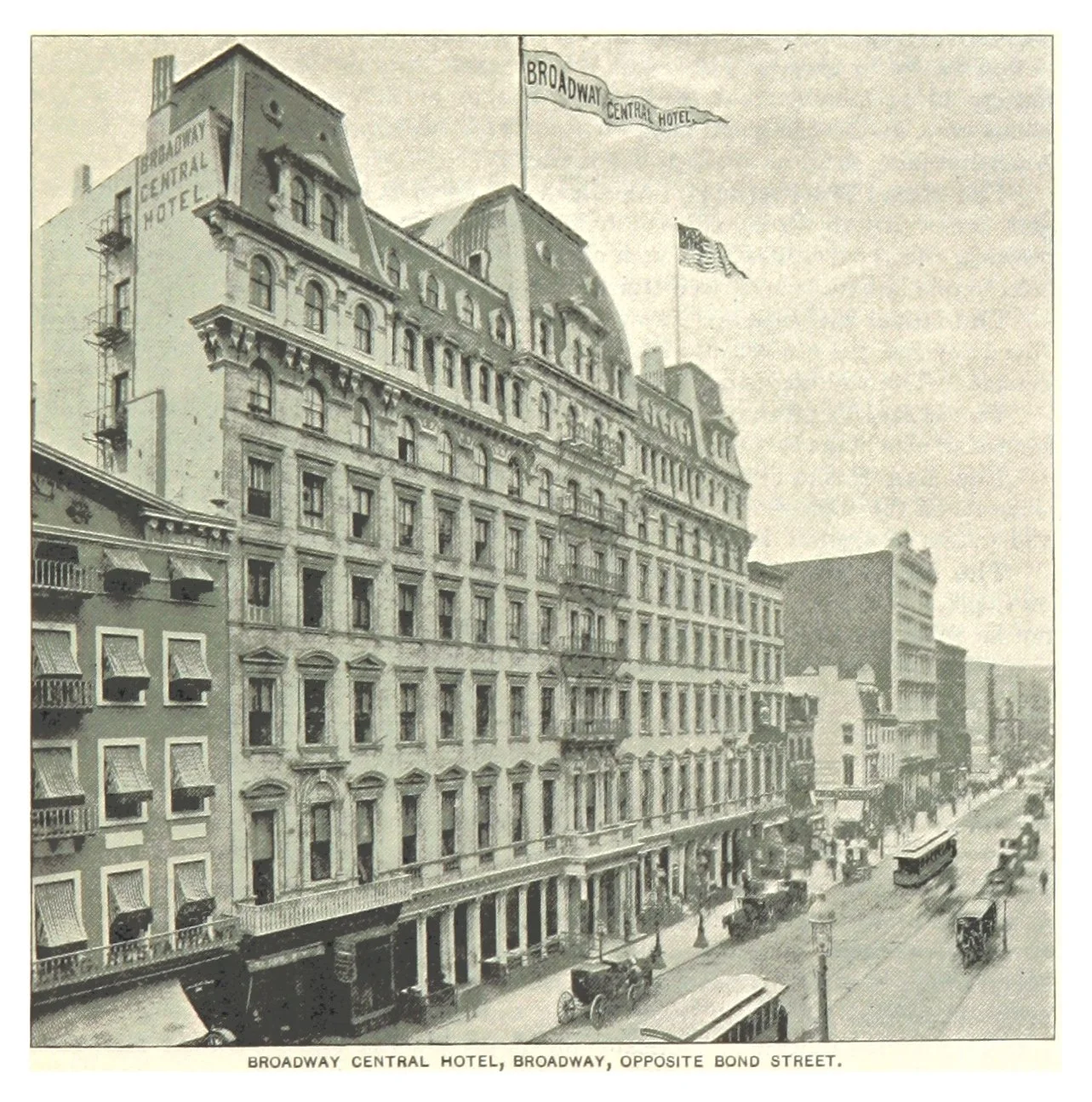
Late on Saturday afternoon, January 6, 1872, Jim Fisk’s carriage stopped at the ladies’ entrance of the Grand Central Hotel on Broadway, near Bond Street.1,2 The hotel was not yet two years old and one of the largest in the country.3 Fisk had come to call on Mrs. Morse, the widow of an old friend, whose family he was supporting. He asked the porter whether she was in, told him to let the family know he was there, and started up the stairs to the parlor floor to wait.4,17,18
Ned Stokes was waiting at the top.5,17
Until recently Stokes had been Fisk’s friend and business partner. Now he was the lover of Fisk’s former mistress, and earlier that day a grand jury had indicted him for trying to blackmail Fisk. He drew a revolver and fired twice. One bullet struck Fisk in the arm. The other went into his abdomen.6
Fisk was thirty-six. Four years earlier, hardly anyone outside Wall Street knew his name. By the end of 1869 he was the most famous speculator in America.5 How he got there, and how quickly it came apart, is a New York story.
The printing press in the basement
Fisk was a Vermont peddler’s son. He made his first money selling textiles to the Union Army during the Civil War and arrived on Wall Street in 1864.1,6 He wore diamonds and velvet coats in loud colors, waxed his mustache and smoked fat cigars.6
In early 1868 Cornelius Vanderbilt, who already controlled the New York Central, set out to buy control of the Erie Railway. Erie’s treasurer, Daniel Drew, and his two young allies, Fisk and Jay Gould, decided to sell Vanderbilt all the Erie stock he wanted, even if they had to print it. A judge had forbidden Erie to issue new stock. The directors voted $10 million in bonds anyway, supposedly to buy steel rails, ran them off on a press in the cellar of the Erie office and converted them into 100,000 new shares. As Vanderbilt bought, they fed the new shares into the market. “If this printing press don’t break down,” Fisk said, “I’ll be damned if I don’t give the old hog all he wants of Erie.”7,17
The press did not break down. Vanderbilt ended up holding piles of stock and still did not have control. When the judge moved to arrest the Erie directors for contempt, they packed millions of dollars of Vanderbilt’s money into trunks and fled across the Hudson to Taylor’s Hotel in Jersey City, out of reach of New York’s courts. Fisk posted guards, named the place “Fort Taylor” and told reporters, “We shall stay here until we rot.”8,17
They did not have to. Gould went to Albany, and the legislature passed a bill making the new shares legal. The victory cost an estimated $500,000 of Erie’s stockholders’ money.17 William M. Tweed, the boss of Tammany Hall, joined Erie’s board, and the Erie men began winning rulings from judges who owed their places to Tweed.6 One of the most useful was Justice George G. Barnard, the judge who had issued injunctions against them in 1868.9,17 Gould became Erie’s president. Fisk became its vice president and controller.5,10
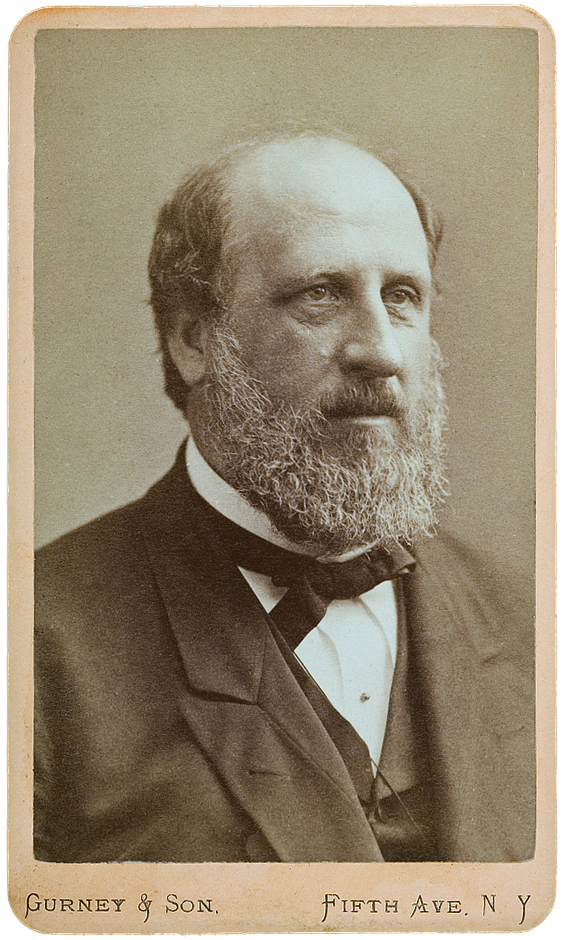
William M. Tweed leader of Tammany political movement
“Nothing is lost save honor”
In January 1869 Fisk and Gould bought Pike’s Opera House, a new theater on the northwest corner of Eighth Avenue and 23rd Street. They renamed it the Grand Opera House and moved the Erie’s offices upstairs, finished in black walnut inlaid with gold and crimson velour.11,12 Fisk ran the theater. Nearby on West 23rd Street lived Josie Mansfield, a young woman who called herself an actress, in a house Fisk had provided. She was his mistress. Behind his back, people called her the Cleopatra of 23rd Street.1,6,12
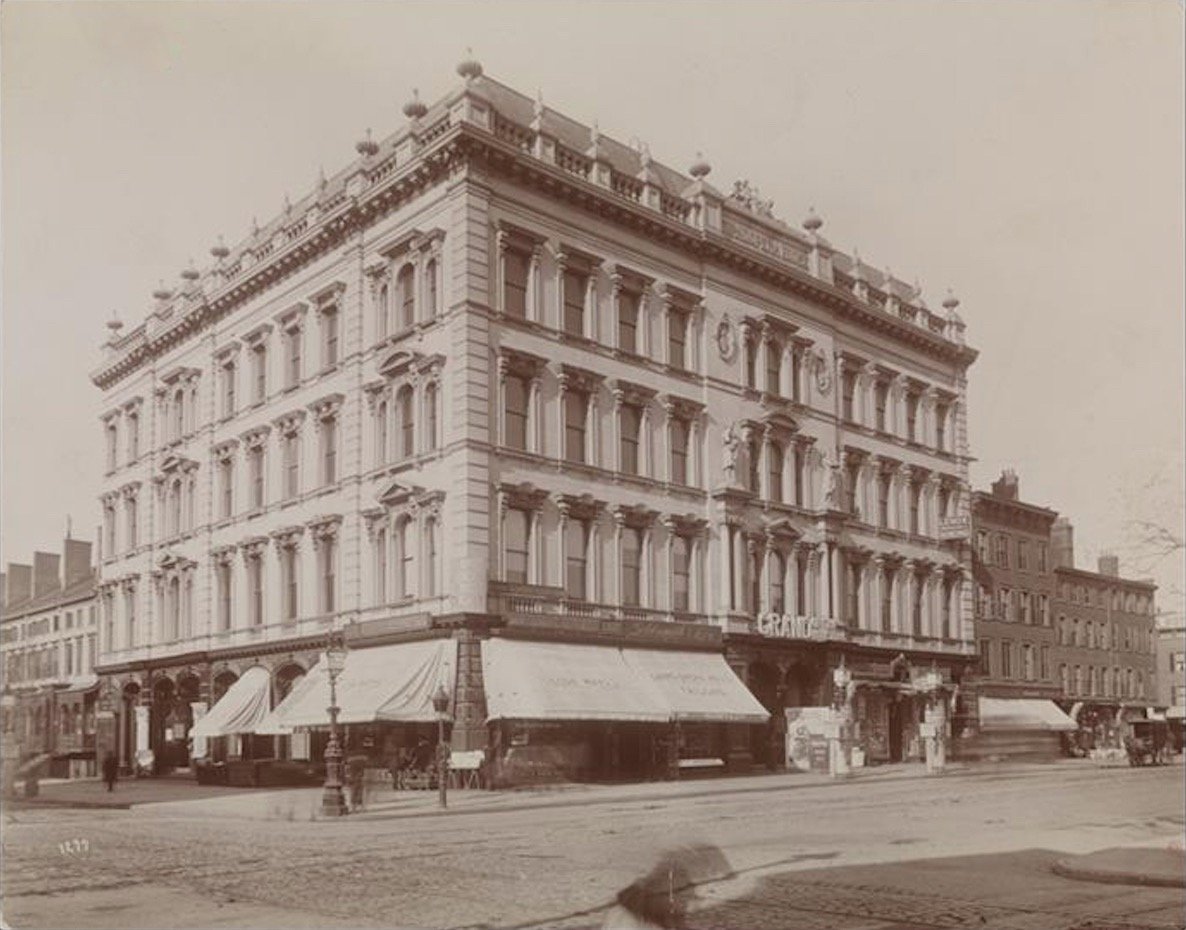
Grand Opera House 1895
Critics found out what Fisk did with them. When Samuel Bowles, editor of the Springfield Republican, wrote that Fisk had “probably destroyed the credit of the [Erie] railroad, while piling up a fortune for himself,” Fisk sued him for libel. Sheriff’s officers took Bowles out of the lobby of the Fifth Avenue Hotel one evening and locked him in the Ludlow Street jail overnight, at an hour when no one could accept his bail.17 When Fisk lost a battle for another railroad, the Albany & Susquehanna, in 1869, he shrugged it off: “Nothing is lost save honor!”17
The money behind all of it belonged to other people. In September 1869 Fisk and Gould tried to corner the gold market, using President Grant’s brother-in-law, Abel Corbin, to get close to the President. On Friday, September 24, the government sold gold, the price collapsed, and many investors were ruined. Fisk simply refused to pay for most of the gold he had ordered. He claimed he had been buying for a broker named William Belden, who then failed. Men who thought Fisk owed them money got nothing.1,13,17 The day became known as Black Friday, long before the name meant a shopping day.13
Two engines on one track
In 1869 Fisk introduced Josie Mansfield to Ned Stokes, a handsome friend from a well-to-do New York family. Fisk had put up the money to reopen the Stokes family’s oil refinery in Brooklyn, and the two men were partners.2,6 Before long Mansfield and Stokes were lovers. Fisk answered by cutting off the Erie’s business with the refinery.17
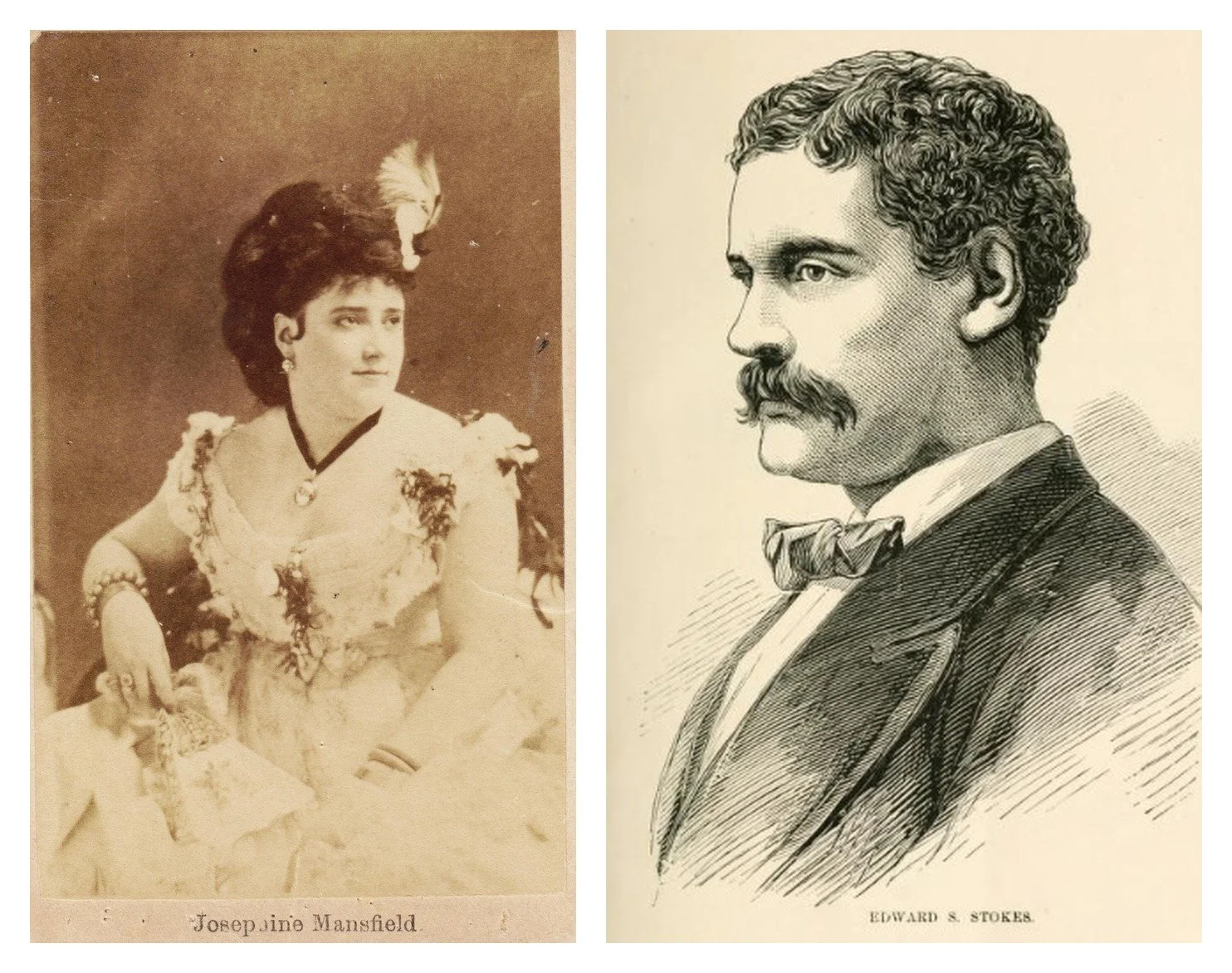
Mansfield and Stokes
Stokes proposed settling it at Delmonico’s: let Josie choose. The two men rode together to her house and put the question to her. She said she did not see why the three of them could not all be friends. “It won’t do, Josie,” Fisk told her. “You can’t run two engines on one track in contrary directions at the same time.”2,17
The refinery failed. Stokes collected $27,500 a customer owed it and kept the money. On a Saturday evening in January 1871, Fisk had him arrested for embezzlement at the bar of the Hoffman House and held in the Ludlow Street jail until Monday, the same trick he had used on Bowles. A judge ruled that a partner could not embezzle from his own partnership, and Stokes sent eighteen men to hold the refinery. Fisk sent a larger crew. They broke down the door and threw Stokes’s men out.14,17
Mansfield asked Fisk for $25,000 she said he was holding for her. He refused. She and Stokes then threatened public humiliation by publishing the letters Fisk had written her. Stokes put the price at $200,000.2,6 Fisk would not pay. He took the fight to the courts, where he had always done well, and the lawsuits multiplied.6 Stokes’s lawyers later offered testimony that Fisk had said of Stokes, “I go prepared for him all the time; so sure as my name is Jim Fisk I will kill him.”6
When the protection ran out
That summer, the courts began to change. In July 1871 the New York Times began publishing evidence, leaked from the city comptroller’s office, that the Tweed Ring had stolen millions of dollars from the city.10 On September 7 Justice Barnard turned on his patron and issued an injunction that barred the Ring from spending city money.9,15 On October 27 Tweed was arrested. Gould put up most of his $1 million bail.15,17
Four days later a deputy sheriff walked into Fisk’s office at the Opera House with an order for his arrest in one of Mansfield’s suits. Fisk laughed. “So it’s Mansfield again, is it?” he said, and posted bail.17 The next day the newspapers printed an open letter to Fisk from Josie Mansfield, written with expert help. “Unfortunately for yourself,” it said, “I know too well the many crimes you have perpetrated.” She reminded him of the gold brokers he had refused to pay, and of the nine weeks she had spent with him in Jersey City while he was “buying the Legislature.” It closed with a dare: “If you feel your power with the Courts still supreme, and Tammany, though shaken, still able to protect you, pursue your own inclination.”17
The protection Fisk and Gould had bought was going fast. The Erie’s English shareholders, who owned most of the stock but had been shut out of control, were pressing their case in federal court. At the end of December, Fisk quietly resigned as the Erie’s vice president and controller. The resignation was never announced.5
By then the city was following Mansfield’s libel suit against Fisk, which had come to trial in November.6
Up the ladies’ staircase
On January 6, 1872, Stokes testified in that case that he had never had an improper relationship with Josie Mansfield. Afterward he went to Delmonico’s with his lawyer. Justice Barnard walked in with news: the grand jury had just indicted Stokes and Mansfield for blackmailing Fisk. Stokes was standing a little apart, and his companions said later they could not tell whether he had heard. Either way, he left abruptly.6,17
That afternoon he hurried into the ladies’ entrance of the Grand Central Hotel and up the stairs. How he knew Fisk was on his way there has never been settled.5,17 Fisk came in about ten minutes later. As he climbed toward the top, Stokes raised the revolver. A bellboy, Thomas Hart, later testified that Stokes said, “I’ve got you now.”17 Then he fired. He threw the pistol aside and tried to leave the building, but he was caught and turned over to the police.6,17
Fisk was carried into a room on the parlor floor, and doctors were sent for. He told the coroner that Stokes had shot him.4,6 Within an hour newsboys were in the streets with extras, and the crowd outside the hotel blocked Broadway.5 Fisk died the next morning.4
His body lay in state at the Grand Opera House, dressed in the uniform of a colonel of the Ninth Regiment, the militia unit he commanded. Mourners filed in through both doors, on 23rd Street and on Eighth Avenue.12 He was buried in Brattleboro, Vermont.1
What the letters said
On Sunday, January 14, 1872, a week after Fisk died, the New York Herald published his letters to Josie Mansfield, thirty-nine of them.17 They revealed nothing about the Erie, Tammany or anyone else. They were ordinary letters from a man to the woman he loved. From his cell, Stokes claimed the damaging letters had been held back. Gould said every one had been printed.17 As far as anyone has ever shown, the threat that had driven the quarrel for a year, and the “many crimes” Mansfield said she knew, never made it onto paper.
The revealing testimony came that summer. Barnard had been impeached in March 1872.9 In July, at his trial in Saratoga Springs, Josie Mansfield took the stand. She testified that Fisk, Gould, Tweed and Barnard, along with businessmen, judges and lawyers, had made a habit of meeting at her house on 23rd Street, and that Barnard had once received a large cash gift for his child from Fisk and Gould.6 The court convicted Barnard on 26 charges, among them rulings he had made for Gould and Fisk in the fight for the Erie, and removed him from the bench.9
Stokes was tried three times. The first jury could not agree. The second convicted him of murder, and on January 6, 1873, a year to the day after the shooting, he was sentenced to hang. The Court of Appeals threw out the verdict. The third jury found him guilty of manslaughter, and in October 1873 he was sentenced to four years in Sing Sing. He was released in 1876.6,18 He died in 1901. Josie Mansfield died in Paris in 1931.6
The hotel stood for another century
The Grand Central Hotel outlasted all of them. In 1892 it was renamed the Broadway Central.5 By the late 1960s it had become a welfare hotel.3
On August 3, 1973, tenants spent the day hearing groans in the walls and watching plaster fall. At about ten minutes past five that afternoon, a large section of the building collapsed onto Broadway. Four people were killed.3 Reports afterward blamed, in part, illegal alterations to a bearing wall in the basement.16 What was left was torn down.3
Jim Fisk walked up its stairs in 1872 and was carried out. A hundred and one years later, the whole building came down.
Author’s note. Neither building in this story survives. The Grand Opera House closed in 1960 to make way for the Penn South houses, and a fire gutted it before demolition was finished. Its corner, in Chelsea, at Eighth Avenue and 23rd Street, is part of Penn South today. The hotel site on Broadway sat empty for years after the collapse; New York University later built a law school residence there.11,16 — Mark D. Schutzman
A question for readers. Did anyone in your family stay at, work at or remember the Broadway Central Hotel before it fell in 1973? Write to me at mdschutzman@400stories.net.
References
1. Wikipedia, “James Fisk (financier).”
2. Library of Congress, Headlines & Heroes blog, “Murder in Manhattan: The Death of Jim Fisk,” November 2018.
3. Village Preservation, “Grand Central Hotel ca. 1870” (Urban Archive).
4. “Shooting of James Fisk,” Cromwell Argus (New Zealand), March 5, 1872, p. 7, reprinting New York reports of January 6–7, 1872 (Papers Past).
5. John Steele Gordon, “To a Speculator Dying Young,” American Heritage, November 1992.
6. Historical Society of the New York Courts, “People v. Stokes, 53 N.Y. 164 (1873).”
7. Wikipedia, “Erie War.”
8. American Heritage, “By Way of Contrast: ‘Uncle Dan’ Drew.”
9. Historical Society of the New York Courts, “George G. Barnard.”
10. Wikipedia, “Jay Gould”; Historical Society of the New York Courts, “People ex rel. Tweed v. Liscomb.”
11. Wikipedia, “Grand Opera House (Manhattan).”
12. John Ambrose, “Grand Opera House on 23rd,” Substack.
13. Wikipedia, “Black Friday (1869).”
14. Wikipedia, “Edward Stiles Stokes.”
15. Historical Society of the New York Courts, “People ex rel. Tweed v. Liscomb”; Encyclopedia.com, “Boss Tweed Trials: 1873.”
16. Wikipedia, “Grand Central Hotel”; 6sqft, “When NYC Collapsed: The Rise and Fall of America’s Largest and Grandest Hotel,” 2018.
17. W. A. Swanberg, Jim Fisk: The Career of an Improbable Rascal (New York: Charles Scribner’s Sons, 1959): chs. 5–7 (the Erie printing press, Fisk’s “old hog” remark, Fort Taylor and the Albany bill); pp. 82–84 (the Bowles arrest); ch. 11 (the Albany & Susquehanna fight and “Nothing is lost save honor!”); Black Friday and the repudiated gold contracts (ch. 16); pp. 208–212 (the Delmonico’s challenge, “two engines on one track,” Stokes’s arrest and the refinery raid); pp. 248–251 (Fisk’s arrest of October 31, 1871, Tweed’s bail and Mansfield’s open letter); pp. 269–273 (Delmonico’s, the Morse visit and the shooting, including Thomas Hart’s testimony); pp. 288–290 (the Herald letters and Stokes’s trials).
18. Thomas S. Duke, Celebrated Criminal Cases of America (San Francisco, 1910), as transcribed at HistoricalCrimeDetective.com, “The Killing of Jim Fisk by Edward Stokes, 1872”: Fisk’s statement asking for Mrs. Morse; Stokes’s sentence and discharge.