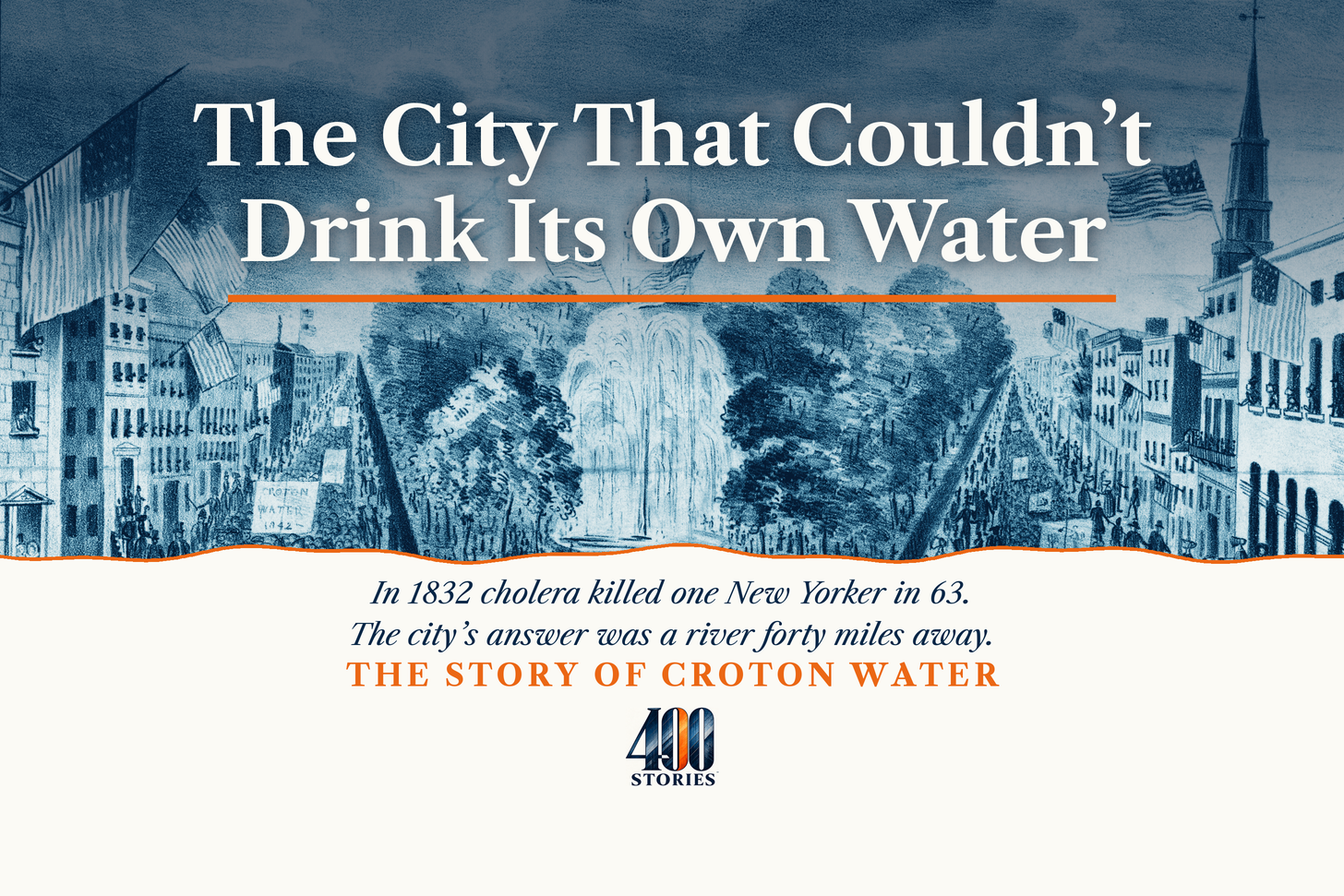
The Express
When cholera reached New York in 1832, those with money fled. The poor stayed and drank from the street pumps.
The pumps drew from sand that soaked up about 100 tons of human waste every day.
Ten years later the city brought in a river from forty miles away. Getting it up the stairs was another story.
In 1832 New York canceled the Fourth of July.
Philip Hone, a former mayor who kept a diary, called it “a lovely day, but very different from all previous anniversaries of independence.” There were no booths on Broadway. The parade had been canceled, along with the city’s official dinner and the ringing of bells. Most stores were closed. Boys set off firecrackers anyway, “but it is not a regular Fourth of July,” Hone wrote. “The disease is here in all its violence, and will increase.”1
The disease was Asiatic cholera, and he had seen it coming. Nearly three weeks earlier, when news arrived that it had reached Quebec and Montreal, he wrote: “It must come, and we are in a dreadful state to receive it. The city is in a more filthy state than Quebec and Montreal, and I do not know a European city which is worse.”1
Hone then did what New Yorkers with money did that summer. By late July his diary finds him at Rockaway.1 The family of twelve-year-old George Templeton Strong, who would grow up to keep a diary of his own, went to Wilton, Connecticut.2 Estimates of the exodus run from a third of the city to half.3–5 The historian Charles Rosenberg accounted for everyone else in one sentence: “The poor having no choice, remained.”6
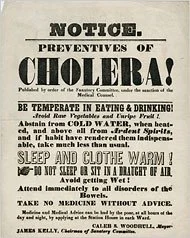
About 3,500 New Yorkers died, roughly one of every 63 residents.3–5 In a city the size of New York today, that share would be about 135,000 people.7 The deaths gathered where people were packed tightest on the worst ground: Five Points, Corlear’s Hook, Laurens Street. Dr. David Meredith Reese, who treated cases that summer, wrote that nearly two hundred people perished around a single block of Laurens Street.8 He also recorded what the dying felt: “a thirst that is intolerable.”8 Another New York physician, Martyn Paine, advised that once vomiting began, “all fluids should be denied the patient.”9
No one in 1832 knew that cholera travels in water fouled by human waste. That would not be shown for more than twenty years.10 But New Yorkers did not need the science to know what they were drinking.
What was in the bucket
The year before the epidemic, the city’s aldermen received a report from the Lyceum of Natural History on the quality of Manhattan’s water. The city stood on a deep layer of sand that lay over the island’s bedrock. The sand, the naturalists explained, behaved like a sponge. Into that sponge went the contents of every privy in town: “about 100 tons of excrement every 24 hours.” Wells near graveyards gave water with “a ropy appearance” that turned “very offensive” within hours in warm weather. A chemist found so much dissolved in the pump water that the report proposed “mineral water” as the more correct name for it.11
Its strangest finding was about taste. New Yorkers were so used to their water that the pure kind disappointed them. Visiting the country, they complained about the springs: “This water is like wind — there is nothing substantial in it; nothing to bite upon.”11
The writer Asa Greene laid out the choices in 1837. There were the town pumps, at street corners all over the city, free, and seasoned, he wrote, by “the neighboring sinks,” the privy pits. There was the Manhattan Company’s piped water, which cost money and which most people liked even less. And there was spring water, “the only tolerable water in the city,” hauled through the streets in hogsheads and sold at about a penny a gallon. Hotels and “respectable private families” bought it for tea and coffee. “The poor,” Greene wrote, “all resort to the street pumps.”12
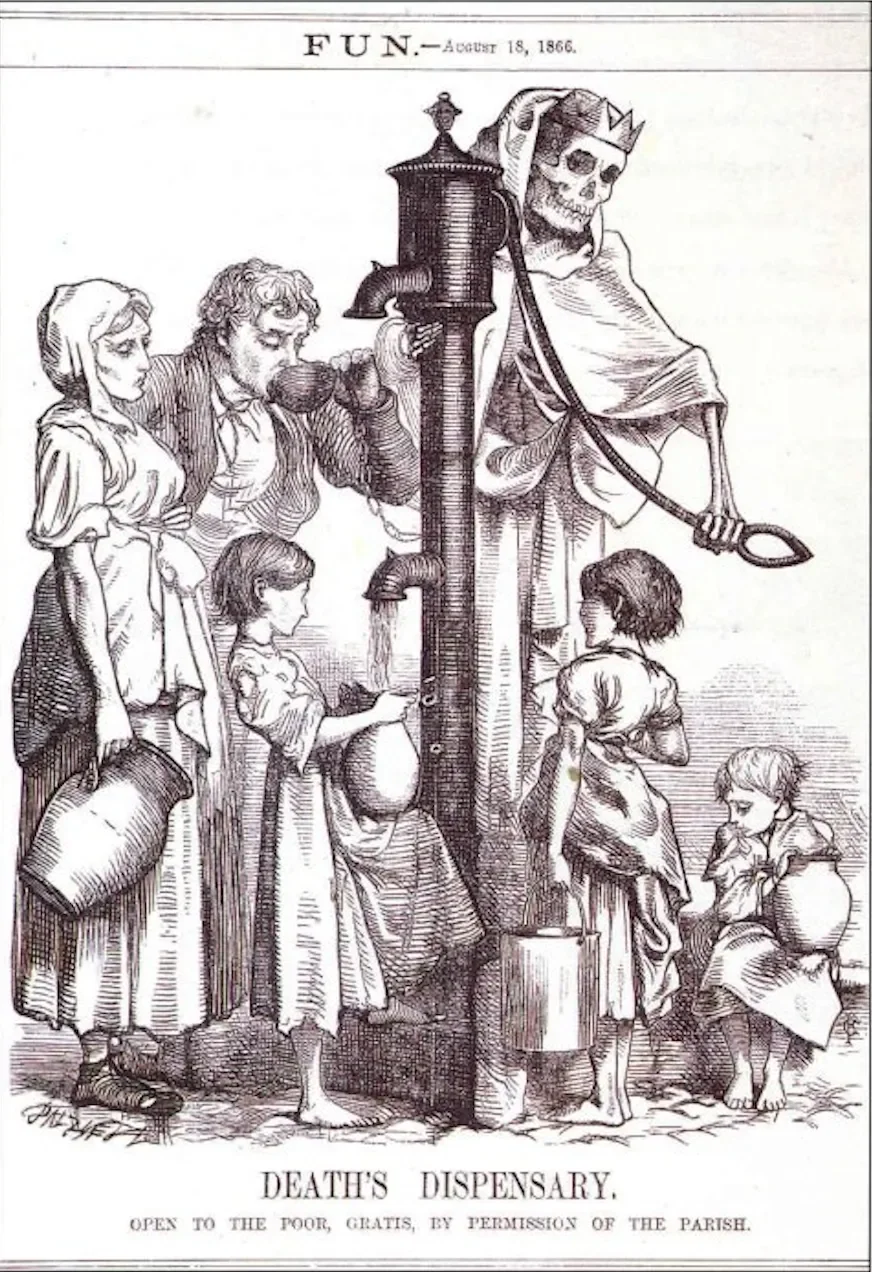
This image is from the 1866 outbreak but conveys the same message applicable to 1832
It takes only arithmetic to see what this meant inside a home. Water weighs a little more than eight pounds a gallon. In a city with few pipes, every gallon a family drank, cooked with, or scrubbed with was carried in by hand, and in a house of several floors it was carried up. The cheap water was the dangerous water. And if Greene was right about who drank what, the people who stayed in town in July 1832 were the people drinking from the pumps.
A river on Fifth Avenue
In 1835 the city voted for a remedy, and it spent the next seven years and more than ten million dollars building it: a dam on the Croton River in Westchester County, and a masonry channel that carried the river about forty miles downhill to Manhattan by gravity alone.11
At five in the morning on June 22, 1842, the engineers let the river in, and a small party rode the current through the aqueduct in a boat named the Croton Maid. Five days later the water entered the receiving reservoir at Yorkville, on the site of today’s Great Lawn in Central Park.11
One stop remained. On the west side of Fifth Avenue, between 40th and 42nd Streets, stood the Croton Reservoir, the distributing point for the whole system. Its granite walls, more than 40 feet high and 25 feet thick, towered above the street.13,14 They enclosed a little over four acres and room for twenty million gallons, and they were crowned by an Egyptian cornice and a walk around the top.13 From there the water would run in iron pipes to the crowded wards to the south.
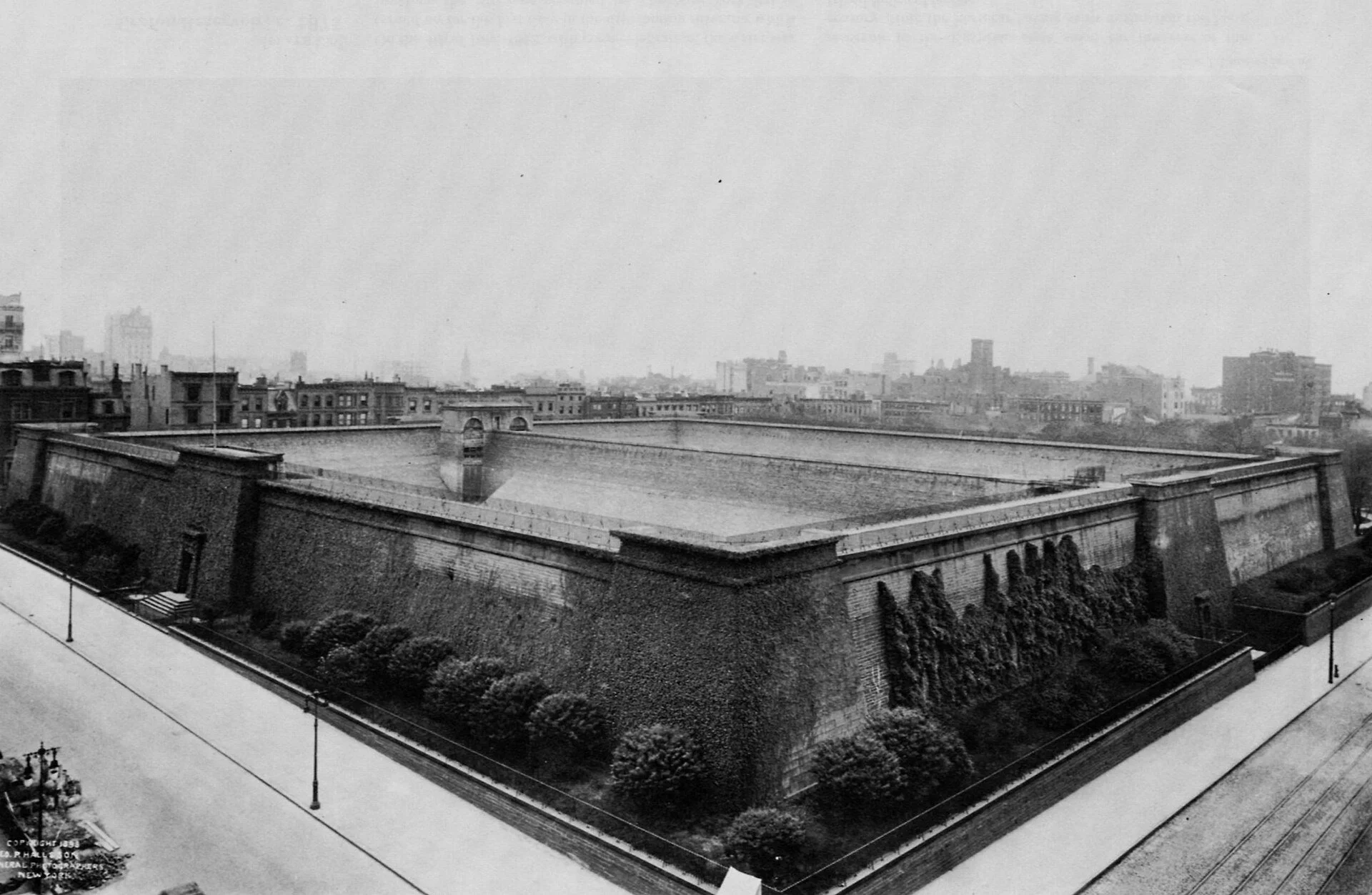
The Croton Reservoir on 5th Ave and 42nd Street
The commissioners had announced the date in advance. On July 4, 1842, ten years to the day after the holiday that wasn’t, the order went out at half past four in the morning to open the stopcocks. By a quarter to five, they reported, “the Croton River was in full flow.” Few people were there to see it. The hour was too early. The mayor and the aldermen came later, and uptown at 47th Street a fountain set up for the day threw water forty to fifty feet into the air.11
Water! Water!
Hone drove out with his wife the following week and, “to be in the fashion,” drank a tumbler filled with Croton water. He pronounced it clear, sweet, and soft.1 Not everyone was persuaded. George Templeton Strong, now twenty-two and a lawyer, told his diary on August 1 that Croton water was “all full of tadpoles and animalculae,” and that he had heard the Irish laborers who built the aqueduct had used it as a privy. “I shall drink no Croton for some time to come.” A friend who had tried it, he added, was “in dreadful apprehensions of breeding bullfrogs inwardly.”2
By October the doubters were outnumbered. “Nothing is talked of or thought of in New York but Croton water,” Hone wrote on the 12th. “Water! Water! is the universal note which is sounded through every part of the city.”1
Two days later the city gave itself a parade about five miles long.1 Strong thought the procession had “just the usual amount of clap-trappery and stuff and humbug and rowdyism,” but conceded that the whole population “seemed to have precipitated itself bodily into Broadway.”2 What struck Hone was the crowd itself: “not a drunken person was to be seen.”1
The writer Lydia Maria Child thought only someone who had been “made to drink of its brackish springs” could measure the gift. She went to see the new fountains, which threw a column sixty feet into the air. “My soul jumped, and clapped its hands,” she wrote. And of the thing itself: “clean, sweet, abundant water!”15
Who got the river
This is what relief looked like when it arrived. In the spring of 1843, Strong had a back building added to the family house on Greenwich Street, with Croton water piped to a bathroom on the second floor. By July the young man who would drink no Croton was a convert: “Taking a shower bath upside down is the last novelty. A real luxury, that bathing apparatus is.”2
Luxury was the word. A house connection cost money to install and about ten dollars a year after that. By 1844 roughly 6,000 houses had one, in a city of more than 350,000 people.16,17 For everyone else the city set up free hydrants in the street, starting, by its own rules, in the districts where the most poor people lived. That was a real gain. The water at the hydrant was the same river Strong bathed in, and it came from forty miles away instead of from the sand under the privies. But it still had to be carried home, and upstairs.
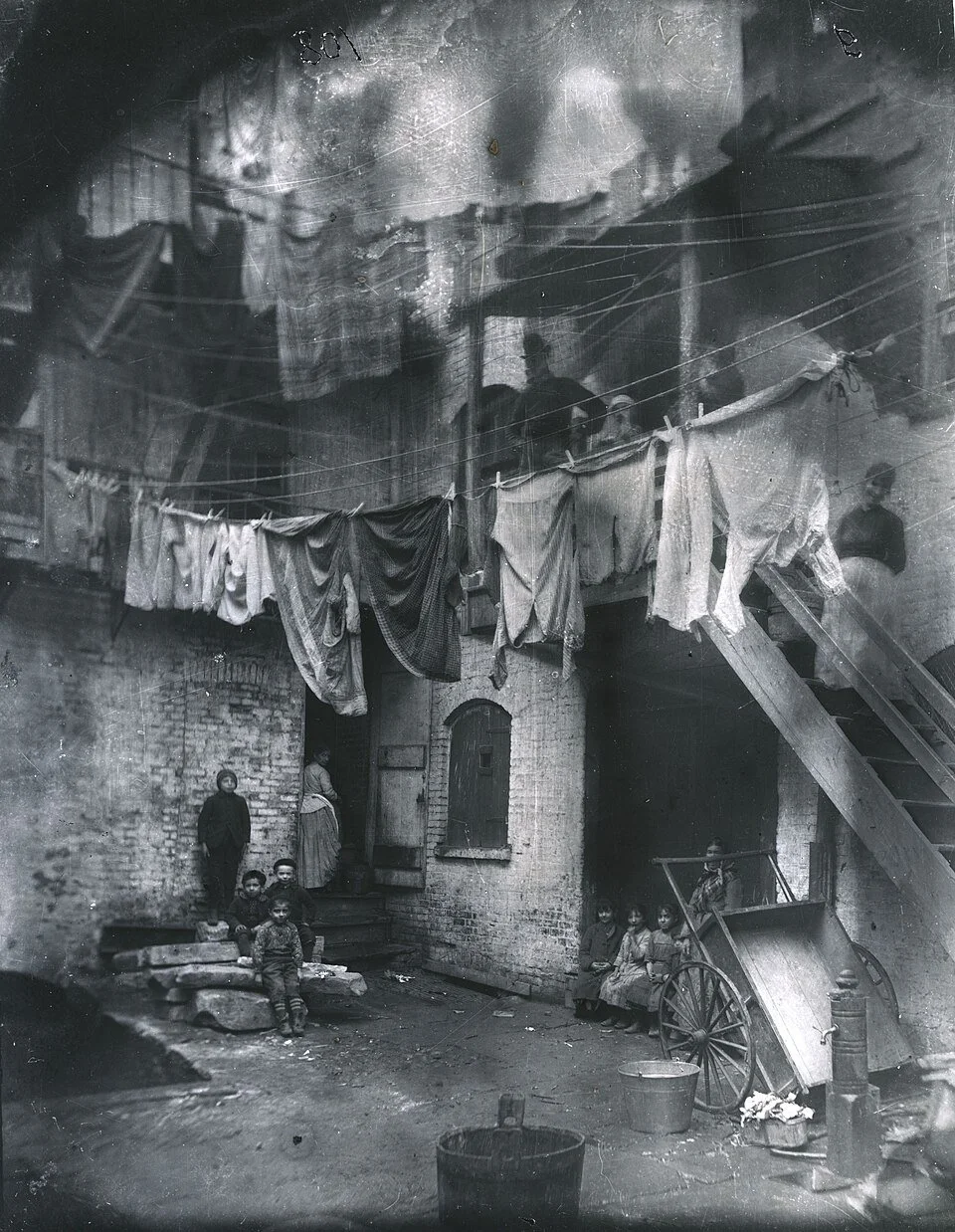
New York tenements. The water was fresh but still needed to be hauled up as many as five stories in buckets
Dr. John Griscom, who had been the city inspector in 1842, saw the new water making an old problem worse. Households with Croton no longer needed their rain cisterns, so they knocked out the bottoms and turned them into cesspools.18 Water was pouring into the ground under the city, and there were few sewers to take it away.
The bucket and the stairs
Then cholera came back. In June 1849 Strong, by then married and building a house uptown, was calm about it: “I don’t think it will take such a hold on the community as it did in ’32.”2 It killed more than 5,000 New Yorkers. That was more than the first epidemic had, though in a city more than twice the size. Afterward the city began building sewers in earnest: 70 miles of them in the next five years.5,19
The household arithmetic changed more slowly. In 1863, twenty-one years after the river reached Fifth Avenue, a landlord named Lucas Glockner put up a tenement at 97 Orchard Street. He paid extra for two things the law did not require: privies that drained to the sewer, and a spigot in the rear yard that ran Croton water.20 His tenants had clean water a few steps from the back door. They still filled a bucket and climbed.
The Croton Reservoir stood on Fifth Avenue until the turn of the century, when it came down to make room for the New York Public Library.14 By then the law was catching up with the stairs. In 1901 the state required every new tenement to have running water and a toilet in each apartment, and made the landlords of older buildings put toilets indoors.21,22
The river reached Fifth Avenue in a single morning. It took nearly sixty years to climb the stairs.
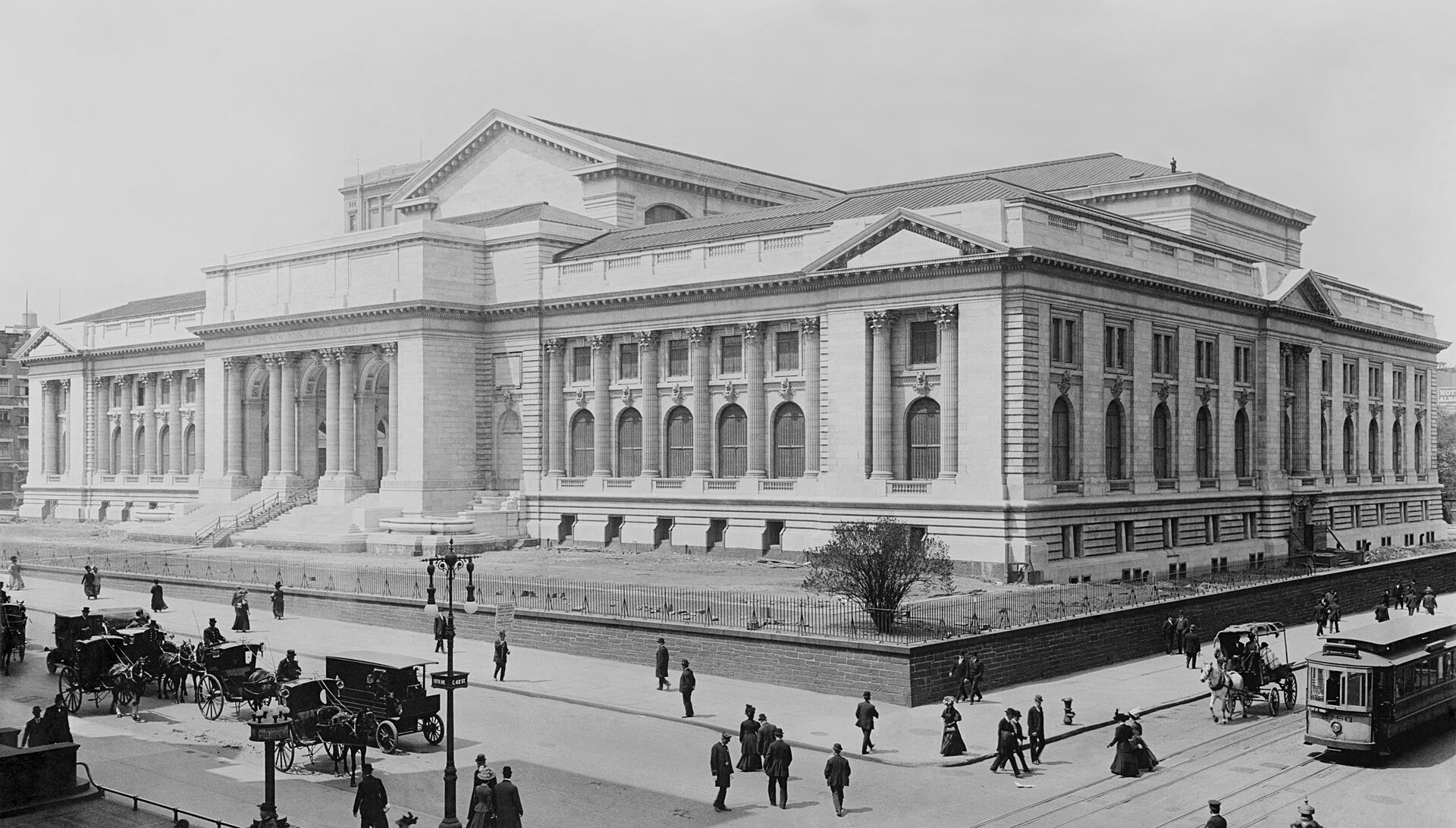
The New York Public Library was built on the site of the Croton Reservoir, where it stands today.
Author’s note
I began this story expecting an engineering triumph. What stayed with me was a city inspector’s 1845 report on the cellars and back rooms the new pipes skipped. The reservoir is gone, but its site is easy to find: the New York Public Library on Fifth Avenue stands where it stood, and part of the reservoir’s foundation can still be seen inside the library.23
— Mark
References
1. Philip Hone, The Diary of Philip Hone, 1828–1851, ed. Bayard Tuckerman (New York: Dodd, Mead, 1889), vol. 1, pp. 56–58 (June 15, July 4 and July 23, 1832); vol. 2, pp. 137 and 150–152 (July 12, October 12 and October 14, 1842).
2. George Templeton Strong, The Diary of George Templeton Strong, ed. Allan Nevins and Milton Halsey Thomas (New York: Macmillan, 1952), vol. 1: editors’ introduction, p. xvii; August 1 and October 14, 1842, pp. 184 and 188–189; May 17 and July 15, 1843, pp. 204 and 210; June 4, 1849.
3. Merchant’s House Museum, “New York’s 1832 Cholera Epidemic.”
4. Jonathan Schifman, “How New York City Found Clean Water,” Smithsonian, 2019.
5. History News Network, “New York Survived the 1832 Cholera Epidemic.”
6. Charles E. Rosenberg, The Cholera Years: The United States in 1832, 1849, and 1866 (Chicago: University of Chicago Press, 1962), as quoted by Troy Tassier and Jason M. Barr, Building the Skyline (2023).
7. Author’s calculation: 3,515 deaths in an estimated mid-1832 population of 221,900 (interpolated from the 1830 and 1840 U.S. censuses) is 1.58 percent; applied to the Census Bureau’s estimate of New York City’s population on July 1, 2025 (8,584,629), about 135,000. The result ranges from about 120,000 to 150,000 depending on the 1832 population used.
8. David Meredith Reese, A Plain and Practical Treatise on the Epidemic Cholera (New York, 1833), pp. 21 and 54–55.
9. Martyn Paine, Letters on the Cholera Asphyxia (New York, 1832), pp. 26–27.
10. John Snow, On the Mode of Communication of Cholera, 2nd ed. (London: John Churchill, 1855).
11. Charles King, A Memoir of the Construction, Cost, and Capacity of the Croton Aqueduct (New York, 1843): report of the Lyceum of Natural History, February 28, 1831, pp. 108–110; Water Commissioners’ reports, pp. 195–196.
12. Asa Greene, A Glance at New York (New York: A. Greene, 1837), pp. 180–182 and 186.
13. F. B. Tower, Illustrations of the Croton Aqueduct (New York and London: Wiley and Putnam, 1843), pp. 119–121.
14. Wikipedia, “Croton Distributing Reservoir,” citing the Bryant Park Corporation, “History: Reservoir Square.”
15. Lydia Maria Child, Letters from New-York (New York: C. S. Francis, 1843), Letter XXX, pp. 200–201.
16. Croton Friends of History, “Watering the Metropolis.”
17. Wikipedia, “Croton Aqueduct.”
18. John H. Griscom, The Sanitary Condition of the Laboring Population of New York (New York: Harper, 1845), pp. 9 and 52.
19. Gotham Gazette, “The Sewer System,” 2005.
20. Tenement Museum, “Lucas Glockner: Health and Construction.”
21. Wikipedia, “Lower East Side Tenement Museum.”
22. Social Welfare History Project, Virginia Commonwealth University Libraries, “Tenement House Reform.”
23. Untapped New York, “Secrets of Bryant Park,” no. 9, “There Are Remnants of the Croton Reservoir Inside the New York Public Library,” 2023.